
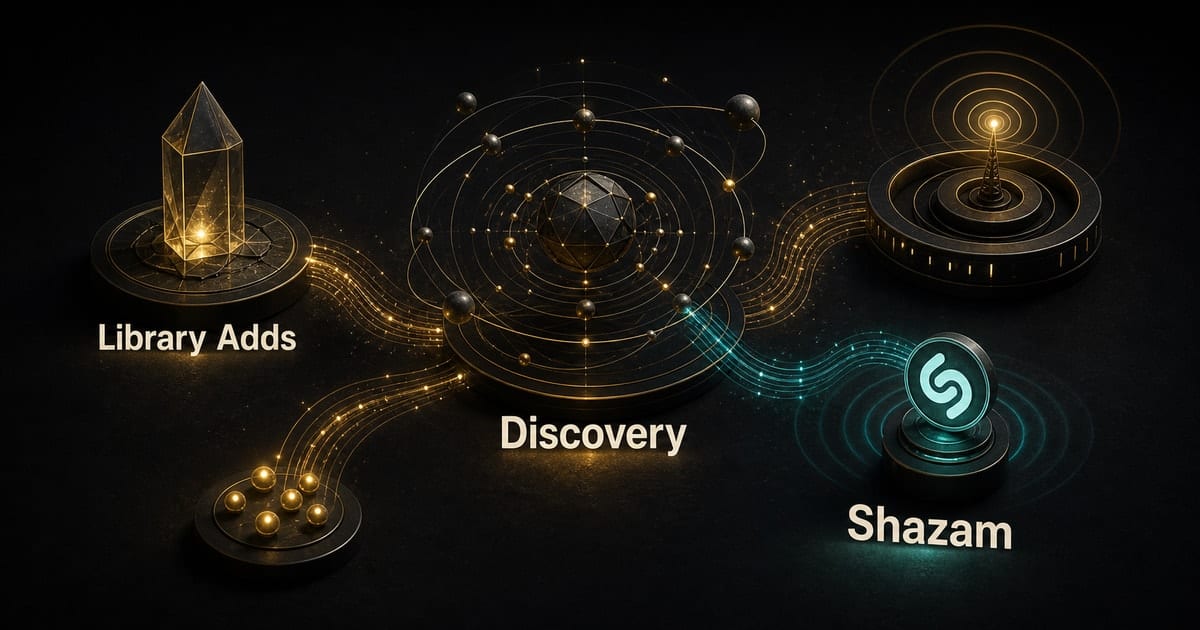
How Apple's Recommendation System Works
Apple uses a hybrid approach combining two main techniques:
Collaborative filtering. Apple analyzes patterns across millions of users. If listeners who love Artist A also love Artist B, the system learns that connection without understanding why the music is similar. This powers "Listeners Also Played" and influences personalized mix curation.
Content-based filtering. Apple also analyzes the audio itself: tempo, key, instrumentation, energy level, and vocal characteristics. This allows the system to recommend sonically similar tracks even if they do not share audience overlap yet.
Apple uses Word2Vec-style embeddings to represent songs and artists as vectors in a high-dimensional space. Songs that cluster together get recommended together. This is why genre positioning and sonic consistency matter: scattered releases confuse the embedding model about where you belong.
The Main Discovery Surfaces
Editorial playlists
Editorial playlists are curated, but they are not random. Apple's editorial layer is tied to identity and context: the playlists tell a story about scenes and moods. That story influences how listeners perceive you when they click through to your artist page and catalog.
When editors place a track on a flagship playlist like Today's Hits or Rap Life, that decision acts as a high-authority signal to the algorithm. The system learns that this track has cultural relevance or quality that raw stream counts might not yet reflect. This is how new artists break through the cold-start problem.
Operator takeaway: editorial is the fastest burst of attention, but you only keep it if listeners convert into repeat behavior. A placement that performs well (high completion, library adds) creates a cascade of algorithmic visibility. A placement that underperforms can limit future reach.
Algorithmic mixes
Apple has several personalized mixes, each serving a different discovery mode:
| Mix | Update Frequency | What It Does |
|---|---|---|
| Heavy Rotation Mix | Daily | Surfaces your top 25 most-played songs from the last 30 days. Launched in 2024 as a way to surface current obsessions. |
| Favorites Mix | Weekly (Tuesdays) | Draws from deep historical data plus explicit Favorites (starred tracks). Reflects long-term taste, not just recent listening. |
| New Music Mix | Weekly (Fridays) | Features new releases from followed artists and similar artists. Selection window is the last 4 weeks, so Friday releases align with the refresh cycle. |
| Get Up! / Chill Mixes | Weekly | Use acoustic and lyric analysis to match energy and mood. Placement depends on how your track is classified. |
Operator takeaway: mixes respond to repeat listening, library behavior, and pattern consistency. The more your early listeners behave like "real fans," the more Apple has reasons to test you wider. If your release is gaining traction through week one, it has a better chance of appearing in more New Music Mixes during weeks two through four.
Algorithmic stations (Discovery Station)
Apple introduced Discovery Station in August 2023 as an algorithmic station designed explicitly for discovery. Unlike a static playlist, it behaves like continuous testing: the system experiments with adjacent artists over time based on your listening patterns.
Discovery Station pulls from taste clusters: groups of listeners with similar behavior patterns. If your track performs well for one cluster (high completion, low skips), Apple tests it against adjacent clusters. This is how reach expands organically.
Operator takeaway: stations reward tracks that keep a session going. If you create "play one song then exit" behavior, you do not get compounding. Session extension matters.
Apple Music Radio
Radio is curated, show-driven, and scene-aware. Apple operates three flagship live stations:
- Apple Music 1: Global pop and culture
- Apple Music Hits: 2000s-2020s catalog
- Apple Music Country: Country music focus
Beyond flagship stations, Apple tracks spins across 40,000+ terrestrial and digital radio stations globally, surfacing this data in Apple Music for Artists.
Radio matters for promotion in two ways. First, a spin on Apple Music 1 or a genre show introduces your track to listeners who may explore your catalog. Second, strong Radio Spins data signals momentum that can support playlist pitches and label conversations.
Operator takeaway: Radio exposure matters most when your profile and catalog are ready to catch the listener.
Shazam
Shazam is a signal of high-intent curiosity. Someone heard your track in the wild (a bar, a store, a friend's car, a social video) and did extra work to identify it. Apple acquired Shazam in 2018, and the data now flows directly into Apple Music's platform.
Shazam data surfaces geographic patterns in Apple Music for Artists. If you see Shazam spikes in a specific city or country, that is a signal to target paid media there or prioritize local press and playlist outreach.
A spike in Shazams without a corresponding spike in Plays often means your track is circulating in the real world but listeners are not yet converting to streaming. That is a signal to double down on discovery creative that bridges the gap.
The Signal Hierarchy: What Apple Actually Weights
Apple's recommendation system discriminates between different types of user interactions. Understanding this hierarchy helps you design campaigns that generate the signals Apple rewards most.
| Signal | Type | Algorithmic Weight | What It Tells Apple |
|---|---|---|---|
| Library Add | Active | Highest | User wants permanent access; strongest affinity signal |
| Favorite (Star) | Active | Very High | Explicit preference; boosts artist visibility across surfaces |
| Playlist Add | Active | High | Provides contextual data (workout, focus, mood) |
| Completion | Passive | Medium | User engaged through the track; validates recommendation |
| Shazam | External | High (Viral) | Organic discovery intent; leading indicator |
| Skip (<30s) | Passive | Negative | Deprioritizes track and similar songs |
| "Suggest Less" | Active | Negative | Hard filter against track or artist |
Library adds are the single most important signal. Unlike a save on other platforms, an Apple Music library add is architecturally equivalent to "ownership," a vestige of the iTunes model. It signals desire for long-term retention and heavily influences New Music Mix and Discovery Station recommendations.
Completion rate matters more than play count. A track that gets started but skipped before 30 seconds sends a negative signal. Ten completed listens from qualified fans beat 100 half-listens from cold traffic.
The Favorite (star) button is underused. When a user marks a track as a Favorite, it ensures the track appears in their Favorites Mix, boosts the artist's visibility in personalized zones, and biases Autoplay selections. Encourage fans to use it.
How Editorial and Algorithm Work Together
Apple operates what industry analysts call an "algo-torial" model. Human curation and algorithmic automation are not separate silos but interactive layers.
Editorial placements train the algorithm. When editors select a track, the algorithm learns from that decision. This is how new artists without streaming history can break through.
Behavioral data validates editorial choices. Once a track is on an editorial playlist, Apple's system watches what listeners do. High completion rates and library adds confirm the editorial bet was correct. Low engagement signals the opposite.
The pitch tool feeds both layers. Apple Music for Artists provides a pitch tool for upcoming releases. The metadata you provide (mood, genre, locale) is ingested by both the editorial team and the algorithm to categorize the song correctly before it has streaming data.
The First Week Window
Release week performance disproportionately shapes your algorithmic trajectory. Apple's system uses early data to decide how widely to test your track against new audiences.
Strong first-week signals create a compounding effect: initial engagement leads to broader distribution in personalized mixes, which leads to more listeners, which generates more signals. Weak first-week performance limits how many new listeners ever see your track.
This is why launch strategy matters. You want your most engaged fans streaming in the first 48-72 hours, not a week later. Those early library adds and completions establish the baseline the algorithm uses to evaluate your track. Pre-adds contribute to first-day streams but do not directly trigger algorithmic placement. What matters is whether pre-add listeners continue engaging after release: adding to library, replaying, and completing tracks.
To generate algorithmic momentum during this window:
- Release when your most engaged fans are active, not just when industry convention suggests
- Communicate the value of library adds to your audience, many casual fans do not realize it helps
- Create music that rewards full listens, tracks with strong endings retain attention
- Use pre-release hype to ensure day-one engagement from your core audience
Common Algorithm Myths
Some beliefs about gaming the algorithm are incorrect:
Playlist placement alone is not enough. Getting on a playlist generates streams, but if those listeners skip or never return, the signals are neutral or negative. Playlist reach without engagement does not compound.
Shazam tags are a leading indicator, not a trigger. High Shazam activity shows organic discovery in the real world, but it signals potential rather than directly influencing algorithmic placement. The algorithm responds when Shazam users convert to Apple Music streams and library adds.
Paid traffic with wrong targeting hurts more than helps. If you drive cold clicks from users who skip before 30 seconds, you generate negative signals. Paid media only helps when it reaches people who will behave like real fans.
You cannot "reset" your algorithmic positioning. If a previous release underperformed, focus on making the next release's first 7 days as strong as possible. The algorithm weights recent behavior more heavily than historical data, but there is no reset button.
How Paid Media Interacts With Discovery
Paid media does not directly "boost" algorithmic reach. It buys enough qualified listeners to generate the signals Apple's platform already rewards.
The paid mistake is driving cold clicks to Apple Music with no bridge. The paid win is earning attention first (via Reels, short-form content), then measuring intent and retargeting the right people.
A well-structured funnel creates the same listener behavior patterns that organic fans exhibit: completion, repeats, library adds. The algorithm cannot tell the difference between an organic fan and a paid-acquired fan who behaves like one.
2026 Platform Updates
Apple continues to evolve its discovery infrastructure. Here are the most significant changes affecting artist strategy.
ChatGPT Integration
Apple partnered with OpenAI to integrate ChatGPT into Apple Music search. The integration enables descriptive, natural language queries like "that song from the bar scene in that 90s movie" instead of requiring exact metadata matches.
For artists, this means metadata quality matters more than ever. Accurate genre tags, mood descriptors, and cultural context in your pitch submissions help the AI surface your tracks for relevant queries. If your music fits a specific use case (workout, studying, road trip), make sure that context exists in your metadata.
iOS 26 Favorites Visibility
iOS 26.2 (December 2026) expanded how the Favorites system appears across the app. The Favorites playlist now surfaces directly in the Home tab, making starred tracks more visible and reinforcing the importance of the Favorite button as a discovery signal.
This change benefits artists whose fans actively use the star feature. When a listener stars your track, it now appears in a more prominent location, increasing replay probability and strengthening the library add signal.
Artist Replay Analytics
Apple rebranded its year-end analytics for artists in 2026. Artist Replay now includes listenership growth metrics, year-over-year performance summaries, and shareable visual assets. The new metrics help identify which markets are growing and which releases drove the most sustained engagement.
Use this data to inform future release timing and geographic targeting. If Replay shows strong growth in a specific country, consider prioritizing local playlist pitches and paid media in that market.
The Pitch Tool: What Editors See
The Apple Music Pitch tool is how you submit upcoming releases for editorial consideration. Understanding what happens after you hit submit helps you craft a stronger pitch.
Pitches require information across several categories:
| Category | What to Include |
|---|---|
| Release Type | New Release, Pre-Add/Pre-Order, or Re-promotion |
| Key Deliverables | Spatial Audio availability, Motion Artwork, Lyrics sync |
| Mood/Genre | Primary and secondary descriptors |
| Story | What makes this release notable (context, collaborations, timing) |
For full consideration, submit pitches at least 10 days before release. Late adds require a minimum of 7 days lead time. Tracks with complete deliverables (Spatial Audio, synced lyrics, motion artwork) receive priority consideration.
Note Individual artists cannot pitch directly to Apple Music. Your distributor submits pitches on your behalf through their iTunes Connect account. Ask your distributor about their pitch process and lead time requirements.
The pitch metadata flows to both editorial teams and the algorithm. Accurate mood and genre tags help the system categorize your track correctly before it accumulates streaming data, reducing cold-start friction.