
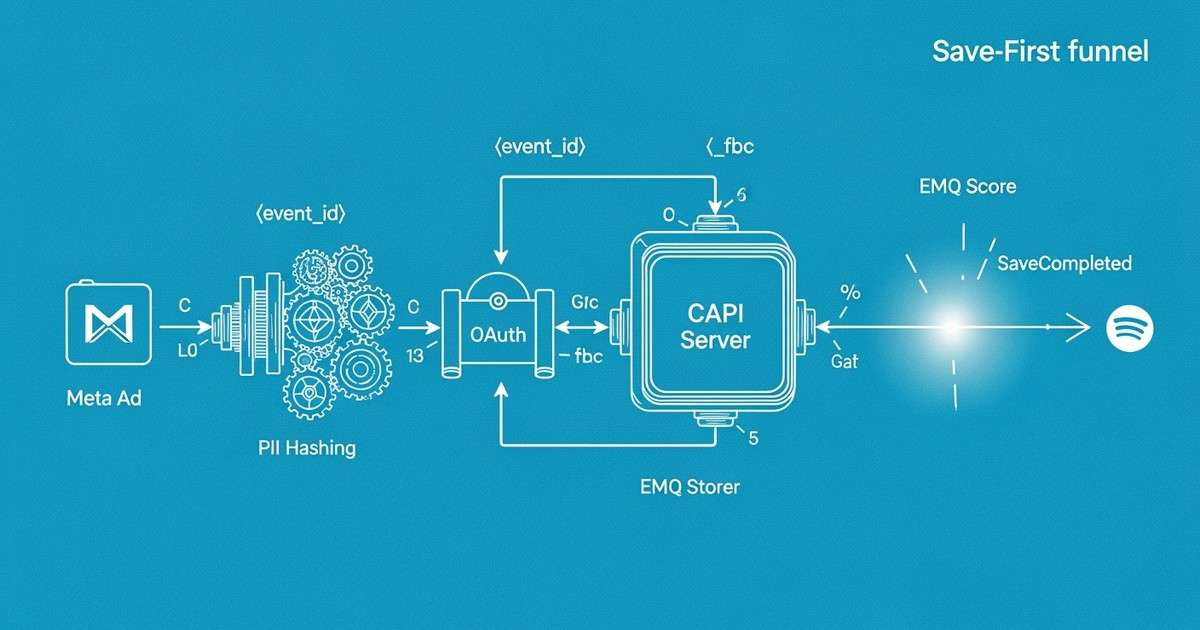
A lot of artists are still tempted to pay for "streams." But the smarter play is engineering saves: that intent signal that actually compounds listening, gets your track onto Release Radar, and trains Meta to go find more fans who stick around. (See our complete Spotify promotion guide for the full strategy.)
This guide shows you how to set up the Meta Conversions API (CAPI) for a save-first funnel that's privacy-aware, measurable, and scalable, without getting lost in jargon.
The Save-First Conversion Flow
Think of it like this:
- Broken funnel: Ad → open.spotify.com → hope for the best
- Better funnel: Ad → landing page → pre-save / OAuth → confirm save → server conversion (CAPI) → retarget → superfan
Why this works so much better:
- You actually own the moment of intent (a save or email), not just a random click.
- Server-side events keep tracking even with iOS privacy limits, lost cookies, or ad blockers.
- You can deduplicate browser + server events, so your reporting stays clean.
The main events to set up:
- ViewContent → fan visits your landing page
- Lead → optional email or SMS opt-in
- SaveIntent → taps “Save on Spotify”
- SaveCompleted → Spotify save confirmed (this is the conversion you’ll want to optimize for)
How to Verify the Save
Option A: Pre-save with Spotify OAuth (most reliable)
- Fan taps “Save on Spotify.”
- You request scopes (like
user-library-modify) and redirect them to Spotify. - After they approve, your app saves the track using the Spotify API.
- On success, you fire a server-side
SaveCompletedto CAPI, using the sameevent_idthat was sent from the browser click.
Option B: Confirmable redirect (simpler, but lighter)
- Log a SaveIntent, then deep-link them to the track.
- Follow up via email or SMS (“Did you save?”) with a one-tap confirm.
- Fire server-side
SaveCompletedfor those who confirm.
This isn’t as airtight as OAuth, but it’s easier to set up and still works well enough for optimization.
What to Send in Every CAPI Payload
- event_name, event_time, action_source, event_id (important for deduplication)
- user_data (hashed identifiers + network hints):
- Hash and normalize identifiers: email, phone (E.164 format), external_id (your user ID). Optional: name, city, state, zip, country.
- Network hints: IP address and user agent.
- Cookies: _fbp and _fbc from ad clicks.
- custom_data: include context like
product: "spotify_save",artist,track_id,country, or campaign tags. - Optional extras:
data_processing_options(for regional rules),test_event_code(for QA in Events Manager),event_source_url.
⚠️ Always normalize before hashing:
- Lowercase and trim emails
- Downcase names, strip punctuation/accents
- Format phones in E.164 (+15551234567)
Hash in memory, and never log raw PII. (Not legal advice, just good hygiene.)
Cookies, Click IDs, and Deduplication
_fbp: Create this cookie if it’s missing.
_fbc: Capture this from the fbclid query param on the first ad click.
Deduplication strategy: Generate a UUID event_id on your landing page and fire a browser pixel event (SaveIntent) with that ID. After OAuth success, send a server event (SaveCompleted) using the same event_id so Meta merges them into a single conversion.
Consent and Regional Controls
Only set cookies or fire events if you have clear user consent. In regulated regions like California (LDU), ensure you set the correct data-processing flags. Always maintain an opt-out or suppression list and check it before sending events.
Aggregated Event Measurement (AEM) Priorities
Start by verifying your domain and ranking your events. Place SaveCompleted at the very top, with softer signals like Lead and ViewContent beneath it. If you sell merch, prioritize purchase events appropriately.
Event Match Quality (EMQ): How to Improve It
- Always send both hashed identifiers (email, phone, external ID) and network hints (IP, UA).
- Make sure _fbp and _fbc are present and accurate.
- Fix any normalization errors. Little things like trailing spaces can wreck your match rate.
- Watch Events Manager diagnostics and fix warnings early.
Debugging and Idempotency
Use Test Events in Events Manager to map everything correctly. Ensure deduplication works (pixel click + server confirmation = 1 event). Log key details like timestamp, event_id, response code, and fbtrace_id. For retries, generate a stable event_id (e.g., hash of userId + trackId + day) so re-sends don't double-count.
Deployment Options
| Option | Pros | Cons/Use Case |
|---|---|---|
| sGTM (Server GTM) | Powerful, flexible | Requires infra care |
| Meta CAPI Gateway | Easy AWS/Docker setup, lighter management | Fewer custom options |
| DIY Custom Server | Total control, advanced flows | You manage retries, logging, scaling |
Pick one option. Don't half-build all three.
Media Buying That Matches the Pipeline
- Objective: Conversions, optimized for your custom
SaveCompleted. - Ad sets: Split audiences into Cold (broad interests, lookalikes), Warm (video viewers, IG engagers), and Hot (email lists, prior savers).
Creative tips for saves (not just clicks):
- UGC/selfie-style videos feel authentic.
- Subtitles help.
- Hook fans in the first few seconds.
- CTA should be “Save on Spotify,” not “Stream now.”
- Cut 10–16 quick variants from one master, kill weak ones in 48 hours, keep two winners running and iterate.
Scaling rules:
- Increase budgets ≤ 20% per day.
- Refresh creative every 10–14 days.
- Pause campaigns at ≥ 3× target CPS unless repeat listens are strong enough to justify.
Save-to-Revenue Math
Every save you buy through Meta has a downstream revenue value. At Spotify's current $3.02 per 1,000 streams, here is how the math works:
| Monthly saves | CPS | Ad spend | Streams per save (90 days) | Total streams | Revenue at $3.02/1K |
|---|---|---|---|---|---|
| 500 | $0.40 | $200 | 10 | 5,000 | $15.10 |
| 1,000 | $0.45 | $450 | 15 | 15,000 | $45.30 |
| 2,000 | $0.50 | $1,000 | 20 | 40,000 | $120.80 |
Single-release ROI is rarely positive from Spotify royalties alone. The return compounds across releases as new listeners explore your catalog. Artists routing a portion of traffic to Apple Music ($5.43/1K) or Amazon Music ($9.02/1K) through multi-DSP smart links can significantly improve their blended revenue per acquired listener.
KPIs That Predict Real Growth
- Primary metric: Cost per save (CPS), segmented by source + country. For many genres/geos, sub-$1 CPS is a healthy benchmark.
- Secondary metrics: skip rate (first 30s), repeat listens per listener in week one, playlist movement (especially on quality playlists), new followers, and email/SMS opt-ins.
Decision shortcuts:
- If your save rate is below your rolling median by day 3–4 → pause, re-cut creative, refine targeting.
- If skips climb after scaling → you scaled too fast; tighten targeting or swap your opener.
- If saves are strong but reach is limited → try a short in-app boost, then reevaluate.
Common Pitfalls to Avoid
- Direct-linking ads straight to Spotify (you lose ownership and tracking).
- Paying for “guaranteed playlist placements” (policy risk, bad data, worse long-term reach).
- Using Audience Network for music funnels (cheap clicks, poor quality).
- Splitting tiny budgets into too many tests (spread yourself thinner than necessary).
- Logging raw PII (always hash client-side or in-memory).
Don’t Want to Wire It All Yourself?
If hashing, cookies, deduplication, and OAuth sound like too much, Dynamoi's Smart Campaigns handle it all for you, Meta CAPI included. Just pick "Spotify Save," hit launch, and the system manages pre-save flows, server conversions, budgets, and cross-network routing in one click.
Try it: dynamoi.com
Bottom line: Don't waste money on "streams." Engineer saves instead. With a consent-aware, CAPI-powered funnel, Meta learns to find fans who actually stick, and every release gets easier to grow than the last.