
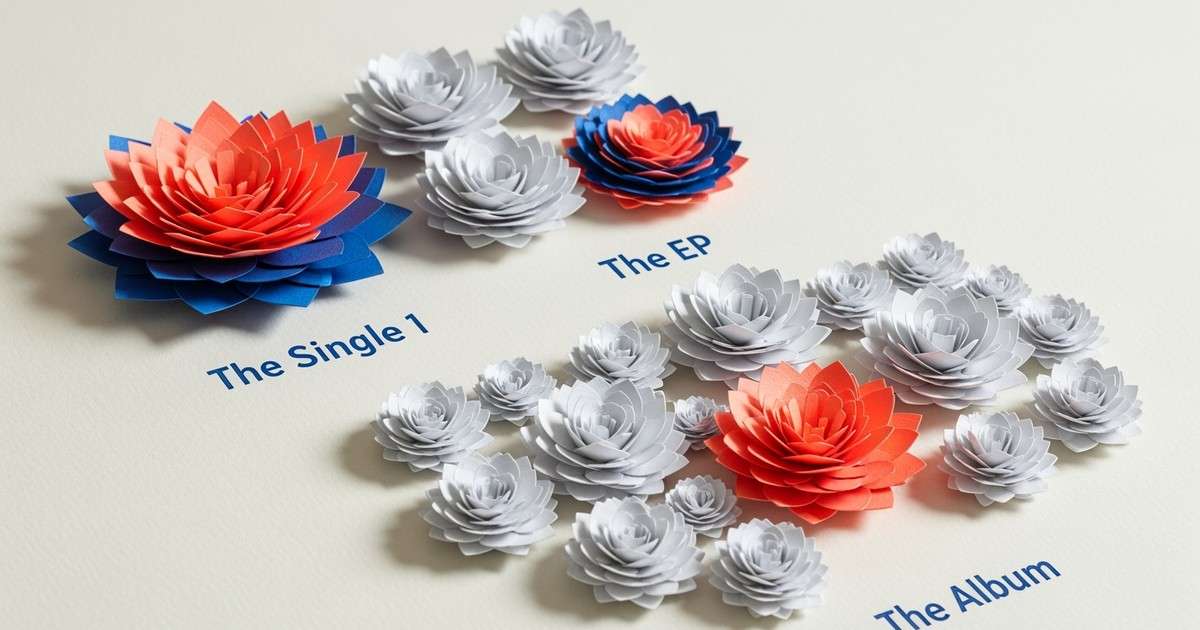
The release format you choose affects your pitching options. Singles are straightforward: one track, one pitch. Albums and EPs force a choice: which track represents the project? Make the wrong call and you've spent your one pitch on the wrong song.
The One-Track Rule
Spotify allows you to pitch only one track per release. This applies regardless of format:
- Single: Pitch the single (obvious)
- EP (4-6 tracks): Pick one focus track
- Album (10+ tracks): Pick one focus track
Your remaining tracks cannot be individually pitched. They either ride the coattails of your focus track's success or sit unpitched.
Single Release Strategy
Singles are the cleanest pitching scenario. One song, one chance.
Why Singles Dominate Pitching
Most successful independent artists have shifted to a singles-first release strategy. Every release gets a pitch opportunity, you get Release Radar exposure every 4-6 weeks instead of once per album, stakes are lower per release (one song underperforming doesn't sink an album), and you gather more data points for what resonates.
Single Pitching Best Practices
Pitch 4-6 weeks before release, use the full 500 characters in your description, reference your previous single's performance if strong, and plan your marketing around the single rather than a future album.
Album Pitching Strategy
Albums complicate pitching. You've created 10-15 tracks but can only pitch one.
Choosing Your Focus Track
The focus track should be:
The most playlist-friendly song. Not necessarily your favorite or the most "artistic" track. The song that fits editorial playlist aesthetics.
Representative but accessible. It should introduce listeners to your sound but not be so experimental that it alienates new listeners.
Strong within 30 seconds. Editors and listeners decide quickly. Front-load your hooks.
Common Focus Track Mistakes
Choosing the single you've already released. If you dropped a single before the album, that single is already released and cannot be pitched when the album drops.
Choosing the deep cut. Your 7-minute experimental closer might be your proudest work, but it's not getting on New Music Friday.
Choosing based on personal attachment. Your favorite song isn't always the best pitching candidate.
The Pre-Single Problem
Many artists release singles leading up to an album. Here's the trap:
| Release | Can You Pitch? |
|---|---|
| Single 1 (Month 1) | Yes |
| Single 2 (Month 2) | Yes |
| Single 3 (Month 3) | Yes |
| Album drops (Month 4) | Only new tracks |
When your album releases, the three singles are already out. They're not eligible. You can only pitch from the remaining tracks, which might be the deeper cuts you didn't lead with.
Strategy: If you're building to an album, hold back your strongest playlist candidate for album release. Let it be the "new" track you pitch.
EP Pitching Strategy
EPs (typically 4-6 tracks) require the same focus-track decision as albums but with fewer options.
EP Advantages
Shorter production cycles mean more frequent pitch opportunities. Each EP release resets your Release Radar presence, and EPs require lower listener commitment than a full album.
EP Focus Track Selection
With fewer tracks, the selection pressure is lower. But the same principles apply: pick the track with the broadest appeal, ensure it works standalone (not dependent on EP context), and consider if it represents what you want new listeners to hear first.
Format Comparison for Pitching
| Format | Pitch Opportunities | Release Radar Frequency | Listener Commitment |
|---|---|---|---|
| Singles (monthly) | 12/year | Every month | 3-4 minutes |
| EPs (quarterly) | 4/year | Every 3 months | 15-20 minutes |
| Albums (annual) | 1/year | Once per year | 40+ minutes |
From a pure pitching standpoint, singles maximize your opportunities. But artistic and audience considerations may warrant EPs or albums.
Release Radar Implications
Your release format affects how Release Radar works for your followers.
Singles
Each single release sends your track to followers' Release Radar for up to 28 days. Monthly singles mean near-constant Release Radar presence.
Albums/EPs
When you release an album or EP, Spotify selects which tracks appear in Release Radar. If you've pitched a focus track, that's the one sent to followers.
Non-pitched tracks from your album may appear in some followers' Release Radar, but you don't control which ones. The algorithm decides based on listener preferences and your pitch selection.
When to Batch vs. Drip
| Strategy | Approach | Best For |
|---|---|---|
| Drip | Singles every 4-6 weeks, pitch each one | Building an audience from scratch, streaming-focused artists, singles-dominant genres (pop, hip-hop) |
| Batch | Albums or EPs, pitch strongest track | Established artists, album-oriented genres (rock, jazz, indie), prioritizing artistic statements |
| Hybrid | 2-3 singles building to EP, pitch each plus unreleased EP track | Building momentum toward larger release, testing what resonates, wanting both pitch opportunities and cohesion |
The Drip Strategy
Release singles consistently (every 4-6 weeks). Pitch each one. Maximize pitch opportunities and Release Radar presence. This works best when building an audience from scratch or when streaming metrics are your priority.
The Batch Strategy
Release albums or EPs. Pitch your strongest track. Accept fewer pitch opportunities for artistic cohesion. This suits established artists with existing audiences and genres where albums carry cultural weight.
The Hybrid Strategy
Release 2-3 singles building to an EP. Pitch each single. When the EP drops, pitch a previously unreleased track. This lets you test which sounds resonate before committing to a full project while maintaining multiple pitch opportunities.
Amazon Music Difference
Amazon Music allows pitching up to 14 days after release and doesn't have the same one-track-per-release restriction in the same way.
For albums on Amazon, you can technically pitch different tracks at different times, though each pitch is still limited to one track per submission. The post-release pitching window gives flexibility to adjust based on initial response. This makes Amazon particularly useful for album releases where you want to test different focus tracks.