
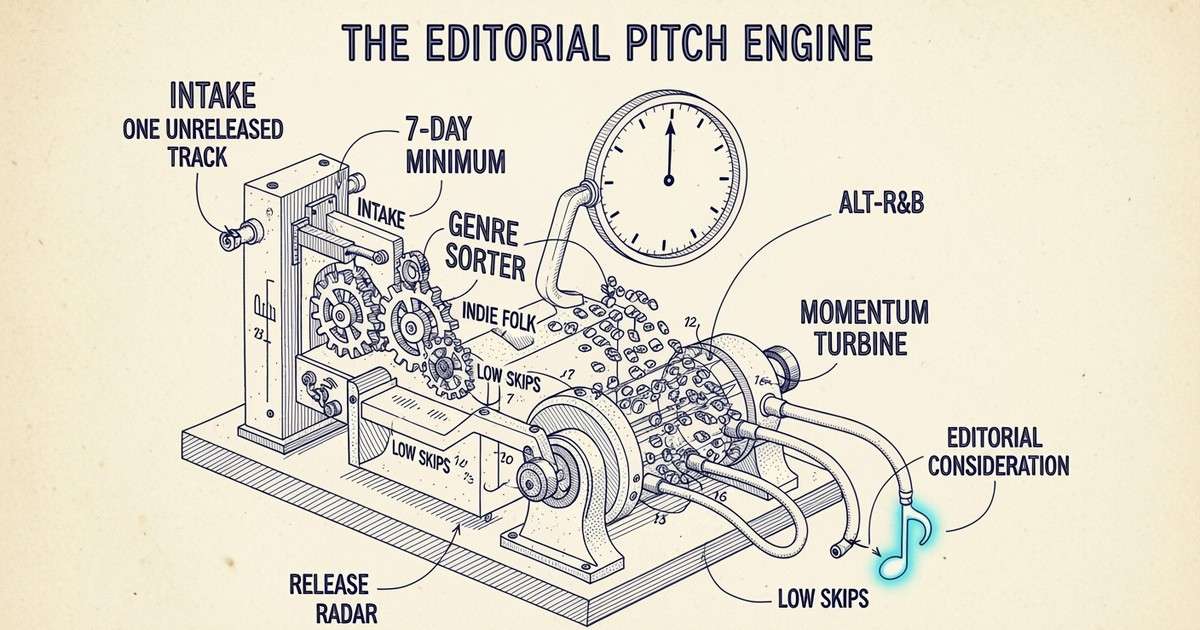
Spotify's algorithmic playlists are not one system. They are a family of recommendation surfaces, each with different update cadences, selection logic, and strategic implications for artists. Understanding what drives each one helps you plan releases, target promotion, and interpret your Spotify for Artists data.
The core engine: BaRT
Under the hood, Spotify uses a recommendation system called BaRT (Bandits for Recommendations as Treatments). BaRT's job is to keep listeners on the platform by balancing familiarity (songs they already like) with discovery (new songs they might like). It learns from every skip, save, repeat, and playlist add across hundreds of millions of users.
All algorithmic playlists draw on this engine, but each surface weights signals differently and serves a different listener intent.
Release Radar
What it is: A personalized playlist of new releases from artists the listener follows or has recently engaged with. Updated every Friday.
How songs get in:
- Your followers receive your new release automatically if you submit via Spotify for Artists at least 7 days before release
- Non-followers may see your track if your early engagement metrics (saves, completion rate, low skips) are strong and their listening profile overlaps with your existing fans
Strategic implications:
- Follower count matters here. More followers = larger guaranteed Release Radar reach
- The first 48-72 hours of engagement data determine whether you expand beyond your follower base
- Pre-save campaigns concentrate day-one saves, which signals demand to the algorithm
Exclusion policy:
Spotify began filtering alternate versions from Release Radar. Acoustic, live, and karaoke versions are now deprioritized or excluded entirely. Remixes remain eligible. Spotify's audio analysis can detect live recordings even when metadata does not label them as such.
If you frequently release acoustic sessions or live recordings, lead with the original studio version first to capture Release Radar exposure. See Spotify Release Radar Changes for the full breakdown.
Discover Weekly
What it is: A personalized playlist of 30 songs the listener has not heard before, refreshed every Monday. Driven by collaborative filtering and audio similarity.
How songs get in:
- Spotify waits 1-2 weeks after release to observe engagement before surfacing a track in Discover Weekly
- Songs typically need at least 20,000 streams with strong listen-through rates, saves, and playlist adds
- The algorithm identifies "taste clusters" of users with similar listening patterns and surfaces tracks that performed well with similar listeners
Strategic implications:
- You cannot pitch directly to Discover Weekly. It is earned through sustained engagement, not release-week spikes
- Tracks that build steadily over weeks often outperform tracks that spike and fade
- Appearing in Discover Weekly for one listener cluster often triggers cascading placement in adjacent clusters
Daily Mix
What it is: Up to six personalized playlists (3-4 hours each) that group a listener's favorite artists by genre or mood. Updated daily.
How songs get in:
- Based on the listener's library saves, recent plays, and liked songs
- Spotify identifies distinct taste profiles within each user and creates separate mixes for each (e.g., one for hip-hop, one for indie rock)
- New songs from artists a listener already streams frequently appear automatically
Strategic implications:
- Daily Mix is a retention surface, not a discovery surface. It rewards catalog depth
- Artists with multiple strong tracks get more Daily Mix placement than one-hit artists
- Repeat plays from fans reinforce your position in their Daily Mix, creating a flywheel
Radio
What it is: An infinite stream seeded from a song, artist, or playlist. Optimized to keep the listener playing indefinitely.
How songs get in:
- Audio similarity (tempo, key, energy, timbre) to the seed track
- Behavioral signals: tracks that listeners with similar taste did not skip
- Session continuation logic: Spotify prioritizes songs that extend listening sessions
Strategic implications:
- Radio placement compounds over time. Once you are in Radio rotations for a cluster of similar artists, you stay there unless skip rates spike
- Completion rate matters more here than anywhere else. If listeners consistently finish your track, you stay in the rotation
- See our Radio trigger guide for specific metrics to target
Autoplay
What it is: The songs that play automatically after an album or playlist ends. Similar logic to Radio but triggered by end-of-context rather than explicit seed selection.
How songs get in:
- Same signals as Radio: audio similarity, skip avoidance, session extension
- Often draws from the listener's existing taste profile plus sonically adjacent new releases
Editorial vs algorithmic
It is worth clarifying the distinction:
| Type | Selection | Scale | Predictability |
|---|---|---|---|
| Editorial (e.g., RapCaviar, New Music Friday) | Human curators | Fixed audience size | Low (depends on pitch and curator taste) |
| Algorithmic (e.g., Discover Weekly, Radio) | Machine models | Scales with engagement | Higher (driven by measurable signals) |
| Algotorial (hybrid) | Curator seeds, algorithm expands | Variable | Medium |
Editorial gets headlines, but algorithmic surfaces drive the majority of discovery for most independent artists. A single Discover Weekly placement that triggers cascading placements can outperform a one-week editorial spot that fades.
What the algorithm is actually measuring
Across all these surfaces, Spotify tracks a consistent set of engagement signals:
| Signal | What it indicates | Relative weight |
|---|---|---|
| Save rate | Listener wants to hear it again | Very high |
| Playlist adds | Listener integrating into daily listening | Very high |
| Completion rate | Track held attention to the end | High |
| Skip rate (pre-30s) | Poor fit or weak intro | Negative |
| Repeat listens | Strong preference | High |
| Session extension | Listener kept playing after your track | Medium |
In 2026, Spotify's models weight saves and playlist adds more heavily than raw stream counts. A track with 1000 streams and 200 saves outperforms a track with 10,000 streams and 10 saves in algorithmic reach.
Practical optimization checklist
Use this as a release-day reference to maximize algorithmic opportunity across all surfaces.
Tip Submit to Spotify for Artists 7+ days before release and concentrate day-one engagement with pre-saves.
Make the first 30 seconds count to avoid Radio/Autoplay disqualification. Build catalog depth for Daily Mix rewards. Track save rate and completion rate to predict algorithmic expansion.
Common mistakes
These errors actively harm your algorithmic profile and are difficult to recover from.
Warning Buying playlist placements poisons your algorithmic profile by inflating streams while tanking save rates.
Ignoring followers wastes your free Release Radar distribution. Optimizing for streams instead of signals teaches the algorithm to stop recommending you.
The common thread: chasing vanity metrics at the expense of the engagement signals Spotify actually uses.