
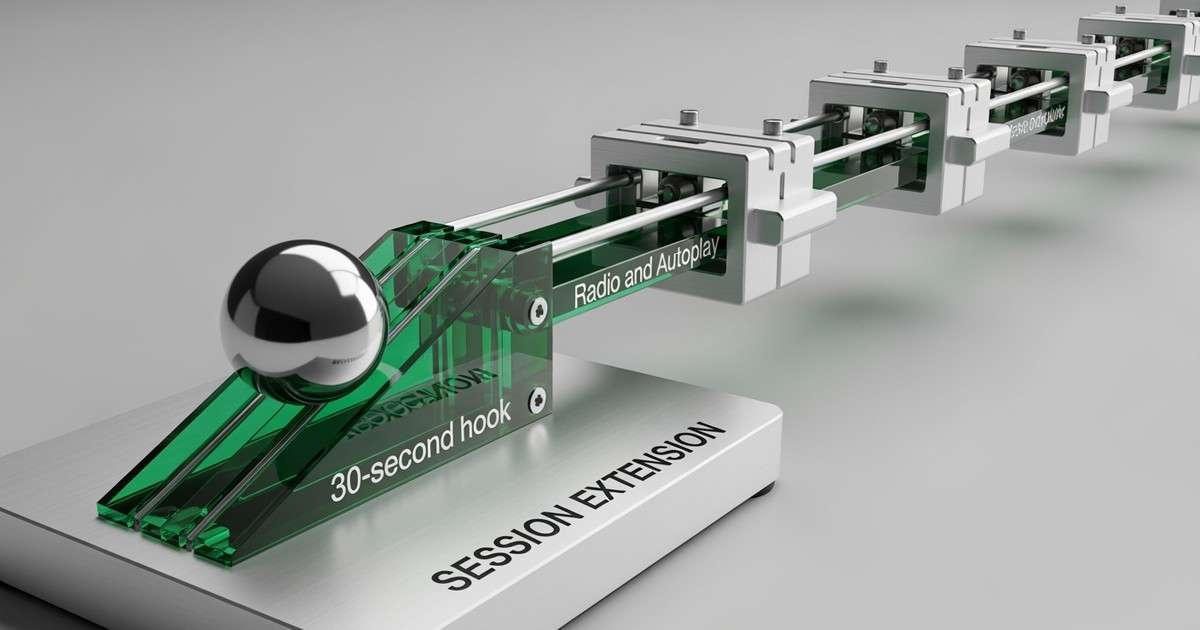
Spotify's recommendation system is session-driven. The platform wins when people keep listening, so tracks that extend sessions get more algorithmic chances.
This guide is the practical playbook for training that outcome.
What "session extension" means
Session extension is the behavior that happens after a listener hits play on your track. The metric Spotify cares about is not whether someone heard your song, but what happened next.
Good extension means the listener finishes your track, does not skip the follow-on song, and ideally saves, playlists, or explores more of your catalog. Bad extension is the opposite: an early skip, a session that dies after your track, or a listener bouncing to something tonally unrelated.
Radio and Autoplay are the main surfaces that reward extension because their entire job is to keep sessions going. When your track consistently leads to more listening, these systems learn to use it as connective tissue between other artists.
Step 1: Win the first 30 seconds
The opening moments of your track determine whether Spotify keeps testing it with new listeners or moves on.
Warning Early skips are the fastest way to kill extension. If listeners bail before 30 seconds, Spotify registers a failed experiment and becomes less likely to try that pairing again.
The fix is structural. Put the emotional or melodic hook before the 0:30 mark. Remove long intros or dead air that give impatient listeners a reason to leave. Make the genre signal obvious quickly, because listeners decide "is this my lane" in the first few seconds.
If you have multiple mixes available, lead with the version that performs best on first listen rather than the one that rewards deep attention.
Step 2: Engineer context fit
Spotify needs to know where your track belongs in the listening graph. Misplacement causes skips even when the music is good, because the listener expected something else.
Metadata clarity is the first lever. Accurate genre, mood, and credits reduce the chance Spotify serves your track to the wrong audience. Catalog cohesion is the second: adjacent songs in your discography should live in the same sonic neighborhood so listeners who explore your page find a consistent experience. Seed audience targeting is the third: your marketing should reach people who already love adjacent artists, not a generic "music fans" bucket.
When these three align, your track survives Smart Shuffle tests and becomes eligible for larger Radio sets.
Step 3: Create follow-on listening
Follow-on listening is the hidden multiplier. It proves that your track is not just enjoyable on its own, it is a gateway to more listening.
Release sequencing matters more than most teams realize. If you drop an EP or album, front-load the strongest tracks. Weak early tracks create session drop-off that poisons the whole release.
Artist page funnels also play a role. In ads and social posts, link to a clean artist profile rather than a random playlist. This gives curious listeners a clear path to explore more of your work.
Playlist strategy completes the picture. Encourage fans to add your track to their own playlists. This anchors you in their daily listening loops and creates repeat exposure that Spotify's systems learn from.
Step 4: Measure extension in Spotify for Artists
Spotify does not surface "session extension" as a single metric, but you can infer it from a combination of signals.
| View | What to look for |
|---|---|
| Skip rate | Pre-30s skips should trend down release to release |
| Save rate | Rising saves signal repeat intent |
| Source of streams | Growth in Radio, Autoplay, and algorithmic mixes |
| Audience overlap | More listeners who also stream adjacent artists |
If Radio streams rise but save rate falls, you are scaling to the wrong listeners. Tighten your targeting before the algorithm learns the wrong lesson.
Step 5: Session extension for catalog
Catalog tracks can resurface for years if they keep extending sessions. The opportunity is real, but the approach differs from new releases.
Turn on Discovery Mode for catalog songs with proven low skip rates. This tells Spotify you are willing to trade royalty margin for placement, but only do it for tracks that already perform well, otherwise you are paying to fail faster.
Reintroduce older tracks via short-form content or a remix, then drive listeners back to the original. This refreshes the signal data and gives Spotify new evidence that the track still works.
Target warm audiences first when promoting catalog. These songs perform best when the seed listeners are already primed, not when they are meeting you for the first time.
The simple rule
Everything in this guide reduces to one principle.
Tip Design every release to win three things: low early skips, high saves, and follow-on listening.
Spotify does not reward "streams." It rewards tracks that create repeat listening loops and longer sessions. Radio and Autoplay will do the rest.
When you optimize for session extension, you align your incentives with Spotify's. The algorithm becomes a partner, not a gatekeeper.