
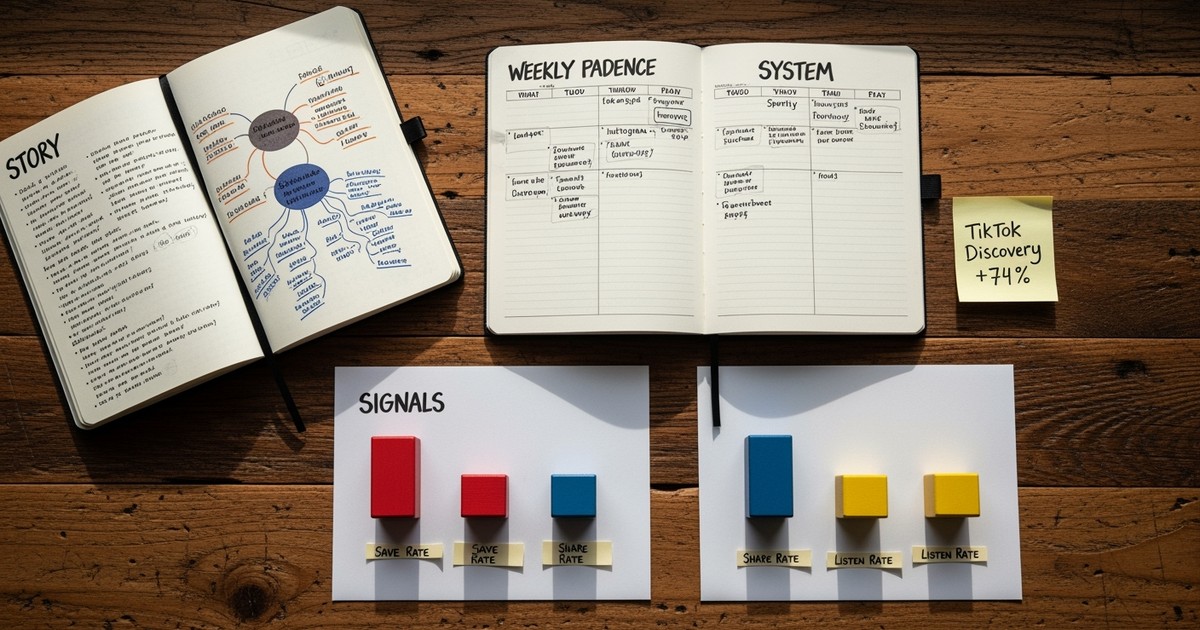
Strong music brand marketing is a positioning discipline. It answers three questions clearly: why this artist matters now, who the core listener is, and what action you want after each content touchpoint.
What Music Brand Marketing Means Now
It is not about posting everywhere. It is about owning a coherent story and repeating it across channels in ways that fit each platform's behavior. Short-form usually wins discovery, long-form builds trust, and streaming conversion metrics tell you if interest is becoming habit.
For campaign-level execution, use this page with the cross-platform strategy guide and release timeline.
A simple framework: Story, System, Signals
Story – the narrative that earns attention
Your brand is the promise you keep. Write a one-page narrative that covers who you are, who you serve, the change your music offers, and proof that you deliver. Codify three brand assets you can ship every week: a recurring short, a behind-the-scenes clip, and a fan-first post that invites participation. Keep the vocabulary concrete and the voice consistent across platforms.
System – the engine that keeps you publishing
Build a small, durable stack: content calendar, asset templates, an email or SMS list, and a weekly cadence you can actually sustain. Use social to pull people into owned channels where you can reach them without algorithm risk. A Discord or private community is useful, but pair it with email so you can re-activate fans before releases or tours.
Signals – the metrics that platforms reward
Focus on actions that express intent. On streaming, saves, replays, and adds are stronger signals than raw plays. On video, watch time and completion rate beat vanity impressions. Define one primary KPI for each cycle, for example save rate on Spotify, Shorts-to-subscriber conversion on YouTube, or email list growth from TikTok.
Avoid tactics that create artificial activity since they can lead to removals or withheld royalties per Spotify's policies (Artificial Streaming, and guidance on third-party services that guarantee streams).
Channel plays that work now
TikTok – fast discovery when the concept is tight
TikTok remains a top discovery surface. TikTok and Luminate report that U.S. TikTok users are 74 percent more likely to discover and share new music than average short-form users, based on 2024 data published February 2025 (TikTok Newsroom). Ship concepts that are native to the feed: hooks, challenges, stitch-friendly prompts, or performance moments with a clear payoff in the first seconds. Repurpose the best clips to Shorts and Reels.
YouTube – pair Shorts for reach with long-form for depth
Use Shorts to spark initial interest, then route viewers to long-form performance videos, sessions, or documentaries on your Official Artist Channel. YouTube’s artist resources highlight Shorts as a growth driver and provide practical setup guidance (Shorts for Artists, YouTube for Artists hub). Organize playlists that match your narratives, for example “studio builds,” “tour diaries,” and “song stories.”
Instagram – visual identity and community rhythm
Reels and Stories are your cadence tool. Keep templates for lyrics on screen, quick A-roll to camera, and carousels that recap progress. Use Live for Q&A or mini listening parties. Treat the grid like a portfolio, Stories like daily touchpoints, and Reels like reach.
Facebook – events and groups still matter
For live markets, Events, local Groups, and targeted ads still move tickets. Meta’s own guidance frames Groups as a way to nurture communities around interests and brands (Meta Business Help – Groups overview). Keep copy short and utility-focused.
Streaming platform levers you should understand
Spotify Marquee and Showcase
Marquee is a full-screen, sponsored recommendation booked inside Spotify for Artists to reach listeners likely to stream your new release (Marquee overview). Eligibility and targeting vary by market. Spotify notes that campaign tools require baseline traction, for example at least 1,000 streams in the last 28 days in a target market for certain features (Campaign tools eligibility). Budgets have historically started at 100 USD when booked in Spotify for Artists, subject to change (Getting started with Marquee).
Spotify Discovery Mode
Discovery Mode can increase exposure in certain personalized contexts in exchange for a 30 percent commission on recording royalties for opted tracks in those contexts (Discovery Mode cost, contexts explained). Access has rolling availability with eligibility that has included thresholds like 3 eligible songs and 25,000 monthly listeners in supported countries, which Spotify may update over time (access info). Use this only when your save and repeat-listen rates are strong, and monitor uplift against the commission.
Recommendation basics and policy reminders
Spotify describes how personalized recommendations order content across Search, Home, and playlists (Understanding recommendations). Do not pay for streams or guaranteed placements. Spotify can withhold royalties, exclude artificial activity from charts, and take further action (Artificial Streaming).
Your 90-day launch plan
Days 1–7 – build the kit
Write your one-page brand narrative, define your 2 or 3 weekly content formats, set up your Official Artist Channel, email list, link-in-bio or smart link, and a tracking sheet for KPIs. Prepare 12 to 16 short clips from the upcoming single so you can post daily without scrambling.
Days 8–45 – story in motion
Publish a daily short, twice-weekly longer video, and a weekly community touchpoint like Live or Discord office hours. Pair each drop with an email that adds context. Track save rate, repeat listens, click-through to your hub, and subscriber growth. Tighten what works, cut what does not.
Days 46–75 – amplify
Pilot a small Marquee or Showcase test if eligible. Run modest TikTok and YouTube creative tests that retarget viewers who engaged with your clips. Use geographic budget where you tour or where Shorts has spiked.
Days 76–90 – convert momentum
Bundle formats into a “mini-doc” or performance session and push to email and community first. Offer a limited drop or experience to your core fans. Publish a metrics post that shows progress to date. Close with a clear invite to your next chapter.
Measurement that keeps you honest
Pick one primary KPI per cycle and two supporting indicators. For example: primary save rate on the new single, supporting email signups and Shorts-to-subscriber conversion. Review weekly.
If save rate drops, fix the top of the funnel with better hooks or target warmer audiences. If watch time is low, re-cut the first seconds and tighten the edit. If email growth stalls, improve the offer with a demo, tab sheet, or preset download.