

What Instagram Ads Are Good For in Music
Instagram ads create discovery in the same visual language your fans already consume. A Reels ad feels like another clip in the feed, which is why you can buy reach without tripping "ad blindness." The organic Reels vs paid Reels breakdown explains where the paid version adds reach that organic cannot.
They also let you scale beyond your current fan graph. Organic discovery is constrained by your starting audience. Paid discovery is constrained by creative quality and unit economics, and unit economics are the constraint you can control. If you are wondering whether Instagram ads actually increase Spotify streams, the short answer is yes, with the right funnel architecture.
Instagram ads are poor at closing a cold listener directly into a stream on a DSP with no bridge. If you skip the bridge, Meta optimizes toward cheap curiosity clicks and you get traffic that never becomes listening. See best landing pages for Instagram music ads for what that bridge should look like.
The Mental Model: Discovery, Intent, Conversion
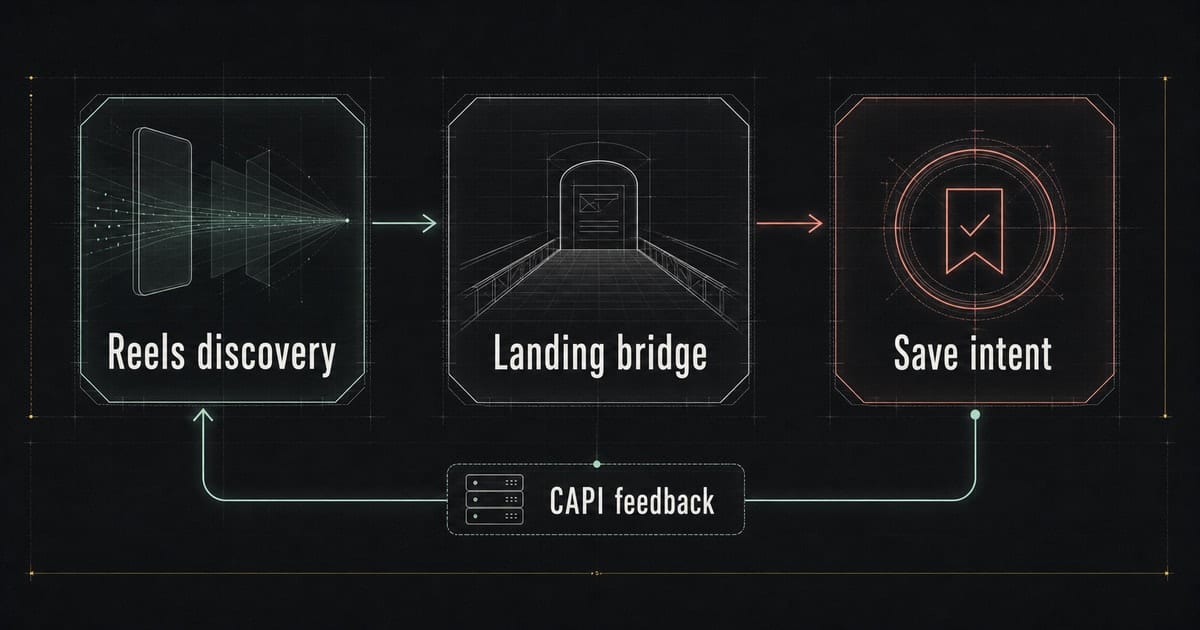
Think of Instagram ads for music as a three‑stage system.
Stage 1: Discovery
Discovery ads are Reels‑native clips whose only job is to earn attention. The metric that matters most is not view count, it is how much of the video people watch. Instagram Reels music discovery statistics show what ThruPlay rates look like across genres.
Use:
- Reels placements first. The Advantage+ placements guide for music ads covers when to expand beyond Reels.
- 6 to 15 second cuts.
- A hook that lands in the first 1 to 2 seconds. The best hooks for Instagram Reels music ads lists the patterns that consistently earn attention.
The right optimization goal here is usually ThruPlay or Video Views. You are training the system on who will actually watch music clips, not who will click on a random link.
Stage 2: Intent
Intent is a choice the listener makes after you have their attention. For music, intent is usually one of:
- saving the track — see what a good cost-per-save looks like before you set a target
- following the artist
- pre‑saving an upcoming release — the how to promote a song before release guide covers the full pre-save funnel
- watching a longer video
This is where you introduce a bridge: a landing page, a pre‑save flow, or a destination that lets you measure intent and retarget it. Once someone visits your landing page, use the retargeting listeners from landing page guide to build your intent audiences.
Stage 3: Conversion
Conversion is the durable action you want to compound:
- repeat streams and algorithmic playlist lifts
- YouTube watch sessions — the full funnel architecture is in Instagram ads funnel to Spotify and YouTube
- email or SMS opt‑in
- ticket or merch purchase
You do not need Instagram to "complete" this conversion in one step. You need Instagram to reliably identify people who will take the next step.
| Stage | Goal | Key Metric | What Happens |
|---|---|---|---|
| Discovery | Earn attention | Watch completion rate | Reels-native ads reach potential fans who watch music clips |
| Intent | Capture action | Save rate, follow rate | Landing page converts viewers into Spotify saves or follows via oauth |
| Conversion | Compound growth | Repeat streams, playlist lifts | Server events via CAPI train Meta to find more listeners like your savers |
Choosing the Right Campaign Objective
Meta still offers a menu of objectives. For music, only a few are consistently useful.
| Objective | When to use | What it optimizes for |
|---|---|---|
| Video Views / ThruPlay | Cold discovery | People who watch to completion |
| Traffic | Only after intent events are wired | Low‑friction clicks, often low quality |
| Leads | Pre‑save + email capture, SMS lists | People who submit a form |
| Sales / Conversions | When you can send server events for saves, follows, purchases | People most likely to complete your event |
Avoid starting with Sales unless you already have clean conversion events. If you optimize Sales without a real music intent event, Meta will go find the cheapest "converters," which in practice means low‑attention scrollers. This is one of the most common Instagram ad mistakes for music campaigns.
Audience Strategy: Broad First, Then Shape
Meta’s targeting systems shifted from "pick an interest stack" to "let the model generalize." That shift accelerated again with Advantage+ audiences and creative‑driven personalization.
Start broad
For discovery campaigns, use:
- country or region
- age floor if you need one for genre fit — if you are targeting a specific niche like hip-hop fans on Instagram ads, genre-based layering is covered there
- language if it is core to the song
Do not stack 20 micro‑interests. You are not smarter than the model. Your job is to supply creative that makes the model’s job easy. The full targeting setup is in the Instagram ads targeting for musicians guide.
Add a "shape" layer for intent campaigns
Once you have intent events, add:
- engaged viewers from Stage 1
- landing‑page visitors who did not save
- past savers or followers (for lookalike audiences for music promotion if volume supports it)
Retargeting windows for music should be longer than ecommerce. People do not become fans in 24 hours. Use 7, 14, and 30 day windows depending on your release cycle. If you also run on Facebook, read whether Facebook is still worth it for musicians before splitting budget.
Creative That Works for Music Ads
Instagram is a sound‑on environment. Still, your creative must win before the listener notices the audio.
The 2‑second rule
If the hook does not land visually in the first 2 seconds, you lose. "Hook" can be:
- the artist in a recognizable moment
- a lyric that reads like a text message
- a reaction from a creator — working with influencers to promote music on Instagram covers how to source and brief creators for Reels
- a context line that frames the song fast
Structure
High‑performing music ads usually follow one of these structures:
- Lyric punchline first: open on the most quotable line, then reverse‑engineer context.
- Creator proof: open on a creator using the track, then cut to the artist.
- Scene setting: open on a visual that implies the song’s world, then bring in the hook.
You will see all three across your winning Reels ads, even for the same track. If you are promoting a music video specifically, there are additional format considerations for longer-form creative. The creative testing system guide explains how to run structured A/B tests across these structures without burning budget.
Format rules you cannot ignore
- 9:16 vertical.
- Captions baked in — note that music can get muted in Instagram ads if you use certain licensed tracks; that FAQ explains what is and is not allowed.
- Safe zones respected for Reels UI overlays.
- One idea per ad. Do not cram.
One common question before launching: can you run Instagram ads with licensed music? The answer depends on whether you own or have cleared the rights, and the linked FAQ walks through all three scenarios.
Also worth deciding before launch: Stories ads versus Reels ads for music. Both placements have roles, but they serve different stages of the funnel.
Tracking and Measurement
What to track
Track three layers:
- Attention: 3‑second views, ThruPlays, average watch time. Current benchmarks are in Instagram music ads benchmarks 2026 and good CPM for Instagram music ads.
- Intent: saves, follows, pre‑saves, email opt‑ins. If you're unsure what a good CPM for music ads on Instagram looks like, that FAQ gives current ranges.
- Downstream: repeat streams, algorithmic playlist lifts, YouTube session depth, purchases.
Attention metrics tell you whether the creative works. Intent metrics tell you whether the song fits the audience. Downstream metrics tell you whether to scale.
Why Conversions API matters
Browser‑only tracking undercounts. iOS opt‑outs, ad blockers, and third‑party cookie collapse mean Meta gets a blurry view of what happened after the click. Conversions API restores signal, and Meta uses that signal directly in optimization. The full setup is documented in the Meta Conversions API for music campaigns guide.
At a minimum, send server events for:
ViewContentor equivalent landing‑page viewLeadif you capture email or SMS- your music‑intent conversion, for example a confirmed save
Deduplicate browser and server events with a shared event_id.
A common reason tracking breaks down is that campaigns get stuck in the learning phase before they collect enough conversion data. That FAQ explains the thresholds and how to exit learning phase faster.
Budgets and Scaling
Music ads scale differently than DTC products. You are not trying to win a single conversion. You are trying to buy enough qualified discovery that the platform algorithms compound it.
Use this sequence:
- Run 3 to 5 discovery creatives at low spend to find a winner. If you are starting out with a tight budget, see whether $5 a day Instagram ads work for music and what the minimum budget for Instagram ads actually is.
- Move the winners into an intent campaign with a clean conversion.
- Scale spend slowly, watching whether intent rate holds.
If CPM rises but intent rate holds, scale. If CPM holds but intent rate falls, your audience is exhausted or the creative stopped matching the culture. Watch for ad fatigue on Instagram music campaigns — the guide covers refresh cadences and early warning signals.
Benchmarks and budget splits are covered in depth in Instagram ads budgets and benchmarks 2026. The current Dynamoi exclusive CPM and cost‑per‑save ranges are published there with dates and sample sizes. For a full campaign around an album cycle, see the Instagram ad campaign for album release guide. And if you're wondering how long to run Instagram ads for a single release, that FAQ gives concrete timelines by release type.
Common Failure Modes
You buy cheap views that never listen
Cause: optimizing cold traffic for clicks or Sales with no intent event.
Fix: discovery campaigns optimize for watch time, intent campaigns optimize for confirmed music intent. If you are already seeing views but no saves on Instagram music ads, the fix almost always involves either the bridge page or the conversion event setup.
You retarget too aggressively
Cause: using ecommerce retargeting patterns with 1 to 3 day windows.
Fix: music retargeting windows should match listening cycles. Give people time to come back.
You think Boost Post equals a strategy
Boosting is fine for a quick test. It is not fine for a funnel. Use Ads Manager for anything you intend to scale. The should you use Boost Post for music FAQ breaks down exactly what Boost can and cannot do compared to a real campaign structure.
Where the Revenue Lands
Instagram ads generate the discovery signal. The revenue shows up on streaming platforms and YouTube. For real benchmarks on what that revenue looks like after your funnel converts listeners, see streaming royalties data by platform and country and YouTube AdSense RPM statistics.
If you want a clean, automated setup that handles the ad-tech plumbing and guardrails for you, Dynamoi runs your music campaigns end-to-end across Meta, YouTube, and TikTok with Starter at $25/month, a $50 launch campaign credit, and daily campaign-spend billing — managed advertising. The strategy still applies whether you use Dynamoi or set it up yourself in Ads Manager.