
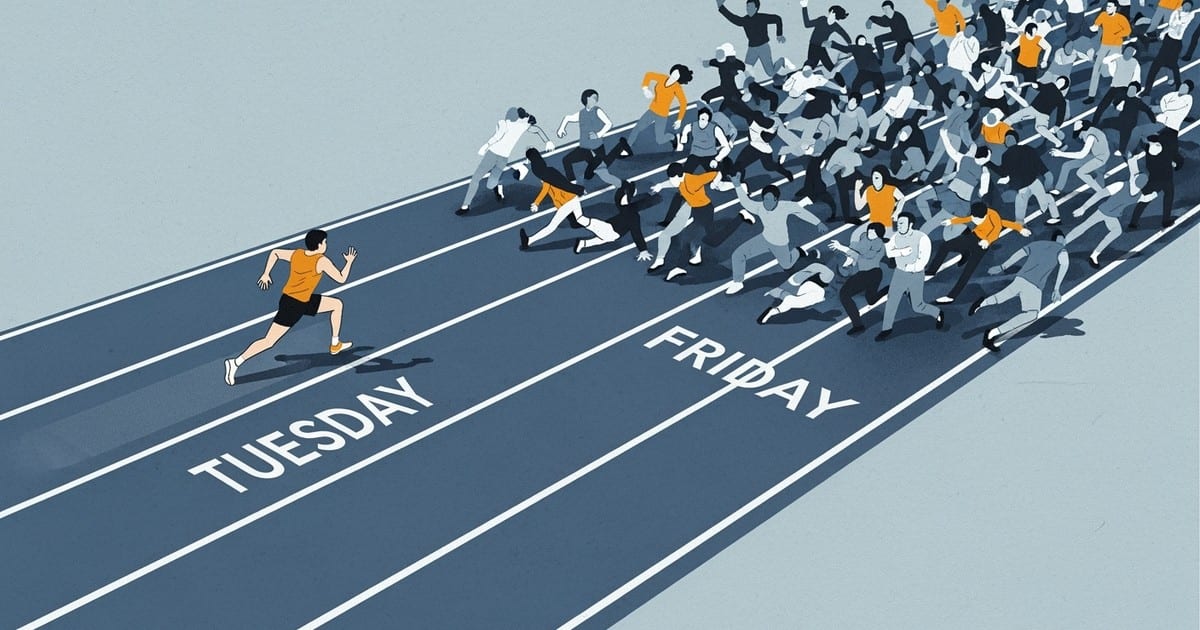
Why Friday became the standard
The Music Business Association coordinated the switch to a global Friday release day on July 10, 2015. Before that, different countries released on different days (Tuesday in the US, Monday in the UK). The switch standardized digital and physical releases worldwide at 00:01 local time.
Spotify reinforced this cadence by updating Release Radar every Friday. Release Radar can include one song per artist per week, and tracks may appear for up to four weeks if a listener has not heard them yet. Ordering is based on release date and how likely Spotify predicts the listener will enjoy the track.
The result: Friday is when follower-facing discovery resets, editorial playlists refresh, and the industry's promotional machinery fires in unison.
What the competition data shows
A 2025 SSRN study ("Timing the Drop") analyzed over 1,000 tracks released on Spotify in 2024 and found three patterns worth noting.
| Finding | Detail |
|---|---|
| Friday is most dominant | The largest share of releases ship on Friday, making it the most competitive day. |
| Mid-level artists prefer Thursday | Artists outside the top tier disproportionately release on Thursdays, avoiding Friday's crowded field. |
| Genre timing varies | EDM, K-Music, and Hip-Hop each show distinct release-day patterns, though the study does not quantify an "optimal" day per genre. |
Friday's dominance creates a supply problem. When the largest volume of new tracks arrives on the same day, each individual release competes for the same listener attention and curator bandwidth.
Tip If your audience is not expecting a Friday drop, Thursday gives you a head start on engagement before Release Radar resets.
Release Radar mechanics: what Spotify confirms
Spotify does not publish a formula for how early velocity affects algorithmic pickup. What it does confirm is more specific and more useful for planning.
Release Radar eligibility requires two things: pitch at least 7 days before release and deliver at least 7 days before release through your distributor. Missing either deadline means your track can miss its first Release Radar cycle entirely.
Release Radar ordering factors in release date and personalization signals. That means your release date is a confirmed input to a major algorithmic surface, even though Spotify does not claim it directly boosts Discover Weekly, Radio, or autoplay.
Spotify's reporting day runs midnight to midnight UTC, with stats updating around 3 PM EST (8 PM UTC). If you are analyzing "day one performance," be precise about whether you mean first 24 hours from go-live or the UTC reporting day.
For country-level launch checks, see Spotify release time by country. It separates local-midnight rollouts from synchronized global releases so teams do not confuse link availability with algorithmic timing.
The pre-save advantage
Spotify reports that 70% of users who pre-save a release stream it in the first week. That is one of the strongest conversion benchmarks available for release planning.
Pre-saves concentrate listening into the window when early engagement matters most. The causal chain is straightforward: more pre-saves lead to more week-one streams, which generate stronger early engagement signals across saves, playlist adds, and completions.
Start pre-save campaigns weeks before release, aligned with your pitch and distributor delivery timelines. Spotify does not specify an exact number of days, but its own guidance frames pre-saves as part of building anticipation ahead of launch.
Tactical release timeline
This timeline works for Friday or non-Friday releases. The key variable is lead time relative to your chosen release date, not the specific day of the week.
2+ weeks before release: pitch in Spotify for Artists Spotify recommends pitching at least two weeks before release. This gives editors time to evaluate your track and increases the chance of editorial playlist consideration.
7+ days before release: confirm delivery and pitch minimum At minimum, pitch and deliver 7 days before release. This ensures Release Radar eligibility for the first week. Missing this window is the single most common preventable mistake in release planning.
Weeks before release: run pre-save campaigns Drive pre-saves through smart links, social content, and email. The 70% first-week stream rate from pre-savers makes this the highest-impact promotional activity before release day.
Release day through day 7: monitor and promote Spotify provides a live stream count that updates every 2 seconds for the first 7 days. Watch early performance, drive external traffic, and optimize social promotion based on what content resonates.
After month 1: keep promoting Spotify reports that 75% of a track's first-year streams happen after the first month. Treat week one as the start, not the finish line. Sustained promotion through playlist outreach, social content, and targeted ads compounds over months.
When Friday still makes sense
Friday works best when you have coordinated promotional support: label marketing, PR pushes, chart ambitions, or a large engaged audience primed for a simultaneous drop. The industry infrastructure is built around Friday, and artists with the resources to compete for attention benefit from that alignment.
For independent artists or mid-roster releases without that infrastructure, the data supports experimenting with Thursday or other mid-week days. Less competition means each stream, save, and playlist add carries more relative weight in your track's early performance signals.
The revenue impact of release timing
Release timing moves revenue, not just stream counts. At Spotify's current $3.02 RPM (per 1,000 streams from Dynamoi first-party data), even a modest boost from better timing compounds.
If a well-timed release generates 20% more first-week streams by avoiding Friday competition, the math looks like this: a track that would have earned 100,000 streams in its first month earns 120,000 instead. At $3.02/1K, that is $362 versus $302 — a $60 difference from one tactical decision. Scale that across a 12-track album over its catalog lifetime and the difference becomes material.
The same logic applies to pre-save timing. Concentrated day-one velocity does not just wake up the algorithm — it shifts when revenue accrues, which matters for distributor payout cycles and reinvestment timing.
The bottom line
There is no universal best day. What matters more than the calendar is the checklist: pitch early, deliver on time, run pre-saves, and promote beyond week one. The release day that gives your specific audience the best chance to engage is the right one.