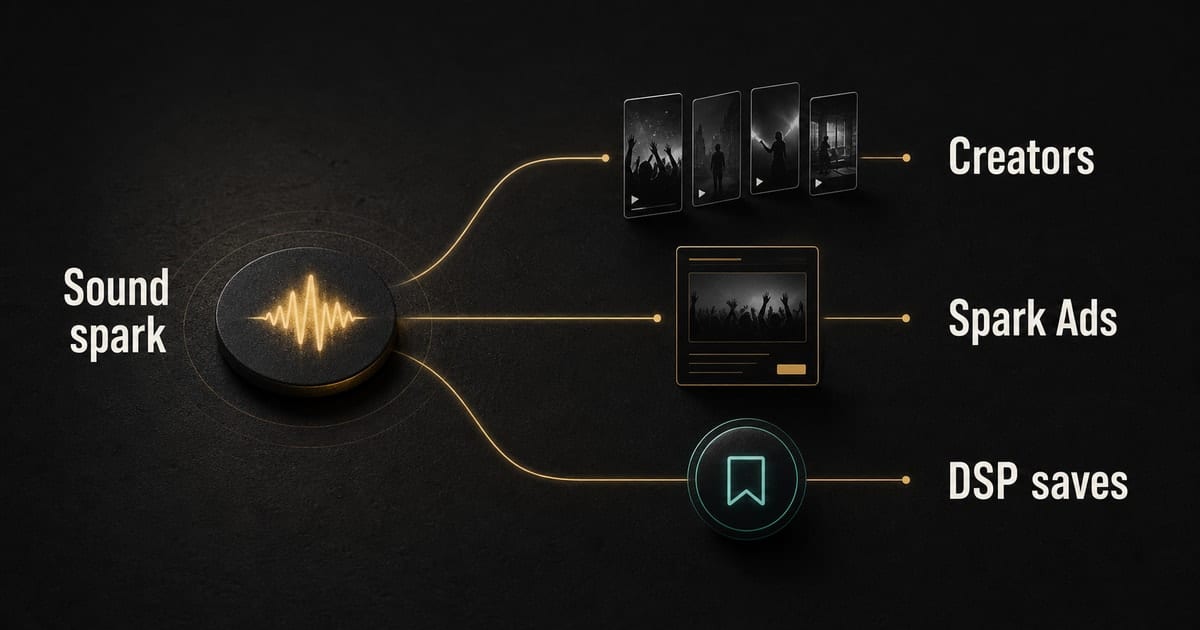
| TikTok signal | What it proves | Next move |
|---|---|---|
| Video creations | The sound has creator utility | Push more creator formats and Spark Ads |
| Sound saves | Listeners may want the full track later | Route to Spotify and Apple Music |
| Completion/replays | The hook is working | Build YouTube Shorts and long-form variants |
| Stream lift | Attention is becoming durable demand | Scale managed campaigns through smart links |
Use TikTok royalty data, Spotify royalty benchmarks, and YouTube creator revenue by country together. TikTok's job is usually to start demand; the money often arrives after that demand moves to DSPs and YouTube.
How TikTok Music Discovery Works
TikTok does not rely on who you follow. The For You Page (FYP) surfaces content based on what users watch, replay, skip, and share. A song from an unknown artist can reach millions if the content using it triggers engagement signals.
The Algorithm's Music Signals
When a user scrolls past a video, TikTok learns nothing. When they watch to the end, replay it, share it, or use the same sound in their own video, TikTok learns everything. For a deeper look at how these signals combine, see how TikTok's algorithm discovers music.
For music specifically, these signals matter most:
| Signal | What It Means | Why It Matters |
|---|---|---|
| Video creations | Number of videos using your sound | Primary indicator of trend potential |
| Sound page saves | Users saving the sound for later | Intent to create content with your track |
| Completion rate | Users watching videos with your sound to the end | Indicates the song enhances content |
| Shares | Users sending videos to friends | Viral coefficient multiplier |
The algorithm does not care about your follower count, your label, or your prior success. It cares about engagement velocity. A sound that generates 1,000 video creations in 48 hours will be pushed harder than one that accumulates 10,000 over six months.
The Sound Page
Every song on TikTok has a Sound Page, accessible by tapping the spinning disc icon on any video. This page shows total video creations using the sound, top-performing videos featuring the sound, and a direct link to stream the full track (via "Add to Music App").
The Sound Page is your conversion point. Users who discover your music through random videos land here, and from here they either create their own content or save the track to Spotify/Apple Music. Optimizing your Sound Page walks through every lever you control.
From Sound to Stream
In 2024, TikTok expanded its "Add to Music App" feature to include album pre-saves. Over one billion tracks have been saved directly from TikTok to streaming services since the feature launched.
The conversion funnel:
- User sees video with your sound
- User taps sound icon, lands on Sound Page
- User taps "Add to Music App"
- Track appears in their Spotify library or Apple Music
This direct path from discovery to DSP is what makes TikTok fundamentally different from Instagram or YouTube. The platform is architected to convert attention into streams.
TikTok for Artists Platform
In June 2025, TikTok launched TikTok for Artists, a dedicated analytics and campaign platform. This is not optional tooling. If you are running music campaigns on TikTok without access to this data, you are operating blind.
Key Features
Analytics Dashboard: Daily-updated metrics on sound performance, video creations, creator engagement, and audience demographics. You can see exactly which creators are using your sound and how their videos perform.
Pre-Release Campaigns: Create pre-save links that allow fans to save upcoming albums directly to Spotify or Apple Music from TikTok. This bridges the gap between TikTok momentum and release-day streaming spikes.
Team Access: Grant visibility to managers, agencies, and label teams. Multiple stakeholders can monitor campaign performance without sharing login credentials.
Creator Insights: Understand who is creating content with your music - their follower counts, engagement rates, and geographic distribution.
Access Requirements
TikTok for Artists requires a certified TikTok Artist Account. Most distributors (DistroKid, TuneCore, CD Baby, Ditto) can help with verification. The platform is available in North America, Europe, Asia-Pacific, and Latin America, with Africa expansion completed in August 2025. The full walkthrough is in the TikTok for Artists setup guide.
Organic Sound Strategy
Paid campaigns amplify momentum. They do not create it. Before spending on Spark Ads or creator partnerships, you need organic traction that proves your sound resonates.
The 15-30 Second Rule
TikTok is not about full songs. It is about 15-30 second clips that enhance video content. Shorter is almost always stronger.
The most viral music on TikTok front-loads hooks so the catchiest moment arrives in the first three seconds. It triggers emotional responses: nostalgia, humor, drama, or surprise. It has clip-friendly structure with clear start/end points for editing and sounds good on loop without becoming grating.
Artists are increasingly writing with TikTok in mind, placing multiple "hookable" moments throughout tracks rather than building to a single climax.
Sound Selection for Your Own Content
When posting from your artist account, every video should use your Official Sound, not "Original Audio." The distinction matters: Original Audio creates a new, untracked sound tied only to your video. Official Sound links to your distributed track, aggregates all video creations, and enables Sound Page discovery.
Using Original Audio on your own content is a wasted opportunity. Every view on that video should be feeding your Sound Page metrics.
Posting Cadence
The algorithm rewards consistency more than volume. Three to five posts per week performs better than daily posting that exhausts your creative capacity.
Test different 15-30 second clips from the same track, various content formats (performance, behind-the-scenes, reaction), and posting times (early morning and late evening often outperform midday). Track what works: which clip generates the most video creations? Which format drives the highest completion rate? Double down on winners. The organic growth strategy guide goes deeper on cadence and format testing.
Trend Participation
Jumping on existing trends with your sound rarely works - the sound is already attached to the trend. What works is using trending formats with your music: a trending visual style or editing pattern with your track, a trending caption format applied to your song's theme, or a trending challenge concept adapted to feature your music.
Early adoption matters. The first 48 hours of a trend are the most algorithmically favorable. By day five, the trend is saturated.
Creator Partnerships
The most effective TikTok music campaigns involve creators - accounts with established audiences who feature your sound in their content. This is not influencer marketing as traditionally understood. It is sound seeding. The end-to-end process for building and managing these relationships is in TikTok creator partnerships for music.
Creator Tiers
TikTok creators fall into rough tiers. Current market rates are tracked in TikTok creator pricing for music promotion.
| Tier | Followers | Typical Music Rate | Best For |
|---|---|---|---|
| Nano | 1K-10K | $50-150 | Volume seeding, authenticity |
| Micro | 10K-100K | $150-500 | Targeted demographics |
| Mid | 100K-500K | $500-2,000 | Reach with engagement |
| Macro | 500K-1M | $2,000-5,000 | Broad awareness |
| Mega | 1M+ | $5,000-20,000+ | Event-level impact |
Average music promotion rate across all tiers: approximately $210 per sponsored post.
Volume Seeding vs. Influencer Campaigns
Traditional influencer campaigns target a few high-follower creators. The emerging approach is volume seeding: working with dozens or hundreds of smaller creators to simulate organic trend emergence.
Warner Records has used this approach for artists like Benson Boone and Teddy Swims, operating networks of smaller accounts that collectively generate massive sound usage. The goal is not to have one video go viral. It is to create the appearance of organic momentum that triggers algorithmic amplification.
Volume seeding math:
- 50 nano-creators at $100 each = $5,000
- Each creates 2-3 videos = 100-150 videos using your sound
- Collective reach: potentially millions of views across diverse audiences
- Algorithmic signal: "This sound is trending"
Compare to a single macro creator:
- 1 creator at $5,000 = $5,000
- 1-2 videos using your sound
- Concentrated reach: one audience segment
- Algorithmic signal: "This creator's content performed well"
The volume approach generates stronger trend signals because TikTok's algorithm weighs sound usage diversity, not just total views. The tactical playbook for seeding your sound is in how to get people to use your sound on TikTok.
Burner Page Strategy
The most aggressive form of volume seeding involves "burner pages" - networks of accounts created specifically for sound placement. Labels and marketing companies operate fleets of thousands of accounts, posting content with target sounds to simulate organic discovery.
This approach carries risks. TikTok periodically purges inauthentic accounts, and a single error can destroy thousands of dollars in account value. But for labels with resources, it has become standard practice.
The strategy works because TikTok's algorithm cannot distinguish between a "real" account with 50 followers going viral and a strategically operated account with 50 followers going viral. The engagement signals look identical.
Spark Ads
Spark Ads are TikTok's native advertising format for boosting existing organic content. Unlike traditional ads, Spark Ads use real TikTok posts, preserving authenticity while adding paid reach.
Why Spark Ads for Music
The key advantage: engagement accrues to the organic post. Likes, comments, shares, and video creations generated during the paid campaign remain on the original content after the campaign ends. This compounds the value of your spend.
For music campaigns specifically, you can boost videos that feature your sound to drive Sound Page traffic. You can boost creator content (with authorization) to use their authentic presentation. And views count toward sound usage metrics, triggering algorithmic amplification. The authorization flow uses a Spark Code, which you generate inside TikTok Ads Manager.
Campaign Setup
Objective selection depends on your primary goal. Traffic campaigns send users to a smartlink or DSP landing page. Video Views campaigns maximize exposure to your sound. Conversions campaigns optimize for specific actions but require pixel setup. For most music campaigns, Video Views or Traffic performs best.
Targeting options include interest-based targeting (users who engage with specific music genres, artists, or hashtags), custom audiences from uploaded email lists (minimum 1,000 contacts), lookalike audiences of users similar to your existing fans, and demographic filters for age, location, and language.
Budget requirements: minimum $20/day per ad group. For testing, allocate $100-300 over 5-7 days. For sustained campaigns, budget $500-2,000/month.
Creative Best Practices
Spark Ads that feel like ads underperform. The best-performing creative uses vertical 9:16 format (1080x1920 pixels), runs 15-20 seconds, and features the hook within the first 3 seconds. It looks native to TikTok - not polished like a TV commercial - and showcases multiple song sections across different ad variants.
Test at least 3-5 creative variants. Performance can vary dramatically based on which song section is featured. For a direct comparison of what Spark Ads deliver versus standard in-feed placements, see Spark Ads vs. non-Spark Ads for music.
Spark Ads vs. Promote
TikTok offers an in-app Promote button for boosting posts, and Spark Ads in Ads Manager for more control and measurement. See Spark Ads vs Non-Spark Ads to choose.
Converting TikTok to DSP Streams
TikTok virality without streaming conversion is a vanity metric. The goal is not TikTok fame. The goal is listeners who save your track, trigger algorithmic playlists, and generate royalty-producing streams.
The Conversion Challenge
Less than 1% of songs on TikTok achieve viral status (defined as video creations doubling within a month with 250,000+ total creations). Of those viral songs, only about 15% see long-term streaming growth. Benchmarks for each stage of the funnel are in TikTok to streaming conversion benchmarks, and do TikTok views help Spotify streams explains the mechanics.
The drop-off happens at multiple points:
- Users enjoy the TikTok clip but never visit the Sound Page
- Users visit the Sound Page but do not tap "Add to Music App"
- Users add the track but never actually listen on Spotify
- Users listen once but skip early, sending negative signals
Optimizing the Funnel
Sound Page to Add: Ensure your track is properly distributed to TikTok via your aggregator. Verify the "Add to Music App" button is active. Check that metadata (artist name, track title, artwork) is correct.
Add to Listen: The TikTok clip should represent the track's actual sound. Avoid bait-and-switch where the viral moment sounds nothing like the full song. Release Radar and Discover Weekly amplification depends on saves translating to listens.
Listen to Save: The track needs to deliver on the promise of the clip. Front-load the full track's appeal - don't bury the hook at 2:30. Consider releasing "TikTok versions" that match viral clip structure.
Measuring Conversion
TikTok for Artists shows sound metrics. Spotify for Artists shows streaming metrics. Cross-reference to understand conversion:
Conversion rate = (New Spotify streams in 7 days) / (TikTok video views in 7 days)
A healthy conversion rate ranges from 0.5% to 2%. Below 0.5% suggests the TikTok content is not driving actual listening intent. Above 2% indicates strong audience-track fit.
Track this weekly during active campaigns to identify when conversion is breaking down. For overall campaign ROI benchmarks, see TikTok music promotion ROI.
Royalties and Revenue
TikTok pays royalties for sound usage, but the payment model differs fundamentally from Spotify or Apple Music.
How TikTok Royalties Work
TikTok transitioned to a view-based royalty model in late 2024. The old per-video-creation model has been fully deprecated.
Our distribution data consistently shows TikTok as a discovery channel first and a direct royalty channel second. Use the current TikTok royalty data when you need a payout model, then compare it against Spotify, YouTube Music and Art Tracks, Apple Music, and the full royalty dashboard.
The strategic point holds even as the exact RPM moves: TikTok views are usually worth far less than full DSP streams. Every successful TikTok campaign needs a clear conversion path to platforms where saves, follows, and repeat listening can turn attention into durable revenue.
Collection Requirements
TikTok only pays royalties for music delivered through licensed distributors. Uploading audio directly to TikTok via the app generates zero royalties. The question does TikTok pay royalties to artists covers exactly how those payments flow.
Ensure your distributor agreement includes TikTok distribution. Royalties are disbursed quarterly through your distributor. If you are setting up distribution for the first time, how to get your music on TikTok covers the process end to end, and best distributors for TikTok compares your options.
SoundOn Alternative
TikTok's own distribution platform, SoundOn, offers 100% royalty retention in year one and 90% after that. The 10% fee applies only to third-party DSP royalties (Spotify, Apple, etc.). TikTok Music (Resso) shut down in November 2024, so all TikTok royalties now flow through the main app.
The tradeoff: SoundOn is optimized for TikTok, not necessarily for global DSP reach. Many artists use SoundOn for TikTok specifically and a separate distributor for other platforms. SoundOn vs. DistroKid for TikTok breaks down when each makes sense.
Campaign Timeline
A typical TikTok music campaign runs 6-8 weeks around a release. Here is a reference structure:
Pre-Release (Weeks -4 to -1)
Week -4:
- Finalize track distribution, ensure TikTok delivery confirmed
- Set up TikTok for Artists access
- Identify 20-50 potential creator partners
Week -3:
- Create 5-10 organic video variants testing different clips
- Begin creator outreach with sound preview
Week -2:
- Activate pre-save campaign via TikTok for Artists
- Post first organic content to seed Sound Page
- Confirm creator partnerships and content delivery dates
Week -1:
- Intensify organic posting (daily)
- Creators begin posting content with sound
- Monitor Sound Page metrics for early signals
Release Week (Week 0)
This is the critical launch window. Execute the following:
- Maximum organic posting frequency
- All creator content live
- Spark Ads activated on best-performing organic posts
- Daily monitoring of Sound Page metrics and DSP conversion
Post-Release (Weeks +1 to +4)
Transition from launch fever to sustained growth.
Week +1:
- Analyze Spark Ads performance, kill underperformers
- Scale budget on winning creative
- Identify top organic posts for additional boosting
Week +2-3:
- Shift focus from sound seeding to DSP conversion
- Add retargeting for users who engaged but did not stream
- Evaluate creator partnership ROI
Week +4:
- Campaign wrap assessment
- Final conversion metrics
- Learnings documentation for next release
Common Mistakes
Mistaking Views for Success
A video with 2 million views and zero video creations is a dead end. Views indicate people watched content. Video creations indicate people want to use your sound. The latter drives algorithmic amplification; the former does not.
Wrong Clip Selection
The most "musical" moment is not always the most TikTok-friendly moment. A clever lyric, an unexpected beat drop, or a meme-able phrase often outperforms a technically impressive chorus. Test multiple clips before committing budget.
Ignoring Sound Page Metrics
If your Sound Page shows high views but low "Add to Music App" taps, the conversion funnel is broken. The track may not be properly distributed, or the TikTok clip may not represent the actual song.
Over-Polished Creative
TikTok's algorithm and user base favor authentic, native-feeling content. A professionally shot music video often underperforms a phone-recorded behind-the-scenes clip. Save the high production value for YouTube. If performing on camera feels like a barrier, how to promote music on TikTok without showing your face covers formats that work without a camera presence.
Single-Channel Focus
TikTok generates discovery. Instagram builds relationships. Spotify generates revenue. YouTube monetizes long-form. A TikTok-only strategy captures attention but fails to convert it into a sustainable fan relationship. Use Dynamoi's royalty data to compare the current TikTok, Spotify, and YouTube spread before judging campaign payback. TikTok vs. Instagram Reels for music examines how the two platforms serve different parts of that funnel.
What Happens Next
TikTok's dominance in music discovery is unlikely to diminish in 2025-2026. The platform is actively expanding its music tools, and the "Add to Music App" integration makes it the most direct path from discovery to streaming.
For artists and labels, TikTok is no longer optional. It is the front door to the modern music industry. The artists who understand its mechanics - who can engineer sounds for virality, structure creator partnerships, and convert attention into streams - will have a structural advantage over those who treat it as just another social platform.
The goal is not TikTok fame. The goal is using TikTok's discovery engine to build an audience that follows you to Spotify, Apple Music, YouTube, and beyond.