

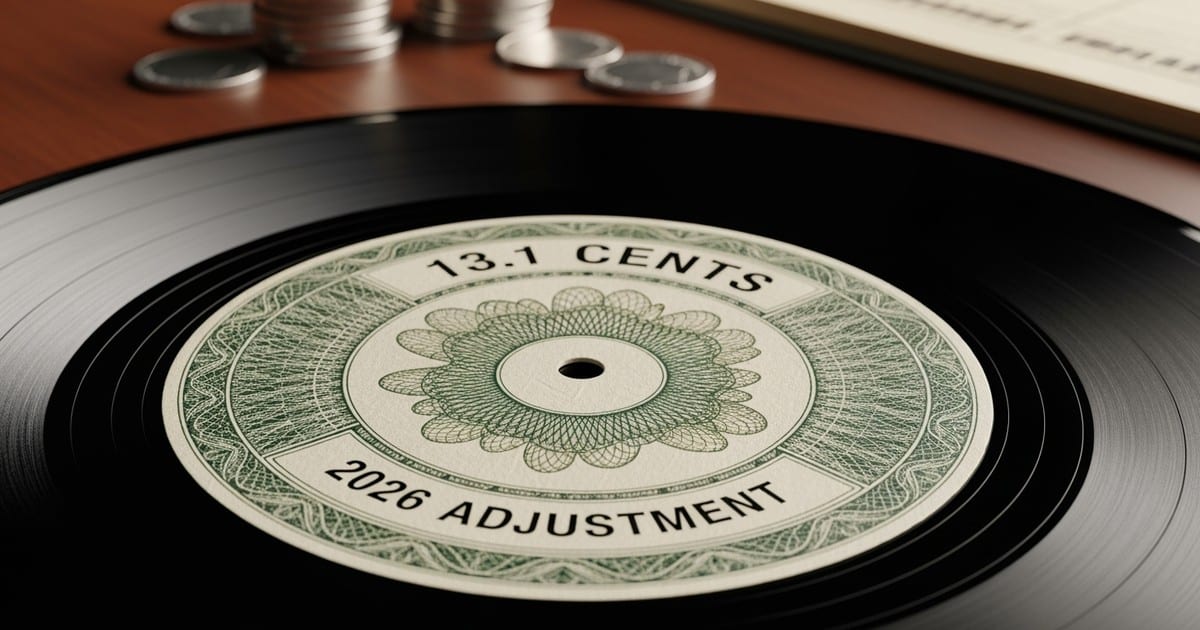
A small line in the Federal Register just made every 2026 physical release a little more expensive - and every songwriter check a little bigger.
The US Copyright Royalty Board (CRB) has confirmed a cost-of-living bump to the statutory mechanical royalty for physical formats and permanent downloads starting January 1, 2026. The new rate: 13.1 cents per work or 2.52 cents per minute of playing time, whichever is higher, up from 12.7 cents and 2.45 cents in 2025.
Why it matters
For streaming-first campaigns this may feel like a rounding error. For anyone still pressing vinyl, CDs, cassettes or selling downloads direct-to-fan, it's another line item tightening margins.
Under US law, the statutory mechanical rate is the minimum you must pay songwriters and publishers for reproductions of their compositions. That includes:
- Physical products (vinyl, CD, cassette)
- Permanent downloads (iTunes-style purchases, some D2C bundles)
- Certain bundles that mix physical/digital with merch
Because many label-artist deals peg artist and producer royalties to "all-in" or "controlled composition" mechanical assumptions, even a modest bump can change where your break-even sits on a campaign.
By the numbers
- 2026 mechanical rate: 13.1 cents per work or 2.52 cents per minute (whichever is higher)
- 2025 mechanical rate: 12.7 cents per work or 2.45 cents per minute
- Increase: Roughly 3.1% year over year on both per-work and per-minute floors
- Example - 10-track album:
- 2025 mechanicals per unit: 10 x $0.127 = $1.27
- 2026 mechanicals per unit: 10 x $0.131 = $1.31
- Delta: $0.04 per unit
- At 50,000 units, that's ~$2,000 of extra mechanical cost; at 200,000 units, ~$8,000.
Crucially, this adjustment does not touch on-demand streaming mechanicals. Those still follow the Phonorecords IV settlement's percentage-of-service-revenue formula, slowly stepping toward a 15.35% "headline" rate by 2027.
Who actually pays this?
In most deals, the party manufacturing or selling the physical or permanent download is on the hook for mechanicals:
- Major / indie labels: pay mechanicals on units shipped/sold, often via their publishing admin or mechanical agency.
- DIY artists pressing their own vinyl: pay mechanicals via Harry Fox, MLC workarounds, or direct deals, depending on repertoire.
- Direct-to-fan platforms: typically bake mechanicals into unit cost or require proof they're being handled elsewhere.
If you're an artist or manager, your recoupment math depends heavily on whether your deal uses an "all-in" royalty that assumes a specific mechanical rate, or treats mechanicals as a pass-through cost against your royalty.
The bottom line
Streaming may dominate the discourse, but as long as physical and download formats remain part of the mix, CRB cost-of-living adjustments quietly reshape the math on every unit you ship. Treat this like a small but real tax on sloppy budgeting - and an equally real bonus for songwriters whose work still sells in physical form.