
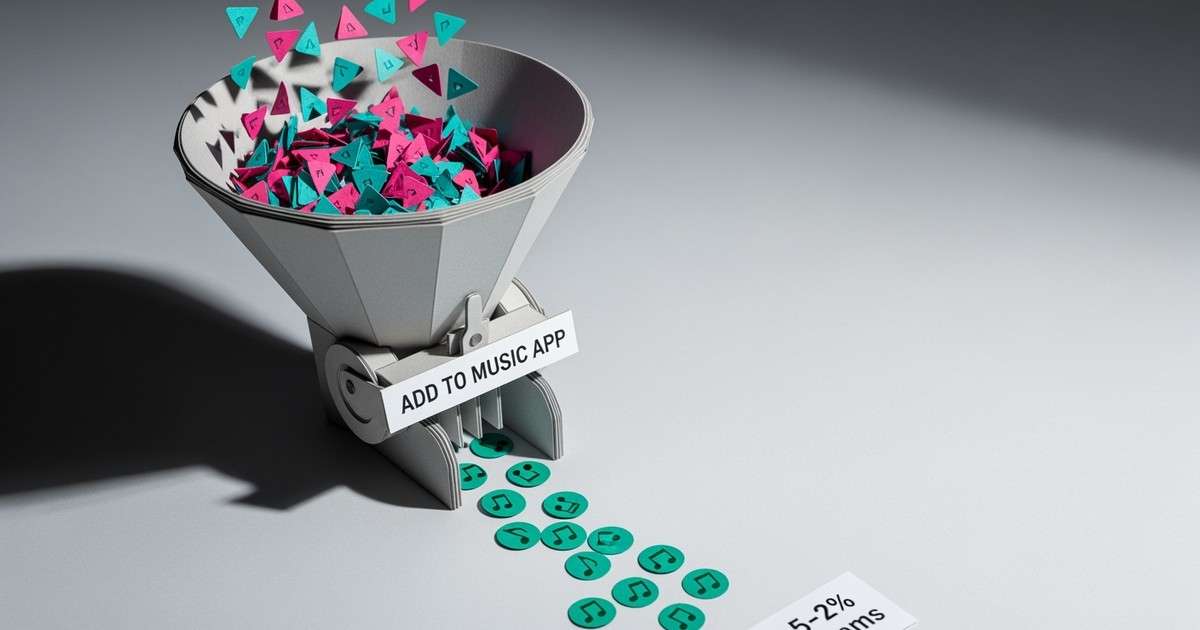
As of 2024, a track must reach at least 1,000 streams in the previous 12 months to be eligible for recording royalties from Spotify.
Why the threshold exists
Spotify implemented this policy to address two problems. First, millions of "noise" tracks (white noise loops, 30-second ambient clips, AI-generated filler) were siphoning small amounts from the royalty pool. Second, most sub-1,000-stream payouts never reached artists anyway - they sat below distributor withdrawal minimums indefinitely.
The reallocation benefits working artists. Spotify estimates this shifted tens of millions of dollars annually toward creators with actual listener engagement.
What happens to sub-threshold tracks
| Royalty Type | Status Below 1,000 Streams |
|---|---|
| Recording royalties (master) | Not paid for that track |
| Publishing royalties (songwriting) | Still collected via PROs and mechanical agencies |
| Playlist eligibility | Unaffected - track can still appear in playlists |
| Algorithmic recommendations | Unaffected - track can still surface in Radio, Mixes |
Your track stays live on the platform. It can still be added to playlists, discovered via search, and recommended by the algorithm. The only change is that recording royalties for that specific track are held until it crosses 1,000 streams in a rolling 12-month window.
Publishing royalties work differently. If you wrote the song, your PRO (ASCAP, BMI, SESAC, PRS, etc.) and mechanical collection agency still pay based on their own thresholds and reporting cycles. Spotify's 1,000-stream rule applies only to the recording (master) side.
What Are the Strategy Implications?
Focus over volume. Uploading 50 tracks hoping one catches on is now a losing strategy. Each release that stalls below 1,000 streams earns nothing on the recording side. Concentrate marketing effort on fewer, higher-quality releases that can realistically cross the threshold.
Catalog hygiene. If you have old tracks sitting at 200-800 streams, a small push (playlist pitching, a social post, a modest ad test) can tip them over. Prioritize tracks that are close to the threshold.
Release timing. New tracks benefit from Release Radar and editorial pitching windows. Maximize first-week momentum to build a buffer above 1,000 rather than trickling streams over months.
The math: At roughly 83 streams per month, a track crosses 1,000 in a year. That is about 3 streams per day - achievable for any track with a small but engaged audience.