
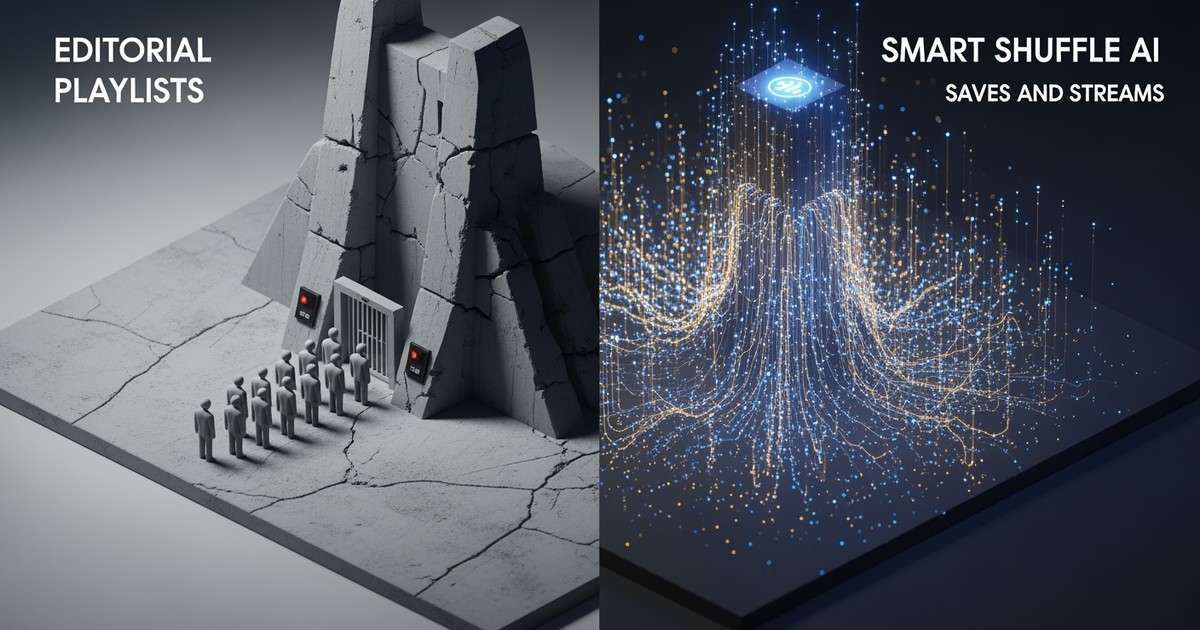
Smart Shuffle creates discovery opportunity and discovery risk. Unlike editorial playlists or Radio, it inserts recommendations directly into listener-owned playlists, which can produce high-fit exposure or context mismatch, depending on how well Spotify's systems understand your audience.
What Smart Shuffle actually is
Smart Shuffle is a Spotify play mode that shuffles a playlist while inserting personalized recommended tracks (marked with a sparkle icon). For playlists with more than 15 songs, Spotify recommends about one song for every three tracks.
Listeners can:
- Save a recommendation into the playlist (positive signal)
- Remove a recommendation with a minus button (explicit negative feedback)
On mobile, Smart Shuffle is the default play mode for Spotify Free listeners. Premium listeners can toggle between standard shuffle and Smart Shuffle, and can disable Smart Shuffle in settings.
What Is the Upside: Discovery Inside Owned Playlists?
At Stream On 2023, Spotify positioned Smart Shuffle as a way "to get your music into the favorite playlists of potential future fans." Spotify frames recommendations as driving nearly half of listening and around one-third of new artist discoveries platform-wide.
The structural advantage: Smart Shuffle places discovery inside a listener's "owned" playlist context. When the match is strong, this can increase the chance of saves or playlist adds because the listener is already engaged with that playlist.
What Is the Downside: Mismatch and Negative Signals?
Spotify confirms that it "takes note when a listener isn't engaging with a song… and factors this in when determining what to recommend in the future."
When Smart Shuffle places your track into a mismatched context:
- Listeners skip quickly
- Spotify captures that engagement signal
- Future recommendations may deprioritize your track
There is no documented recovery timeline or penalty threshold. The system is continuous-learning.
Warning Smart Shuffle is not something artists opt into. It is a listener play mode. You cannot prevent your music from appearing as Smart Shuffle recommendations or target specific playlist contexts.
Who benefits from Smart Shuffle
Artists with strong context signals
Smart Shuffle explicitly inserts recommendations that "match the vibe" of the playlist. Artists whose existing audience has clear, consistent listening patterns give Spotify better data to match correctly.
Spotify's personalization is driven by:
- What listeners play
- Which songs listeners add to their playlists
- Habits of listeners with similar tastes
If your fans actively save your tracks and add them to playlists, those signals strengthen the recommendation system's ability to find similar listeners.
Artists with catalog depth
Spotify does not publish a catalog-size threshold. However, the documented mechanics suggest why depth matters:
- More tracks create more "entry points" for recommendation matching
- Multiple tracks can fit different playlist vibes
- More opportunities for saves and playlist adds
An artist with one track gets one chance for Smart Shuffle to find the right context. An artist with 10+ tracks has more routes to convert discovery into deeper consumption.
Who may struggle with Smart Shuffle
Niche genres
Research on music recommender systems finds popularity bias is common: popular items are over-recommended, and "long tail" items can be underrepresented. Non-mainstream users may receive less accurate recommendations in some algorithm designs.
Note Evidence about popularity bias in commercial recommendation systems is mixed across studies. One study found no evidence of popularity bias in commercial services including Spotify. Treat this as a plausible risk to monitor, not a confirmed penalty.
Artists with misaligned audience data
If your existing listeners came from bot traffic, incentivized streams, or broad low-intent campaigns, Spotify's systems have worse data to work with. Smart Shuffle recommendations based on that audience are more likely to produce mismatches and skips.
What Is Spotify's Official Framing of Smart Shuffle?
Listener benefit
Spotify Support describes Smart Shuffle as keeping listening sessions "fresh" by mixing in recommendations that match the vibe.
Artist discovery benefit
At Stream On 2023, Spotify described Smart Shuffle as helping "fans discover creators and artists" and positioned it alongside broader claims about the centrality of recommendations to discovery.
Spotify has not published tier-by-tier data (emerging vs mid-tier vs superstar) on who benefits most.
How to optimize for Smart Shuffle (based on documented mechanics)
Since Spotify confirms that engagement signals (listening, skipping, saving, playlist adds) train recommendation systems, optimization focuses on signal quality:
1. Maximize playlist adds by real fans
Spotify says personalized playlists are driven partly by "which songs listeners are adding to their playlists." Campaign CTAs should emphasize "add to your playlist," not just "stream."
2. Optimize pitch metadata
Spotify says "more detail gives your song a better chance" when pitching unreleased music. Genre, mood, and culture tags function as targeting inputs that can affect downstream matching across recommendation surfaces including Smart Shuffle.
3. Use Release Radar as a seed audience
Pitching at least 7 days before release gets your track into followers' Release Radar. This creates an early, high-fit listener base whose engagement can shape how Smart Shuffle recommends you to similar listeners.
4. Avoid low-intent traffic
Spotify factors in non-engagement when deciding future recommendations. Campaigns that inflate streams without generating saves, follows, and playlist adds create worse signal data for recommendation matching.
How Does Smart Shuffle Compare to Spotify Radio?
Spotify Radio is a "collection of songs" seeded by an artist, album, or song. Spotify for Artists treats Radio as a measurable stream source under "Radio and autoplay."
Spotify explicitly identifies Radio, Autoplay, and Mixes as Discovery Mode contexts, meaning these are surfaces where Spotify offers an artist-facing lever (Discovery Mode prioritization).
Smart Shuffle is not documented as a Discovery Mode context. The Guardian reported that Spotify clarified Smart Shuffle has "no correlation" to Discovery Mode.
Neither surface is documented as universally superior for discovery. The strategic difference: Radio/Autoplay can be influenced through Discovery Mode; Smart Shuffle cannot be directly targeted.
What Spotify has not published
- Tier-by-tier benefit data (who gains most from Smart Shuffle)
- Genre-specific exposure patterns
- Documented case studies isolating Smart Shuffle impact
- A/B testing tools for Smart Shuffle
Spotify for Artists' "Source of streams" reporting may show Smart Shuffle within algorithmic playlist breakdowns for some accounts, but this is not documented as a guaranteed feature.
What Is the Verdict on Smart Shuffle for Artists?
Smart Shuffle is a high-variance recommendation surface. It is "good" when it places your track in well-matched contexts and listeners engage. It is risky when mismatch produces skips that feed into Spotify's continuous-learning systems.
You cannot opt out or directly target Smart Shuffle. The sustainable strategy is building engagement quality: accurate metadata, high-intent audience acquisition, and campaigns that drive saves and playlist adds. These signals shape how recommendation systems place your music across all discovery surfaces, including Smart Shuffle.