
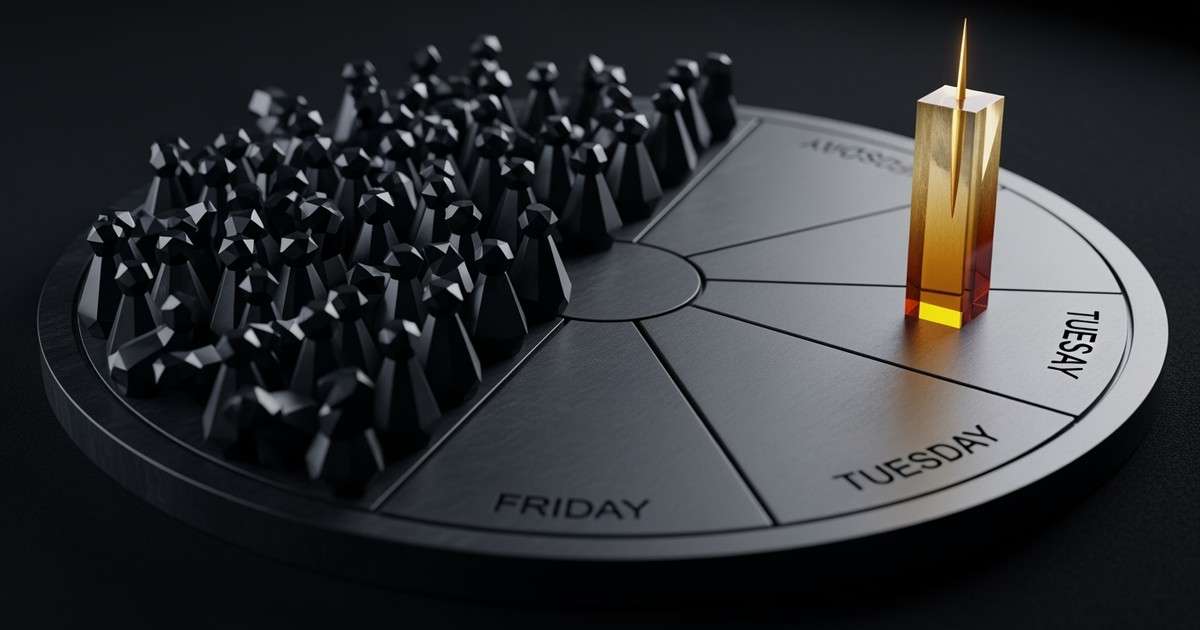
Friday is structurally advantaged for week-1 chart performance because major charts use Friday-Thursday tracking weeks. A Friday release gets seven days of eligible activity; a Tuesday release gets only three. However, Friday is also the most crowded day for releases and playlist adds, with nearly twice the playlist activity of Saturday. For labels and artist teams, the optimal release day depends on whether you prioritize chart debut (Friday wins) or standing out from competition (off-cycle can work). The data supports nuanced timing decisions, not a universal "always release Friday" rule.
Why Friday became the default
The modern Friday release standard is a structural artifact, not a law of nature. On July 10, 2015, the industry aligned to "New Music Fridays" globally, with new music released at 00:01 local time in over 45 countries.
Before this alignment, release days varied by market: Monday in France and the UK, Tuesday in the US and Canada, Friday in Australia and Germany. The IFPI coordinated the switchover based on consumer research showing fans preferred weekend access to new releases.
Note Friday is the default because platform and chart infrastructure built around a synchronized weekly cadence, not because Friday is inherently optimal for every artist goal.
Streaming demand by weekday
Luminate's analysis of US on-demand audio streaming (June-August 2023) shows clear weekly patterns:
| Day | Relative volume |
|---|---|
| Friday | Highest (baseline) |
| Saturday | High |
| Thursday | Climbing |
| Wednesday | Mid-week |
| Tuesday | Building |
| Monday | Low |
| Sunday | Lowest (~85% of Friday) |
Streaming generally climbs from Monday through Thursday, peaks Friday-Saturday, then drops Sunday.
What this supports: If your goal is maximizing raw listening on day 1, Friday and the weekend provide a tailwind.
What it does not prove: That a Friday release causes better outcomes for every artist. Friday is also the most competitive day.
Chart calculation windows
The structural advantage of Friday releases comes from chart math, not streaming volume alone.
Billboard (US)
Billboard's tracking week runs Friday through Thursday. A Friday release gets a full seven days of eligible activity for its debut week. A Tuesday release gets only three days before the tracking week ends Thursday.
UK Official Charts
The UK chart week follows the same Friday-Thursday cadence.
High confidence conclusion: If you care about the highest possible week-1 chart position, releasing Friday is structurally advantaged because it maximizes eligible days in the first tracking period.
Release competition and crowding
Friday is simultaneously the best audience day and the most crowded release day.
Chartmetric's Year in Music 2023 found:
- Average of 22,000+ tracks released daily (Chartmetric-tracked)
- Releases most commonly occur on Fridays
- Most active months for new releases: March, May, and June
- Certain holidays (Valentine's Day, Halloween) see notable release increases
Chartmetric's playlist analysis shows playlist adds happen most often on Fridays, nearly twice as often as Saturday. This is driven by New Music Friday playlists and the concentration of releases.
Off-cycle releases as strategy
Research on 1,000+ Spotify tracks released in 2024 suggests mid-level artists may avoid Friday by releasing more frequently on Thursdays. Some genres (EDM, K-pop, Hip-Hop) show distinct timing patterns.
Medium confidence takeaway: Off-cycle releases (Tuesday-Thursday) can be rational for artists who benefit more from standing out than from maximizing week-1 tracking days. The tradeoff is weaker chart math.
Platform-specific timing requirements
Spotify
Spotify's pitching requirements:
- Pitch at least 7 days before release to get the pitched song into followers' Release Radar
- Deliver music at least 7 days before release so editors have time to listen
- Once a track is live, it is no longer eligible for pitching
Release Radar updates every Friday. To appear in the first week, deliver and pitch at least 7 days before release.
Key insight: Release day matters less for editorial consideration than pitch timing. Spotify says nothing about editors only considering Friday releases. However, if you release after the major weekly refresh, your first-week algorithmic lift can be delayed.
Apple Music
Apple Music pitch deadlines:
- 10+ days in advance for full consideration
- 7 days minimum as a final deadline for late adds
- Off-cycle releases follow the same rolling deadlines
TikTok
TikTok's SoundOn guidance recommends pre-release clips 7-14 days before the official DSP release. This creates a two-stage calendar:
- Pre-release sound/clip window (7-14 days before)
- DSP release day
If TikTok is a major driver, your "release timing" decision is really about when to start the pre-release clip campaign.
YouTube
YouTube recommends scheduling Premieres at least 24 hours in advance. For YouTube, timing is often less about "Friday vs Tuesday" and more about picking the hour your audience is online, then coordinating Shorts and Community posts around it.
Seasonal patterns
Holiday period (November-December)
Holiday music materially reshapes the entire market during this period.
Luminate data shows holiday music grows from modest levels to over 10% of total US on-demand audio market share near its peak week around Christmas:
- 14.3% market share in week 51 of 2020
- 13% market share in week 52 of 2023
Chartmetric analysis shows holiday listening spikes begin as early as November 1 and sustain until January 2.
Practical implications:
- Non-holiday releases in late November-December compete with a seasonal catalog surge that occupies listener attention, playlist space, and chart real estate
- If releasing holiday music, "late November" is often late relative to the listening curve; early November is closer to the ramp
Summer vs winter (genre-dependent)
Luminate's genre seasonality analysis (US on-demand audio, 2022-2023) comparing summer weekly volume to the two-year average:
| Genre | Summer orientation |
|---|---|
| Reggae | Most summer-oriented |
| Country | Sizable summer share |
| Afrobeats | Sizable summer share |
| R&B/Rap | Slightly lower in summer |
| Jazz/Classical | Under-index in summer |
Medium confidence conclusion: "Best time of year" is genre-conditional. A summer release can be structurally advantaged for some genres and slightly disadvantaged for others.
Cultural moment timing
Major events can create measurable streaming shocks for participating artists.
Luminate's Grammy analysis (February 2025) found five artists jumped more than 50% day-over-day in US streaming after the show. Example: Doechii saw +187% and +5.9 million on-demand audio streams after performing and winning.
Medium confidence implications:
- If your artist is nominated, performing, or tied to the moment, aligning a release or content beat close to that window can amplify results
- If your artist is not part of the moment, releasing during peak attention can mean competing against the attention siphon
Time of day considerations
Rolling vs synchronized releases
The New Music Fridays standard is 00:01 local time worldwide, creating a "rolling" release as each territory hits midnight. Some distributors offer synchronized global releases at a specific time.
DistroKid allows choosing a specific Spotify release time and launching simultaneously worldwide.
When rolling local midnights help: Natural wave of first plays across time zones; useful for global fanbases (APAC first, then EU, then Americas).
When synchronized drops help: Align press, socials, live streams, and fan communities to one global moment.
Pre-save conversion timing
Spotify's Countdown Pages study found:
- Publishing a Countdown Page at least 7 days before release nearly doubles pre-saves
- Releasing a single ahead of an album with a Countdown Page results in approximately 2x as many pre-saves
Evidence gap: Public data on "midnight vs noon release time increases conversion by X%" is generally not disclosed. Treat time of day as a coordination decision, not a proven growth lever.
Reporting measurement note
Spotify for Artists daily stats are based on UTC days. This can make "release day" appear to have fewer streams if your audience is concentrated in time zones behind UTC. Normalize to the same reporting windows before concluding time of day helped or hurt.
Key benchmarks for planning
| Factor | Data point | Confidence |
|---|---|---|
| Highest streaming day | Friday | High |
| Lowest streaming day | Sunday (~85% of Friday) | High |
| Chart tracking week | Friday-Thursday (Billboard, UK) | High |
| Release Radar update | Every Friday | High |
| Spotify pitch minimum | 7 days before release | High |
| Apple Music full consideration | 10+ days before release | High |
| Holiday music market share peak | 10-14% of total market | High |
| Holiday listening ramp start | Early November | Medium |
| Off-cycle release advantage | Mid-tier artists avoiding competition | Medium |
| Genre seasonality impact | Measurable but genre-specific | Medium |
Recommendations by confidence level
High confidence (strong platform evidence)
Chart debut priority: Release at the start of the tracking week (Friday) to maximize eligible days.
Spotify algorithmic exposure: Plan so the release is eligible for the Friday Release Radar refresh. Pitch and deliver at least 7 days before release.
Editorial consideration: Optimize for lead time, not weekday. Deliver and pitch 7+ days before; once live you cannot pitch.
Medium confidence (context-dependent)
Standing out vs charting: Consider off-cycle releases (Tuesday-Thursday) when you are more likely to win by standing out than by maximizing week-1 totals.
Seasonal timing: Avoid late November-December for non-holiday releases unless you have a strong narrative or guaranteed attention. Use genre seasonality as a planning input.
Cultural moments: If participating in a major event (Grammy nomination, performance), time releases close to that window.
Low confidence (evidence gaps)
Exact hour optimization: Useful for coordination, but broad causal data on "midnight vs noon for streaming lift" is not publicly established.
First-day number comparison: Many apparent time-of-day effects are measurement artifacts from UTC day boundaries.
The bottom line: Friday is structurally advantaged for chart math, but the most crowded day for competition. The right release day depends on whether you are optimizing for week-1 chart position or long-term growth with less competition.