
The core difference
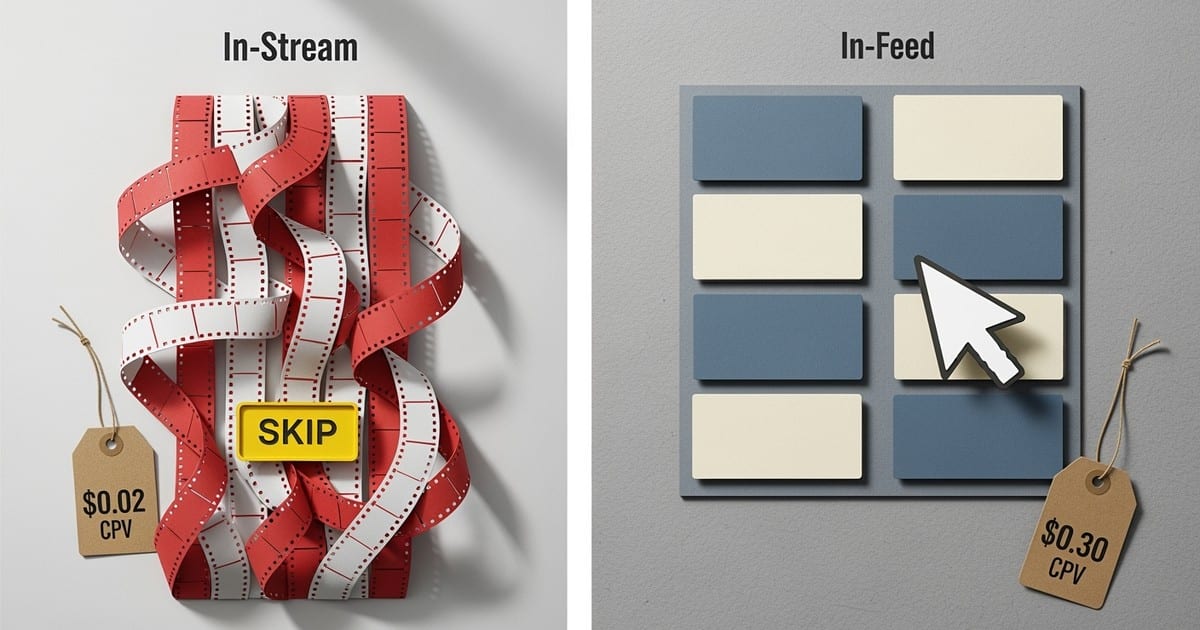
In-stream ads interrupt what the viewer is already watching. In-feed ads appear as thumbnails the viewer chooses to click. This fundamental distinction shapes everything else: cost model, engagement quality, and where each format fits in your funnel.
| Factor | In-Stream Ads | In-Feed Ads |
|---|---|---|
| Placement | Before, during, or after videos | Search results, homepage, related videos sidebar |
| Autoplay | Yes (viewer must watch or skip) | No (requires click to watch) |
| Primary cost model | CPV for skippable, CPM for non-skippable | CPV (per click) |
| Typical CPV | $0.02-0.10 (skippable) | $0.10-0.30 |
| Best for | Reach, awareness, view count growth | Engaged subscribers, channel growth |
| View counting | Counts if watched 30s+ or full ad | Counts when clicked and watched |
In-stream ads explained
In-stream ads play before (pre-roll), during (mid-roll), or after (post-roll) other YouTube videos. They come in two main varieties.
Skippable in-stream (TrueView) ads let viewers skip after 5 seconds. You only pay when someone watches 30 seconds or more, watches the full ad if shorter than 30 seconds, or clicks a call-to-action. This is the most common format for music promotion because you only pay for engaged views.
Non-skippable in-stream ads force the viewer to watch the entire ad (15-20 seconds maximum). You pay per 1,000 impressions (CPM) regardless of engagement. These guarantee full exposure but cost more and can annoy viewers.
Note Skippable in-stream ads are priced on a CPV (cost-per-view) model. If someone skips before 30 seconds, you pay nothing. This makes them highly efficient for music videos where the goal is genuine interest, not forced impressions.
Cost benchmarks for in-stream ads
Based on 2024-2025 industry data, expect these ranges for music promotion campaigns:
| Format | Cost Model | Typical Range | Notes |
|---|---|---|---|
| Skippable in-stream | CPV | $0.02-0.10 | Lower end with broad targeting, higher with niche audiences |
| Non-skippable in-stream | CPM | $6-15 per 1,000 impressions | Guarantees full view, higher cost |
For most music campaigns, skippable in-stream delivers the best cost efficiency. You reach a wide audience, and viewers who skip were unlikely to become fans anyway.
In-feed ads explained
In-feed ads (formerly TrueView discovery ads) appear as thumbnails with text in YouTube search results, the homepage feed, and the "up next" sidebar. The viewer sees your thumbnail and headline, then chooses whether to click.
You pay when someone clicks your ad to watch the video. This means every paid view represents active interest, not passive exposure. The trade-off is higher cost per view and lower raw reach.
Where in-feed ads appear:
- YouTube search results (when users search related terms)
- YouTube homepage (personalized recommendations)
- Related videos sidebar (next to content similar to yours)
Cost benchmarks for in-feed ads
| Scenario | Typical CPV | Notes |
|---|---|---|
| Broad music targeting | $0.10-0.15 | Competing with many advertisers |
| Niche genre or artist targeting | $0.15-0.30 | Smaller but more relevant audience |
| Highly competitive keywords | $0.20-0.30+ | Popular search terms cost more |
In-feed ads cost more per view, but those views represent deliberate choices. Someone who clicks your thumbnail in search results is actively looking for content like yours.
When to use each format
The right choice depends on your campaign goal. Most effective strategies use both formats at different stages.
Use in-stream ads when:
You want to maximize reach and view counts. In-stream ads deliver the most views per dollar. If you need to hit a view milestone, build social proof, or seed a new release with initial traction, skippable in-stream is the efficient choice.
Your music video can hook in the first 5 seconds. Since viewers can skip after 5 seconds, your opening must earn attention immediately. Music videos with strong visual hooks or instant musical payoffs perform well here.
You are targeting fans of similar artists. Placement targeting (showing your ad before specific videos or channels) works exceptionally well with in-stream. A hip-hop video ad playing before a Drake video reaches exactly the right audience.
Use in-feed ads when:
You want subscribers who actively chose your content. In-feed ads attract viewers who saw your thumbnail, read your headline, and decided to click. These are higher-intent viewers more likely to subscribe and return.
You are promoting your channel, not just one video. In-feed ads can link to your channel page, not just a single video. This is useful for building ongoing audience relationships.
Your content benefits from search intent. If people are searching for tutorials, covers, or specific genres, in-feed ads in search results put your content in front of actively seeking viewers.
Tip For new releases, run skippable in-stream ads for the first 2-3 weeks to build view velocity, then shift budget to in-feed ads to capture search traffic and convert casual viewers into subscribers.
Music-specific considerations
Music promotion has unique dynamics that affect ad format choice.
The 30-second rule matters for in-stream. A skippable in-stream view only counts (and costs you) if someone watches 30 seconds. If your music video has a slow build, you might pay for fewer views but those views represent genuine interest. If your track hooks instantly, you will pay for more views because fewer people skip.
Thumbnails matter more for in-feed. In-feed ads live or die by their thumbnail and headline. A compelling visual and clear value proposition ("Official Music Video" or "New Single Out Now") drive click-through rates.
Genre affects targeting options. Placement targeting (showing ads before specific videos) works better for genres with clear artist associations. Niche genres like metal or EDM have dedicated channels and artists to target. Broad pop campaigns may need to rely more on interest and demographic targeting.
Budget allocation strategy
For a typical music release campaign, consider this framework:
| Phase | Duration | Primary Format | Budget Split |
|---|---|---|---|
| Launch week | Days 1-7 | Skippable in-stream | 70-80% of budget |
| Momentum phase | Days 8-21 | Mix of both | 50% in-stream, 50% in-feed |
| Long tail | Day 22+ | In-feed | 70-80% of budget |
Launch week prioritizes reach. You want the video to accumulate views quickly, signal momentum to the algorithm, and build social proof.
Momentum phase balances reach with engagement. As initial buzz fades, in-feed ads capture viewers who are actively searching or browsing related content.
Long tail shifts to in-feed entirely. The video has established its view count; now the goal is converting browsers into subscribers and driving ongoing catalog discovery.
Measuring success by format
Track different metrics depending on which format you are running.
In-stream metrics to watch:
- View rate (percentage of impressions that become views)
- Cost per view (CPV)
- Watch time and average view duration
- Click-through to channel or other videos
In-feed metrics to watch:
- Click-through rate (CTR) on thumbnails
- Cost per click (CPC)
- Subscriber conversions from ad views
- Watch time post-click
A healthy in-stream campaign might show 25-35% view rates and $0.03-0.08 CPV. A healthy in-feed campaign might show 2-5% CTR and conversion to channel actions.
Common mistakes to avoid
Warning These errors waste budget. The most common is using non-skippable ads for music videos, which annoys viewers and rarely converts to fans.
Using non-skippable for music video promotion forces viewers to watch your ad but often generates resentment, not interest. Skippable ads let uninterested viewers leave, ensuring you only pay for genuine attention.
Weak thumbnails on in-feed ads destroy click-through rates. Your thumbnail competes with organic content; it needs to be visually striking and clearly communicate what the viewer will see.
No call-to-action wastes the attention you paid for. Every ad should tell viewers what to do next: watch the full video, subscribe, or check out your playlist.
Ignoring placement targeting for in-stream means your hip-hop video might play before cooking tutorials. Use placement targeting to show your ads before relevant content from similar artists or in your genre.
Dynamoi's approach
Dynamoi campaigns use in-stream ads as the primary format for music video promotion because the CPV efficiency and view-counting mechanics align with how labels and artists measure success.
We optimize for Organic View behavior: not just the paid view, but whether that viewer watches more content, subscribes, or returns organically. This means our targeting prioritizes audiences likely to continue watching after the ad ends, not just audiences cheap to reach.
Want both formats running together? Dynamoi builds and manages the campaign for you, from targeting and bidding to creative.