
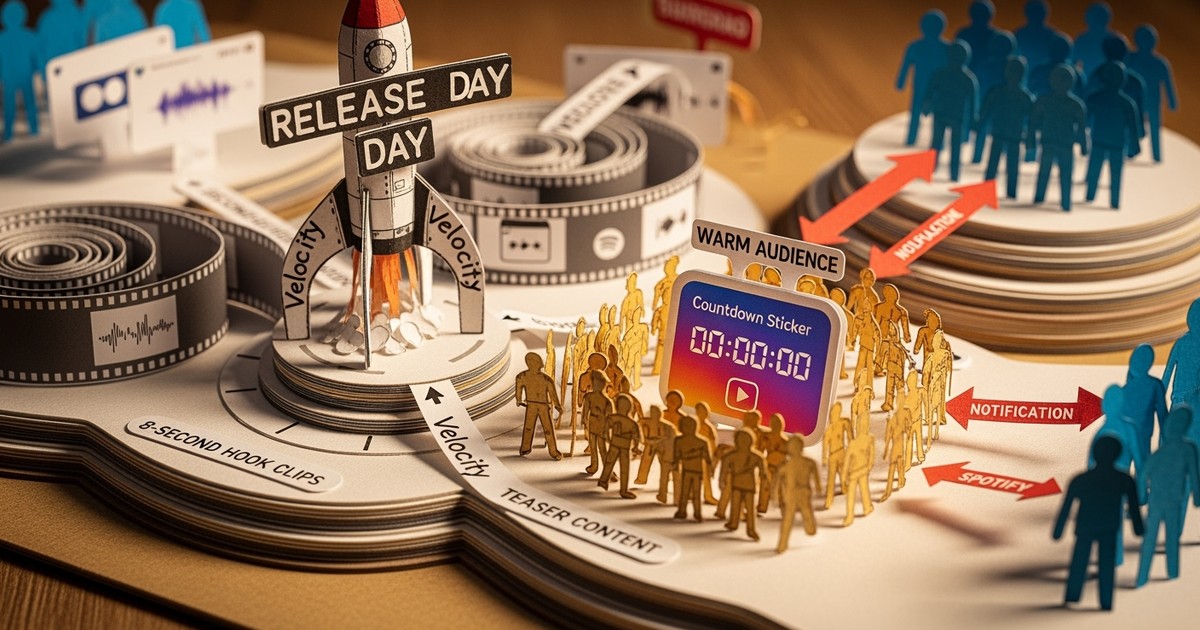
The weeks before release day are worth more than the weeks after. What you do on Instagram before the song drops determines whether release day is a spike or a plateau.
This guide covers the pre-release Instagram playbook that labels and serious artist teams use to stack pre-saves and prime the algorithm for day one.
Why Pre-Release Matters More Than You Think
Spotify's algorithm rewards velocity. A track that accumulates 500 saves and streams in the first 24 hours looks different to the system than one that trickles to the same number over two weeks.
Pre-saves do two things that matter:
Guaranteed first-day streams. When someone pre-saves, the track lands in their library automatically on release. They do not have to remember. Many will stream it within hours.
Follower signal. Pre-save flows on most platforms also trigger a follow. Followers see future releases in Release Radar without you spending again to reach them.
The Instagram pre-release window is your chance to manufacture that day-one velocity instead of hoping for it.
The Pre-Release Timeline
Most campaigns need 2 to 4 weeks of pre-release runway. Shorter than that leaves no time for audience warming. Longer than that risks fatigue.
Note Submit your release to your distributor at least 7 days before the street date. Spotify requires this lead time for editorial playlist consideration, and you need the pre-save link before you can run any conversion-focused ads.
Here is a typical timeline for a single:
| Phase | Timing | Instagram focus |
|---|---|---|
| Announce | 3-4 weeks out | Reveal artwork, title, date. First teaser clip. |
| Warm | 2-3 weeks out | Behind-the-scenes, snippet variations, countdown begins. |
| Push | Final week | Daily Stories, reminder Reels, pre-save CTA in everything. |
| Release day | Day 0 | Shift to "out now" messaging, stream links replace pre-save. |
The exact dates shift based on your release calendar and how much organic reach you have. Smaller audiences benefit from a tighter window so energy stays concentrated.
Teaser Content That Works
Teasers have one job: create incomplete loops that the full song resolves. If the teaser gives away the payoff, there is no tension left.
Three teaser formats that consistently perform:
The 8-second hook clip. Show the catchiest moment of the song, cut right before it lands. Pair with on-screen text that hints at the theme without spelling it out. This works as a Reel or a Story.
The silent reveal. Post the artwork or a visual moment with no audio. Caption announces the date. The absence of music creates curiosity, especially if the visual is strong enough to stop the scroll.
The context clip. Film 15 seconds explaining what the song is about, where it came from, or who it is for. No music plays. The CTA is "pre-save to hear it first." This works well for artists whose audience cares about the story.
Tip Resist the urge to drop the full chorus early. Major artists can get away with it because their fanbase will stream repeatedly regardless. For developing artists, premature teasing means potential fans hear the hook, feel satisfied, and forget to come back when the full track drops.
Using the Countdown Sticker
Instagram's countdown sticker is one of the few native features designed for release marketing. When a follower taps "Remind Me," Instagram sends them a push notification the moment the countdown hits zero.
How to use it effectively:
Place the countdown in Stories, not just once but repeatedly across the pre-release window. Each Story that features the countdown is another chance for someone to opt in.
Pair the countdown with content, not as a standalone element. A countdown sticker on a blank background looks lazy. A countdown on top of a teaser clip or artwork shot signals that something worth waiting for is coming.
Encourage shares. When followers add your countdown to their own Stories, their audience sees it. This is free distribution, but it only happens if the teaser content is worth resharing.
The countdown converts best in the final 48 hours. Stack Stories and Reels during this window. Remind people that the wait is almost over.
Coordinating Organic and Paid
Organic content warms. Paid content scales.
The mistake many teams make is running cold ads too early. If you push pre-save ads to people who have never heard the artist, conversion rates crater and cost-per-save climbs.
A better sequence:
Warm with organic Reels Post teaser content organically 2-3 weeks out. Let the algorithm find your natural audience. Track which clips get the best retention.
Build retargeting pools Anyone who watches 50% or more of a teaser Reel is a warm lead. Create a custom audience from video viewers.
Launch paid pre-save ads to warm audiences Start ads 7-10 days before release. Target the video viewer audience and lookalikes. Use the teaser clip that performed best organically.
Expand to cold in the final days If warm audiences are converting well, scale to broader interest-based targeting in the last 5 days. The social proof from earlier saves helps cold audiences trust the CTA.
This sequence keeps cost-per-save low and ensures the algorithm learns from high-intent users first.
Pre-Save Landing Page Setup
Your ad sends traffic to a landing page. That page has one job: get the save.
Key requirements:
- One button, one action. Do not offer Spotify, Apple Music, YouTube Music, and Deezer as equal options. Lead with the platform that matters most to your strategy, usually Spotify.
- Fast load time. Every second of delay costs conversions. Test on mobile over cellular, not just desktop on Wi-Fi.
- Server-side tracking. Browser pixels miss conversions. Use Conversions API to fire a confirmed save event back to Meta so the algorithm optimizes correctly.
Tools like FeatureFM, Hypeddit, or Dynamoi's built-in pre-save pages handle most of this out of the box. The choice matters less than the structure: one CTA, fast load, confirmed event.
For more on landing page options, see the landing page comparison guide.
Budget Allocation for Pre-Release
Pre-release is not the time for massive spend. You are buying intent, not scale.
A reasonable pre-release budget for an indie single or label priority track:
| Phase | Daily budget | Goal |
|---|---|---|
| Warm-up (organic only) | $0 | Identify best-performing teaser content |
| Pre-save ads (warm audiences) | $20-50/day | Accumulate saves from engaged viewers |
| Pre-save ads (cold expansion) | $30-75/day | Scale if warm is efficient |
| Release day shift | Full budget | Pivot to stream/save messaging |
The exact numbers depend on your total campaign budget. The principle is to spend less during pre-release and more once the song is live and streamable.
Warning Do not exhaust your budget before the song drops. Release day and the first week are when the algorithm is most receptive to velocity signals. Reserve at least 60% of your total campaign budget for post-release.
What to Avoid
Posting the same teaser too many times. Followers notice repetition. Vary the format: clip, static, behind-the-scenes, countdown, reaction.
Launching ads without a pixel firing correctly. Test your landing page tracking before you spend. A week of ads with no confirmed conversions teaches Meta nothing useful.
Ignoring Stories. Reels are for discovery. Stories are for depth with existing followers. Use both.
Treating pre-release as optional. If you skip the warm-up phase and launch ads cold on release day, you are competing at a disadvantage. The teams that stack pre-saves are the ones whose tracks surface algorithmically.
Measuring Pre-Release Success
Track these metrics during the pre-release window:
- Pre-save count: The headline number. Compare to previous releases.
- Cost per pre-save: If you are paying more than $1-2 per save, creative or targeting needs work.
- Teaser retention rate: Which clips hold attention longest? These are your ad winners.
- Countdown reminder opt-ins: A proxy for how much anticipation you have built.
On release day, compare actual first-24-hour streams to pre-save count. A healthy ratio is 0.5 to 1.5 streams per pre-save. Lower than that suggests the pre-save audience was not genuinely interested. Higher suggests strong organic discovery on top of your campaign.
What Happens Next
Release day is not the finish line. It is the handoff.
The pre-release work primes the pump. Release day and the first week are when you scale spend, shift messaging to "out now," and let the algorithm amplify what you built.
For the full funnel from Instagram discovery to DSP saves and streams, see the Instagram ads funnel guide.