
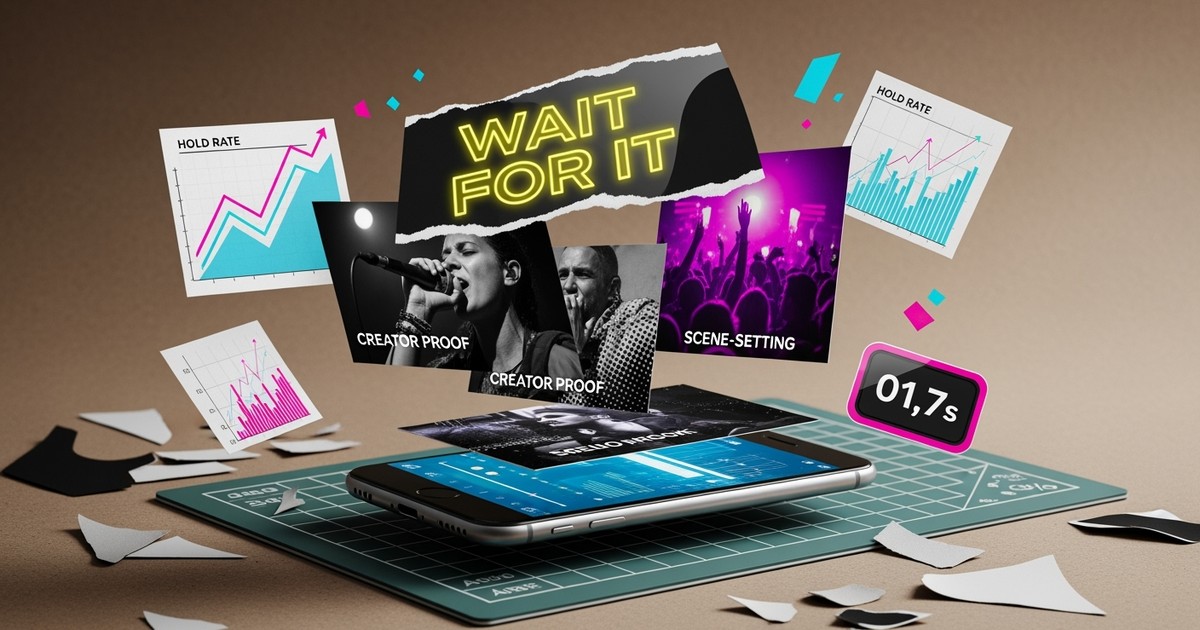
Every music ad competes with the same opponent: the next piece of content in the feed. The hook is how you win that fight.
Scroll speed on mobile has increased over 40% since 2020. Research shows users spend about 1.7 seconds on a piece of content before deciding to engage or keep moving. For Reels ads, that window is even smaller because the viewer did not choose to be there.
The hook is not the song. The hook is the visual and contextual frame that earns the right to play the song.
The 2-Second Rule
Every Reels ad for music must answer one question in under 2 seconds: why should this stranger stop scrolling?
The answer cannot be "because the song is good." The viewer does not know that yet. The answer has to be visible before the audio registers.
Three things work in that window:
A face doing something. Human faces stop scrolls. A close-up reaction, an artist mid-performance, a creator about to speak. The brain processes faces faster than text or abstract visuals.
Text that reads like a message. On-screen lyrics, a provocative statement, a question. The viewer reads before they listen, and if the text resonates, they stay.
A visual that implies a world. A striking scene, an aesthetic that signals genre, a moment frozen before impact. The viewer infers the story and wants to see it unfold.
If your hook requires the viewer to wait 3 seconds to understand what they are watching, you have already lost most of the audience.
The 6 Hook Structures That Work for Music
These structures are not theories. They are patterns that show up repeatedly in high-performing music Reels ads across genres.
1. Lyric-First Hook
Open on the most quotable line as on-screen text. The lyric appears before the audio plays.
How it works: The viewer reads the line, feels something, then hears it confirmed by the track. The text primes the emotional response.
Best for: Pop, hip-hop, R&B, any genre where lyrics carry the hook. Works especially well for songs with a single undeniable line.
Example structure:
- Frame 1 (0-1s): Black screen or minimal visual with lyric text centered
- Frame 2 (1-3s): Cut to artist or performance as the line plays
- Frame 3 (3-8s): Continue into chorus or let the moment breathe
Tip Test the same song with three different lyric lines as the opening text. The line that feels most like a text message someone would send usually wins.
2. Creator Proof Hook
Open on a creator reacting to or using the song, then cut to the original content.
How it works: The creator's endorsement does the heavy lifting. If a viewer trusts the creator, they trust the recommendation. The song arrives pre-validated.
Best for: Any genre, but especially effective for emerging artists without name recognition. The creator's audience substitutes for the artist's.
Example structure:
- Frame 1 (0-2s): Creator reacting ("This song is insane" or just a look of recognition)
- Frame 2 (2-5s): Cut to the song's hook with the artist or music video footage
- Frame 3 (5-10s): Return to creator or stay on the content
This is the structure behind partnership ads and Spark-style campaigns. You are borrowing credibility.
3. Scene-Setting Hook
Open on a visual that implies the song's world before any audio context.
How it works: The visual creates curiosity. The viewer sees a moment, a place, an energy, then the song fills in the meaning. The visual earns the pause; the audio earns the watch.
Best for: Genres with strong visual identity. Latin pop, country, indie, electronic. Any song where the aesthetic is part of the product.
Example structure:
- Frame 1 (0-2s): A striking visual, ideally mid-action. Dancer mid-spin, car on an empty highway, crowd at a show
- Frame 2 (2-4s): Audio drops as the visual continues
- Frame 3 (4-10s): Let the scene play out, cut to chorus if needed
The scene does not need to explain the song. It needs to imply a feeling the viewer wants to experience.
4. Question Hook
Open with a text question that the song answers.
How it works: Questions create open loops. The viewer's brain wants resolution. If the question is relevant to them, they stay to hear the answer.
Best for: Songs with a clear emotional through-line. Works for sad songs, hype songs, nostalgic tracks, anything with a strong feeling.
Example questions:
- "Ever feel like nobody gets it?"
- "What song matches your main character moment?"
- "When you need to remember who you are"
Example structure:
- Frame 1 (0-1.5s): Question as on-screen text, minimal visual
- Frame 2 (1.5-4s): Cut to song hook with performance or visual context
- Frame 3 (4-10s): Continue the moment
Warning Avoid questions that are too broad. "Looking for new music?" does not work because everyone scrolls past it. The question needs to select for the right listener.
5. Tension Hook
Open on a moment of anticipation, then release it with the drop or chorus.
How it works: The viewer sees something about to happen. A beat about to hit, a reaction about to land, a scene about to shift. The tension holds attention; the payoff rewards it.
Best for: Tracks with a strong drop, beat switch, or dynamic shift. EDM, hip-hop, pop, any song where the chorus hits different from the verse.
Example structure:
- Frame 1 (0-2s): Setup, slow motion, silence or low audio, visual anticipation
- Frame 2 (2-4s): The drop, the chorus, the moment
- Frame 3 (4-10s): Ride the energy
This is the music video trailer structure. It works because the viewer's pattern-recognition brain anticipates the payoff and wants to confirm it.
6. Contrast Hook
Open by showing what life is without the song, then cut to what it becomes with it.
How it works: The before/after structure is one of the oldest advertising patterns because it works. The viewer sees the gap, then sees it filled.
Best for: Hype songs, workout tracks, confidence anthems. Any song that promises a transformation in mood or energy.
Example structure:
- Frame 1 (0-2s): "Before" state, muted colors, slow motion, silence
- Frame 2 (2-4s): Audio hits, colors saturate, energy shifts
- Frame 3 (4-10s): Continue the "after" state
The contrast can be subtle. A look that goes from tired to alive. A room that goes from quiet to moving. The shift is what hooks.
Hook Performance by Genre
Different genres have different hook affinities. These patterns are not rules, but they are reliable starting points.
| Genre | Primary hook | Secondary hook | Why it works |
|---|---|---|---|
| Hip-hop | Lyric-first | Creator proof | Bars sell. Quotable lines spread. |
| Pop | Scene-setting | Lyric-first | Visual identity and singable hooks |
| Country | Scene-setting | Question | Storytelling and emotional resonance |
| Latin | Scene-setting | Tension | Visual culture and rhythm drops |
| R&B | Lyric-first | Question | Emotional vulnerability in the writing |
| EDM / Electronic | Tension | Contrast | The drop is the product |
| Indie / Alternative | Scene-setting | Creator proof | Aesthetic discovery, tastemaker validation |
| Rock | Tension | Contrast | Energy contrast, dynamic range |
These are starting points for testing, not formulas. A hip-hop track with a strong visual story might win with scene-setting. An indie song with a killer lyric might win with lyric-first.
How to Test Hooks
Hook testing is the highest-impact creative work you can do on Instagram ads. The same song with three different hooks can produce 3x differences in CPM and ThruPlay rate.
Cut 3 to 5 hook variations from the same source material Use the same chorus, the same footage, the same song section. Change only the first 2 to 3 seconds.
Run each variation at $10 to $20 per day for 3 to 4 days Keep targeting identical. You are isolating the hook, not the audience.
Compare hook rate and hold rate Hook rate: 3-second views divided by impressions. Target 25 to 30%. Hold rate: 15-second views or ThruPlays divided by impressions. Target 15 to 20%.
Kill the losers, scale the winner Once a hook clears benchmarks consistently, move it into your main campaign and increase spend.
The most common mistake is testing one hook and concluding the song does not work. The song might be fine. The hook might be wrong.
What the Metrics Tell You
High hook rate, low hold rate: The opening works, but the rest of the ad loses people. The problem is the middle, not the hook.
Low hook rate, high hold rate (among those who stay): The opening is too weak, but the song resonates with those who make it past. The hook is the problem.
Low hook rate, low hold rate: The creative is not connecting. Test a different angle or structure, not just a different opening frame.
High hook rate, high hold rate: Winner. Scale it and start testing the next batch before this one fatigues.
Common Hook Mistakes
Starting with the song title or artist name. Cold audiences do not care who you are. They care whether the content is worth their next 10 seconds.
Using the intro of the song as the audio hook. Song intros are often slow builds. Reels hooks need immediate energy. Cut to the chorus or the most recognizable moment.
Cramming too much into the first frame. One idea. One visual. One line of text. Clarity beats density.
Forgetting safe zones. Instagram overlays UI on the top and bottom of Reels. If your lyric text lands in those zones, viewers cannot read it.
Testing only one hook per song. This is the most expensive mistake. If you test one hook and it fails, you learn nothing about the song. If you test five hooks and they all fail, you learn the song has a problem.
The hook is not decoration. It is the first unit of the transaction. You are asking the viewer to trade their attention for something they do not know is worth it yet. The hook is your proof of value.
Get it right, and the rest of the ad does its job. Get it wrong, and it does not matter how good the song is.