
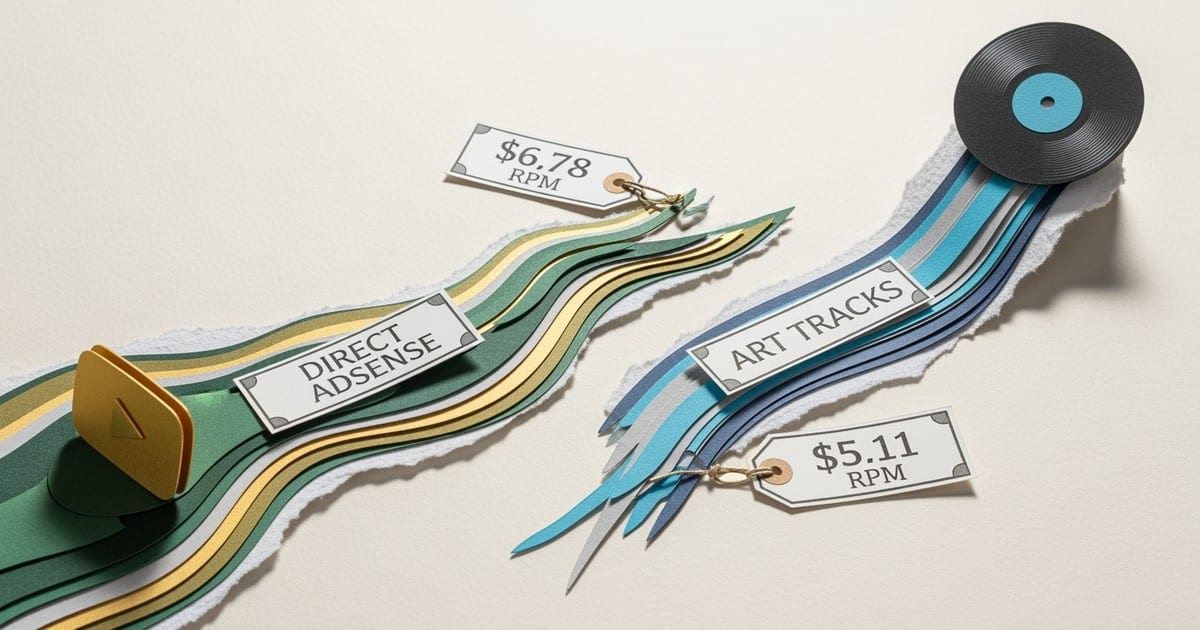
The two revenue paths explained
Path 1: AdSense monetization (direct upload)
You upload a video to your own YouTube channel. If you meet the YouTube Partner Program (YPP) requirements, ads run on your video and you receive 55% of the ad revenue directly through AdSense (see YouTube Help: YouTube Partner Program overview).
Requirements:
- 1,000 subscribers
- 4,000 valid public watch hours in the last 12 months (or 10 million Shorts views)
- No active Community Guidelines strikes
- Linked AdSense account
- Compliance with YouTube monetization policies
What you control: Everything. Thumbnail, title, description, ad placement, content format, upload timing.
Path 2: Distributor royalties (Art Tracks)
You deliver your music through a distributor (DistroKid, TuneCore, CD Baby, etc.). YouTube auto-generates an "Art Track" - a static image with your album artwork playing your audio. Revenue flows through your distributor's agreement with YouTube, minus the distributor's cut (see CD Baby DIY Musician: YouTube Monetization for Musicians).
Requirements:
- Active distribution agreement
- Music delivered to YouTube Music
- Proper metadata (ISRC, UPC, artist name match)
What you control: The audio. That is it. YouTube generates the visual, title format, and description automatically.
RPM comparison: Dynamoi first-party data
Based on Dynamoi's first-party streaming data:
| Revenue Source | Service Type | Average RPM | Median RPM |
|---|---|---|---|
| YouTube Art Tracks & Music Videos | Partner-provided (your uploads) | $6.78 | $5.85 |
| YouTube Art Tracks & Music Videos | UGC (fan uploads using your music) | $4.80 | $3.66 |
| YouTube Content ID | Partner-provided | $3.67 | $1.70 |
| YouTube Content ID | UGC | $1.70 | $0.52 |
Note Partner-provided content you directly upload or control pays significantly more than UGC or Content ID claims. The median Content ID RPM on UGC is just $0.52 - roughly 10x less than direct uploads.
Breaking down by subscription tier
The gap widens when you segment by viewer type:
| Revenue Source | Tier | Average RPM | Median RPM |
|---|---|---|---|
| Art Tracks & Music Videos | Paid (YouTube Premium) | $6.27 | $5.47 |
| Art Tracks & Music Videos | Ad-supported (free) | $1.87 | $1.92 |
| Content ID | Ad-supported | $3.57 | $1.37 |
| Content ID | UGC | $0.05 | $0.02 |
YouTube Premium viewers generate 3-4x more revenue per view than ad-supported viewers. This is why optimizing for session time and playlist engagement - behaviors correlated with Premium subscriptions - outperforms chasing raw view counts.
When to use each path
The choice is not binary. Most artists should use both paths strategically.
Use AdSense (direct upload)
Best for: - Official music videos with high production value - Visualizers and lyric videos you want to control - Behind-the-scenes content and artist commentary - Any video over 8 minutes (mid-roll ad opportunity) - Content targeting Tier 1 geographies
**The math:** A music video uploaded to your monetized channel at $6.78 RPM generates $678 per 100,000 views. The same audio as an Art Track at $5.11 RPM generates $511. The $167 difference compounds across your catalog.
Use distributor (Art Tracks)
Best for: - Passive catalog monetization across all releases - Artists who have not reached YPP thresholds - International reach through YouTube Music app - Tracks where you lack video content - Ensuring your music is claimable via Content ID
**The math:** An Art Track requires zero additional effort once your music is distributed. If you lack the bandwidth to create videos for every release, Art Tracks ensure you are not leaving the entire YouTube platform untapped.
The hybrid strategy
Sophisticated labels and artist teams run both paths simultaneously:
For priority releases: Upload an official music video or visualizer directly to your monetized channel. Maximize RPM through direct AdSense.
For catalog depth: Let your distributor create Art Tracks for every release. Capture long-tail streams from YouTube Music and search traffic.
For Content ID: Ensure your distributor has Content ID enabled. Claim revenue from fan edits, reaction videos, and compilations using your music. Even at $1.70 RPM, this is revenue you would otherwise forfeit.
The key insight: these paths are not mutually exclusive. Your official video and your Art Track can coexist. YouTube treats them as separate assets. You can monetize both.
Warning If you upload the same audio as both an official video and an Art Track, Content ID may flag your own upload as a match. Work with your distributor to whitelist your channel or exclude specific videos from Content ID claims.
Revenue timing and reporting
The paths also differ in how quickly you get paid and how revenue is reported:
| Factor | AdSense (direct) | Distributor royalties |
|---|---|---|
| Payment delay | 30 days after month end | 60-90 days (varies by distributor) |
| Reporting granularity | Video-level, daily updates | Track-level, monthly statements |
| Minimum payout | $100 | Varies ($10-$50 typical) |
| Tax handling | Direct W-9/W-8BEN | Through distributor |
| Revenue visibility | Real-time in YouTube Studio | Delayed in distributor dashboard |
For cash flow planning, AdSense pays faster. For simplicity, distributor royalties consolidate with your other streaming income.
Control vs. convenience tradeoff
The revenue gap is only part of the equation. Consider what you give up with each path:
AdSense advantages
- Full creative control over presentation
- Real-time performance data
- Direct relationship with YouTube (appeals, disputes)
- Ability to optimize titles, thumbnails, descriptions
- Mid-roll ad placement on longer videos
- Community tab and subscriber engagement tools
Distributor advantages
- Zero video production required
- Automatic Content ID protection
- Integration with YouTube Music app
- Consolidated royalty reporting across platforms
- No YPP threshold to meet
- Metadata synced with Spotify, Apple Music, etc.
The bottom line
Direct AdSense monetization pays more per view - roughly 30-40% more for partner-provided content based on Dynamoi data. But it requires meeting YPP thresholds, creating video content, and managing another platform relationship.
For most artists, the optimal strategy is:
- Distribute through your aggregator to ensure Art Tracks exist and Content ID is active
- Upload official videos directly to your monetized channel for priority releases
- Track both revenue streams separately to understand your true YouTube economics
The artists who maximize YouTube revenue are not choosing one path. They are running both in parallel, allocating video production effort to releases where the incremental RPM justifies the investment.