

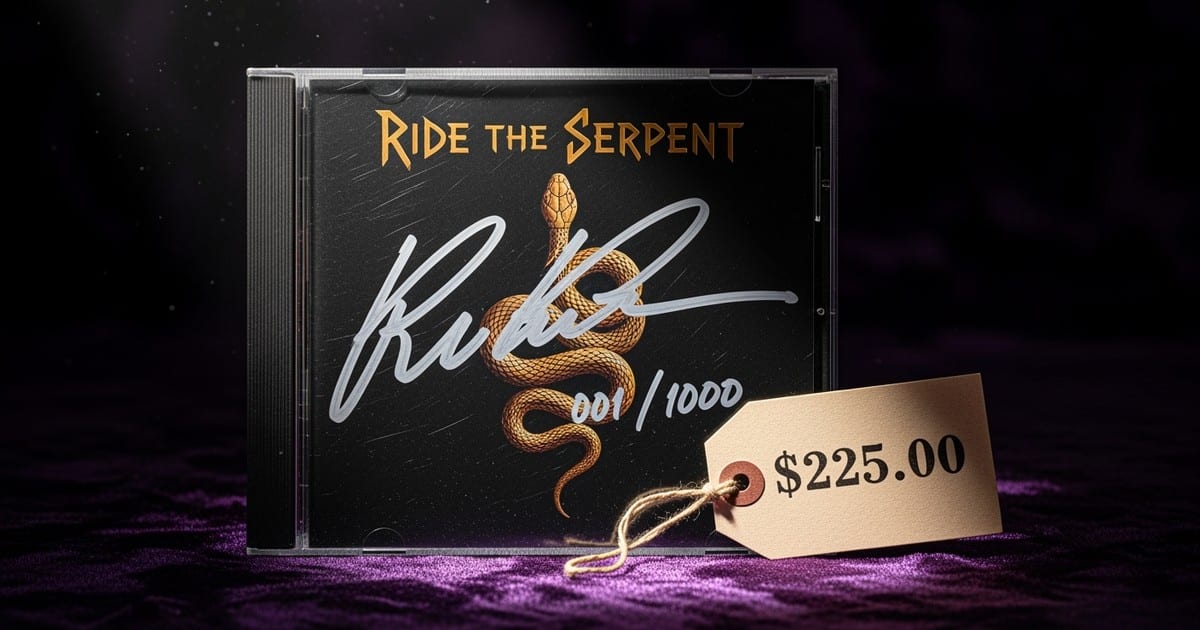
Former Kiss guitarist Vinnie Vincent made a splash Monday with a pricing strategy that looks like a typo but functions like a masterclass in unit economics. His new CD single, "Ride The Serpent," carries a retail price of $225.
While easy to dismiss as a legacy artist's eccentricity, the move highlights a growing sophistication in how independent acts value their work against the "Mad Max wasteland" of the streaming era.
The $225,000 payout
Vincent is releasing strictly 1,000 copies of the single. Each unit is signed, numbered, and positioned not as a consumer good, but as an investable asset.
If the run sells out, the project grosses $225,000. Because this is a direct-to-consumer (D2C) play, Vincent bypasses the traditional distribution tollbooths, retaining the vast majority of that revenue outside of manufacturing and shipping.
The streaming gap
The genius of this pricing lies in the comparative math. For an artist to generate $225,000 via streaming—assuming a generous $0.004 per stream—they would need approximately 56.25 million streams.
Key insight: Achieving 56 million streams is a statistical impossibility for most legacy or indie acts, yet converting 1,000 superfans at a high price point is a tangible, manageable goal.
This stark contrast exposes the inefficiency of the volume-based model for artists with deep but finite fanbases.
Caviar vs. commodities
Vincent explicitly framed the strategy as a rejection of the industry’s race to the bottom. He dismisses the standard $18.99 price point as an artifact of a broken system where artists are forced to "panders for likes."
"Not everyone can afford it. That simple," Vincent noted regarding the launch. He compares the release to "fine art or caviar," signaling that music should reclaim its status as a luxury good rather than a utility.
By positioning the CD as a scarce collectible, he shifts the buyer's psychology. The purchase isn't just about listening; it's about owning a piece of the artist's history.
Monetizing the top 1%
Labels and managers often underestimate the price elasticity of a "whale" fan. While the $225 price point is extreme, the principle is sound: segmenting the audience is critical for 2026.
The opportunity: Most D2C strategies flatten the audience, offering the same vinyl variant to the casual listener and the die-hard evangelist. The fix: Create inventory tiers. Let the casual fans stream for free, but give the top 1% an inventory item that matches their willingness to pay.
How to pivot
Music marketers should view Vincent's "Ride The Serpent" campaign as a signal to rethink physical goods.
- Verify scarcity: Numbered editions create immediate urgency that open-ended pre-orders cannot match.
- Signatures matter: A hand-signed element transforms a product into a souvenir.
- Own the data: High-ticket items must be sold D2C to capture customer emails and
LTVdata for future campaigns.
Vincent’s approach is aggressive, but in an ecosystem where streaming royalties often fail to cover recording costs, extreme premiumization offers a viable exit ramp.