

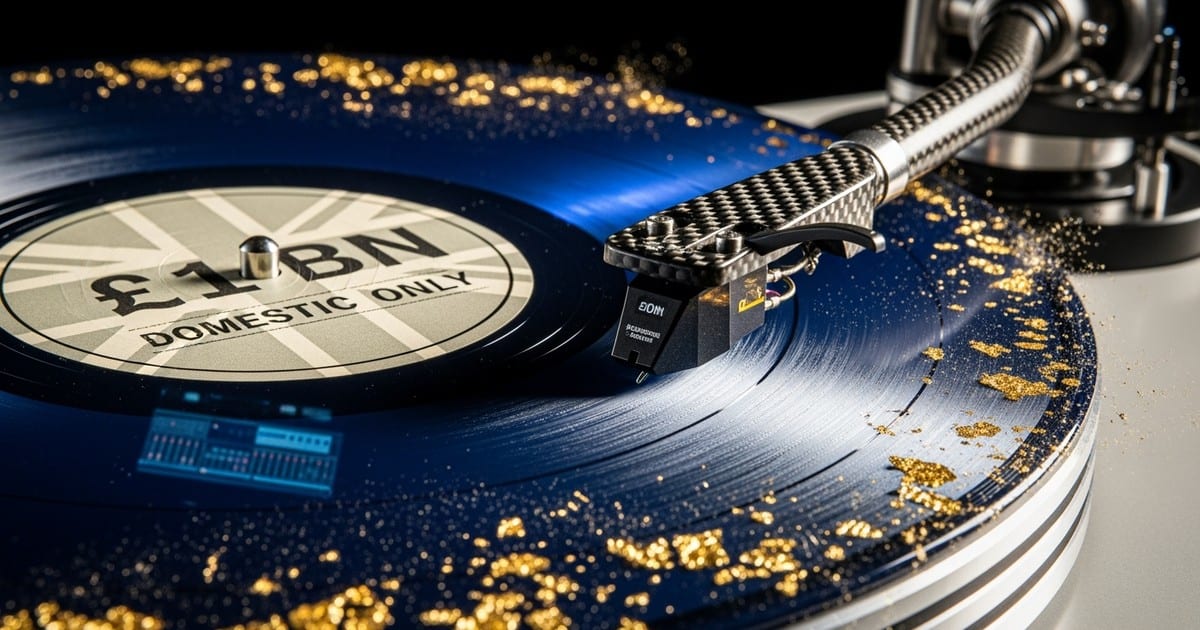
The UK recorded music market has delivered its 11th consecutive year of growth, but the champagne corks should be popped with caution. While the British Phonographic Industry (BPI) year-end figures for 2025 show a resilient sector hitting historic revenue milestones, the data reveals a stark divergence between domestic health and waning global influence.
Total recorded music consumption rose by 4.9% in 2025, reaching 210.3 million album equivalent units. The headline victory is clear: annual streaming revenue has officially surpassed the £1 billion barrier for the first time. Yet, for strategists and label executives, the devil is in the deceleration.
The saturation signal
The engine of the modern industry is slowing down. While streaming remains dominant—accounting for 89.3% of consumption—the growth rate of audio streams has cooled to 5.5%, a significant drop from the 8.4% growth seen previously.
This suggests the UK has reached "peak streaming" saturation. The era of rapid user acquisition is effectively over. Future revenue expansion will no longer come from new subscribers entering the funnel, but from increasing ARPU (Average Revenue Per User) through price hikes and better monetization of superfans.
Vinyl's liquidity role
Contrary to the digital-first narrative, physical formats are driving the industry’s most valuable growth margins. Vinyl sales surged 13.3% to 7.6 million units, marking the format's 18th consecutive year of growth.
The takeaway: Vinyl is outpacing streaming growth by nearly double. It has evolved from a niche collectible to a primary revenue driver for major releases.
Key insight: The disparity between vinyl growth (+13.3%) and streaming growth (+5.5%) proves that high-value physical products are now more critical for year-over-year revenue gains than passive consumption.
Taylor Swift’s The Life of a Showgirl exemplifies this shift. Moving 147,000 vinyl units in 2025 alone, Swift achieved the highest annual vinyl sales for any artist since records began in the 90s. While CDs continued their slow decline (-7.6%), the overall physical sector remains a vital liquidity provider for labels facing streaming stagnation.
The nostalgia gap
The 2025 data exposes a market bifurcated between massive legacy events and developing domestic talent. The Oasis reunion was a commercial juggernaut, driving over one million catalog album sales in a single year. Their tour announcement created a halo effect that monetized passive listeners and collectors alike.
However, the industry cannot survive on nostalgia alone. 2025 did provide a glimmer of hope for new repertoire. Olivia Dean achieved a historic "Chart Double," securing a debut Number One single and album simultaneously. Along with Lola Young’s success, this proves the domestic pipeline is functional, even if it lacks the volume of the Oasis machine.
A global export crisis
The most alarming signal in the BPI report is the collapse in international competitiveness. While export revenue hit a record £794.2 million, the growth rate plummeted to a meager 1.9%, down from 7.6% the prior year.
Even more concerning is the cultural footprint: for the first time in recent history, no British artists ranked in the global top 20 most-streamed acts. The UK’s global market share has slipped to roughly 8-9%. This decline is attributed to the ferocious rise of local repertoire in Latin America and the K-Pop machine, which are crowding out English-language exports.
What labels must watch
The path forward for 2026 requires a defensive pivot. The "easy growth" era of streaming is finished.
- Maximize the Superfan: With
LTVbecoming the primary metric, physical strategy is no longer secondary. Deluxe vinyl is essential for hitting revenue targets. - The Catalog Double-Dip: Managers must sync catalog marketing strictly with live touring news, as evidenced by the Oasis numbers.
- Defend Home Turf: With exports stalling, the domestic market is the safety net. Labels must double down on breaking acts like Olivia Dean locally before attempting expensive, high-risk global campaigns.