

It is officially the end of the line for the cat with headphones. As of January 6, 2026, Napster has abruptly terminated its consumer streaming service, greeting users with a final splash screen rather than their morning playlists.
Following its March 2025 acquisition by Infinite Reality (iR) for $207 million, the company has executed a hard pivot away from the "Red Ocean" of music subscriptions to reinvent itself as an enterprise AI vendor.
This isn't just another platform sunset; it is a capitulation of the mid-tier streaming model and a high-stakes bet on physical AI infrastructure.
A hard stop for streaming
Unlike typical service wind-downs that offer months of runway, this shutdown was immediate. Reports from January 5 confirm that streams began cutting out mid-song, replaced by a static notification urging users to export their data to competitors like Spotify, Apple Music, or TIDAL via TuneMyMusic.
Napster’s leadership, including CTO Edo Segal, has been candid about the economics. They view the DSP market as a saturated trap where mechanical and performance royalties devour margins. By exiting the B2C space, Napster instantly sheds massive overhead to focus on high-margin technology licensing.
Betting on "embodied AI"
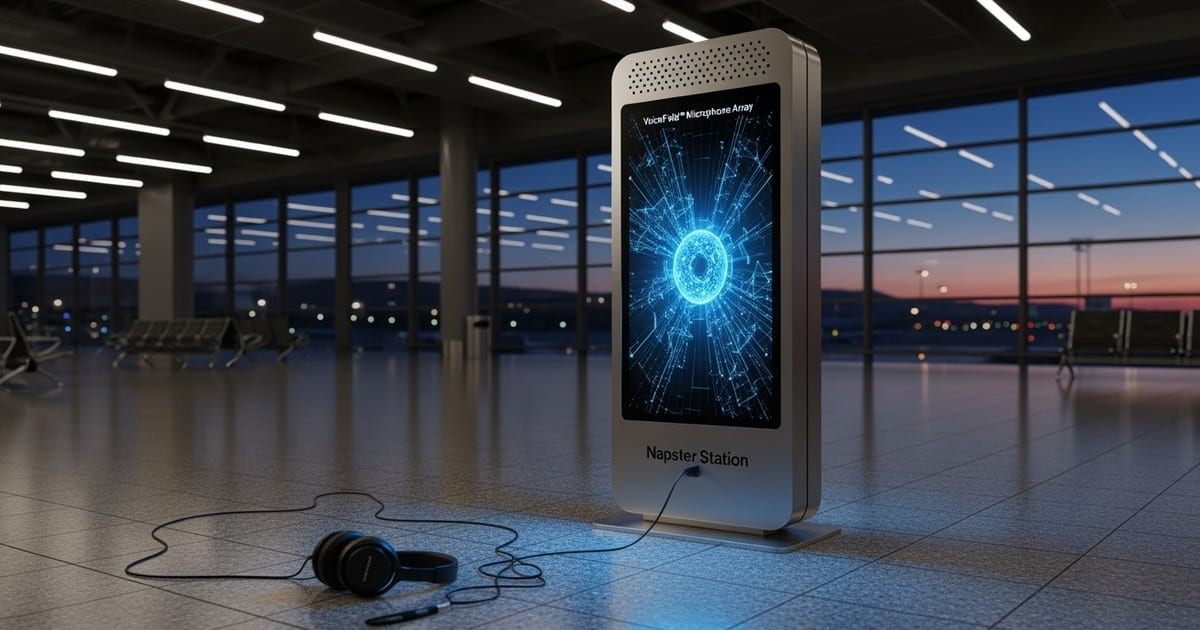
The new Napster isn't about listening; it's about enterprise service. The company's new flagship product, Napster Station, is an AI concierge kiosk powered by Microsoft Azure OpenAI.
Showcased at CES 2026, this hardware moves the brand entirely into the B2B sector (hospitality, retail, airports).
The pivot logic:
- The Product: A "floor-deployable" kiosk with a
VoiceField™ Microphone Arraydesigned to isolate speech in noisy environments. - The Pitch: 24/7 specialist assistance for approximately $1/hour, significantly undercutting human labor costs.
- The Goal: Trade low-margin music subscribers for high-value enterprise software contracts.
The $207M math problem
To understand the abruptness of this shift, you have to follow the money. Infinite Reality acquired Napster when iR was valued at $12.25 billion, but the parent company has faced significant headwinds.
In late 2025, a promised $3 billion cash infusion reportedly "evaporated," leaving CEO John Acunto to navigate a liquidity crunch. Cutting the capital-intensive streaming service preserves cash, allowing the company to pivot toward the investor-friendly "Agentic AI" narrative just as financial pressure mounts.
Unfinished licensing business
While the servers are off, the ledger remains open. The music industry is notoriously unforgiving regarding exit strategies that leave debts unpaid.
Key insight: A corporate pivot does not erase liability. Napster still faces potential legal action from Sony Music and SoundExchange regarding outstanding royalty claims.
Rights holders should be particularly vigilant about how Napster utilizes its legacy data. CTO Segal has compared this moment to the original P2P disruption, noting that "AI is basically making all of us creators." If the company uses its former licensed catalog to train its new generative "Digital Personas" without new agreements, we could see a copyright battle that rivals the current wave of LLM litigation.
Signals for the middle class
Napster’s exit is a bleak signal for the remaining mid-tier DSPs. The unit economics of streaming simply do not work without the massive scale of a Spotify or the ecosystem subsidies of an Apple or Amazon.
Three strategic takeaways:
- Consolidation is inevitable: Services like Deezer and TIDAL face increased pressure to differentiate or exit as the "middle class" of streaming evaporates.
- Brand zombie-fication: Legacy music brands are increasingly valuable only as "skins" for unrelated tech plays—in this case, slapping a music logo on an airport information kiosk.
- B2B is the lifeboat: Distressed music tech assets will likely continue pivoting toward enterprise solutions where margins are healthier and royalty payments are non-existent.