
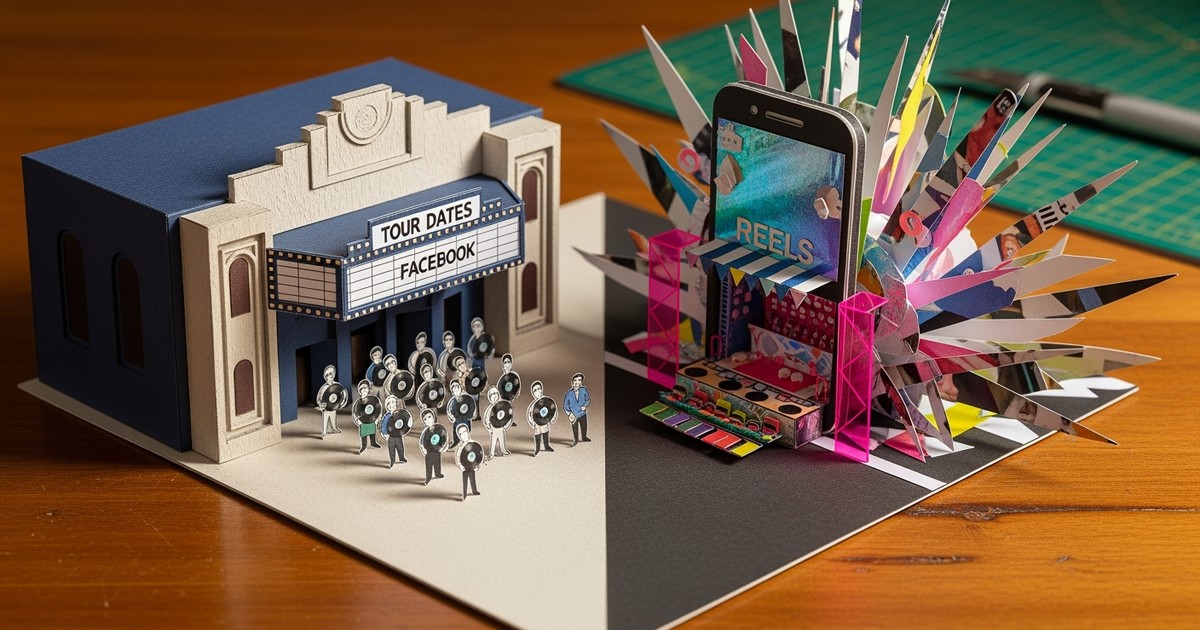
The short answer: Facebook is worth it for specific use cases, but it is no longer where music discovery happens.
Instagram handles cold discovery. Facebook handles warm conversion and audiences that do not live on Reels. Running both through Meta Ads Manager lets you use each platform for what it does best.
Where Facebook Still Wins
Facebook remains the stronger platform in three scenarios.
Event and tour promotion
Facebook Events is still the best native format for live shows. When someone RSVPs, their network sees it. That social proof compounds in ways Instagram cannot replicate.
A regional act promoting a club tour will often see better cost per RSVP on Facebook than on Instagram, especially when targeting 28+ audiences in specific metro areas.
Older demographics
Facebook's user base skews older than Instagram. About 38% of Facebook users are between 35 and 64, representing roughly a billion people worldwide. Among US users over 55, Facebook usage grew 16% from 2017 to 2021 while younger cohorts declined.
If your catalog appeals to classic rock, country, jazz, or any genre where the core fan is 35+, Facebook delivers reach that Instagram simply cannot match.
Retargeting and conversion
Facebook Feed is better suited for longer explanations, link sharing, and multi-step actions. If you are driving ticket sales, vinyl pre-orders, or crowdfunding campaigns, Facebook ads can carry more context than a 15-second Reel.
Retargeting campaigns also perform well on Facebook because the user behavior is slower and more deliberate. Someone scrolling Facebook Feed in the evening is in a different mindset than someone swiping Reels.
Where Instagram Wins
Instagram dominates cold discovery for music.
Reels are the top-of-funnel format for 2026. Meta's algorithm surfaces Reels to non-followers far more aggressively than it surfaces Facebook posts or even Facebook Reels. If you need to reach people who have never heard of you, Instagram is the platform.
Note Users aged 18-34 account for 68% of all Reels interactions. For artists targeting Gen Z or younger Millennials, Instagram is non-negotiable.
Instagram also provides a more cohesive profile experience. A viewer can discover your Reel, tap through to your profile, browse your feed, and tap through to Spotify or merch - all in one session. Facebook's profile structure is clunkier for that flow.
Demographic Breakdown
The audience split between platforms is stark.
| Age group | Facebook share | Instagram share | Best platform for music ads |
|---|---|---|---|
| 18-24 | 19% of US users | Primary platform | |
| 25-34 | 24% of US users | Strong presence | Both, lead with Instagram |
| 35-44 | Strong presence | Declining | Facebook or both |
| 45-54 | Growing segment | Minimal | |
| 55+ | 22% of US users | Minimal |
Gen Z is 89% on Instagram, 82% on TikTok, and mostly absent from Facebook. If your target is under 25, Facebook spend is wasted.
Ad Performance Differences
Both platforms run through the same Ads Manager, but they optimize differently.
Instagram Reels ads benefit from Meta's strongest discovery algorithm. The model is aggressive at finding new audiences for short-form video. Cost per ThruPlay tends to be lower on Reels than on Facebook Feed for music content.
Facebook ads perform better when you have conversion events. Lead forms, event responses, and link clicks all work well because Facebook users are more willing to complete multi-step actions.
Tip Run discovery campaigns on Instagram Reels. Run conversion campaigns across both platforms and let Advantage+ placements find the winners.
Average CPMs in 2026 ran around $6.59 across Meta, with Instagram placements trending toward $9.46 in premium inventory. Facebook Feed CPMs are often lower, but so is intent quality for music discovery.
When to Use Facebook in Your Campaign Structure
Facebook fits best as a secondary platform in a music campaign.
Use Facebook when:
You are promoting a live event and need RSVPs that spread through social networks.
Your target audience is 35+ and unlikely to discover you on Reels.
You are retargeting people who already engaged on Instagram and want to drive a conversion action.
You have a longer story to tell - crowdfunding, album pre-orders, documentary releases - that benefits from Facebook's format.
Skip Facebook when:
You are running cold discovery for a new single and your audience is under 35.
You have limited budget and need to concentrate spend on the highest-discovery platform.
Your creative is vertical, short-form, and built for Reels language. Forcing it into Facebook Feed will underperform.
Budget Split Recommendations
For most music campaigns in 2026, the split looks like this:
Discovery phase: 80-90% Instagram, 10-20% Facebook (or zero if audience is young)
Conversion phase: Let Advantage+ distribute based on performance, typically 50-70% Instagram and 30-50% Facebook
Event promotion: 50-70% Facebook, 30-50% Instagram
Warning Do not split budget evenly "just to test." That dilutes signal and slows learning. Pick a lead platform based on your audience, then expand once you have proof.
The 2026 Shift
Facebook made platform changes in late 2026 that matter for music marketers.
The new "Friends" tab bypasses algorithmic recommendations and shows posts from actual friends. This means organic reach is even weaker, but it also means paid placement is less cluttered.
Both platforms now encourage fan resharing. When fans reshare your post to their feeds, you can boost that shared content from your Page to amplify social proof. This works on both Facebook and Instagram, but the social graph effect is stronger on Facebook where friend networks are denser.
The Bottom Line
Facebook is not dead. It is specialized.
Use Instagram for discovery. Use Facebook for events, older demos, and conversion. Run both through Ads Manager and let the data tell you where to scale.
If you are a teen pop act, Facebook is probably a waste of budget. If you are a classic rock revival band or a jam band with a 40-something core audience, Facebook might outperform Instagram entirely.
The platform question is always secondary to the audience question. Know who you are trying to reach, then pick the platform where they actually spend time.