
Discovery and awareness metrics
Public research generally measures Instagram overall rather than Reels specifically, but Reels now accounts for a substantial share of Instagram usage. Meta claims over half of Instagram time is now spent on Reels.
US survey benchmarks
Edison Research's Infinite Dial 2024 provides the clearest comparison of platform usage for music discovery:
| Demographic | TikTok | |
|---|---|---|
| Music followers (12+) | 40% | 36% |
| Music followers (12-34) | 63% | 58% |
"Music followers" are defined as Americans who say keeping up with music is "very" or "somewhat" important to them.
Warning These figures measure "use this platform to find out about music," not downstream actions like streams, saves, or follows.
Short-form video discovery prevalence
When researchers group short-form video platforms together (TikTok, Reels, Shorts), discovery rates are high:
- Deloitte's 2024 Digital Media Trends: 82% of Gen Z and 70% of millennials discover new artists or music through social media or UGC video sites
- MusicWatch (via DAC Group): 68% of social media users discover new music through short-form video content
- Luminate midyear 2024: 76% of US music listeners have consumed short-form video on platforms including Meta Reels
These figures describe exposure and discovery, not streams generated.
The conversion measurement gap
For the metrics marketers most want, including views-to-streams ratios, save-to-library rates, and artist follow rates attributable to Reels, there is no consistent public benchmark from 2023-2025 that:
- Isolates Reels from broader Instagram surfaces
- Ties exposure to Spotify or Apple Music plays with an attributable ratio
Most available "conversion" evidence is either survey-based (self-reported discovery sources), success-case reporting (non-representative), or platform-commissioned studies designed to prove ad effectiveness rather than off-platform streaming lift.
Why this gap exists
Instagram's conversion infrastructure is newer than TikTok's. TikTok's "Add to Music App" feature launched in 2022 and has generated over 3 billion track saves according to platform disclosures. Instagram's equivalent, the Spotify "Add" button, launched in late 2024.
What you can measure
The most defensible mid-funnel KPI is saves-to-library via Spotify's integration rather than streams-per-view.
Spotify announced in November 2024 that users can tap a song in Instagram, go to the audio page, and hit an "Add" button to save it directly to their Spotify library. This creates a measurable bridge from Reels audio pages to streaming saves, though Meta has not disclosed adoption rates.
Why discovery may not equal streams
MIDiA Research's September 2025 analysis argues that viral exposure on social video does not reliably convert into streaming or fandom. One key friction: consumers report they sometimes do not stream because they feel they already hear the song "enough on social media."
This creates a structural challenge for Reels-to-streaming conversion:
- Short-form clips can feel "complete" to casual listeners
- The full track on Spotify competes with the looping clip they already enjoyed
- Without explicit save or follow actions, the discovery moment evaporates
Practical implication: even when Reels helps people discover a song, incremental streaming value can be limited unless campaigns create reasons to move listeners from "looping a clip" to "full-track listening" through narrative, artist context, calls-to-action, or repeated exposures.
Platform-specific features
Audio environment
Trade coverage of Meta guidance commonly cites that 80%+ of Reels are viewed with sound on. This contrasts with traditional feed content where sound-off viewing is common.
A Meta study reported by Marketing Week found Reels ads with both music and voiceover show a +15-point higher average positive response score than those without sound.
For music marketers, this supports investing in audio-forward creative designed specifically for Reels rather than repurposing silent assets.
Features without public adoption data
The following features exist but have no publicly disclosed usage rates:
- Save Audio button usage
- View Song / streaming link tap rates
- Shazam integration usage on Instagram
- Percentage of Reels using licensed music versus original audio
Given the lack of data, it is better to acknowledge these gaps than to backfill with anecdotal claims.
Comparison to TikTok
Discovery penetration
In US survey data, Instagram slightly leads TikTok as a "music updates/discovery input":
| Metric | TikTok | |
|---|---|---|
| Music followers 12+ | 40% | 36% |
| Music followers 12-34 | 63% | 58% |
This does not mean Reels drives more streams. It means more people report using Instagram to keep up with music.
Conversion infrastructure
TikTok has published significantly more "off-platform value" metrics:
- TikTok's 2024 Music Impact Report (February 2025, citing Luminate research): 84% of songs entering Billboard Global 200 in 2024 went viral on TikTok first
- TikTok's "Add to Music App" feature has generated over 3 billion track saves
Instagram has no equivalent published metric for track saves generated or streaming impact. The closest signal is Spotify's November 2024 "Add" button integration, but without published adoption volume.
Marketing benchmarks for paid Reels
What Meta emphasizes
Meta's advertising guidance stresses that Reels is an audio-on environment and that pairing music with voiceover improves ad response. The +15-point response score improvement for music + voiceover ads supports evidence-backed creative decisions.
What is not publicly available
The following benchmarks do not exist in public, music-specific cuts:
- Reels ad engagement rates for music campaigns specifically
- Cost per engagement benchmarks for music Reels ads
- Organic versus paid performance benchmarks for music Reels
- Streaming conversion rates from paid Reels campaigns
Most benchmark datasets aggregate by industry vertical or content type, not "music marketing for streaming conversion."
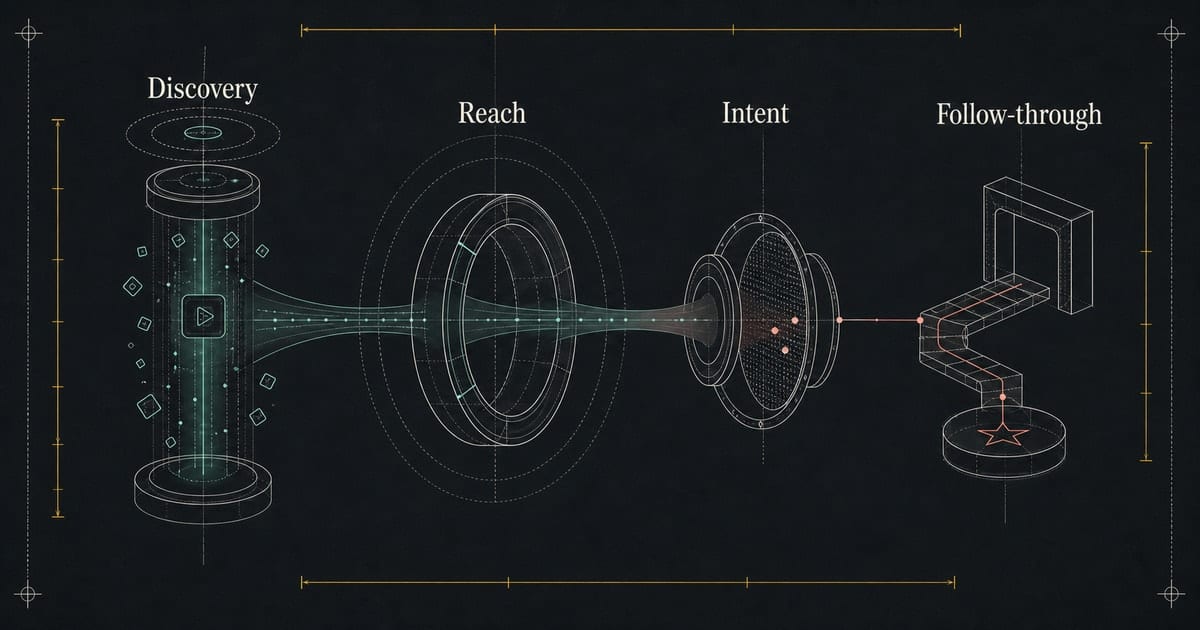
A realistic conversion funnel
Rather than inventing ratios, the honest framing is to present instrumentable stages with known prevalence only at the top:
| Stage | Measurability |
|---|---|
| Reach / exposure (Reels views) | Large scale, but no standardized global MAU disclosure |
| Audio engagement (tap audio / visit audio page) | Trackable in-platform for owned content; no public benchmarks |
| Save intent ("Save audio" / "Add to Spotify") | Feature exists; no public adoption rate disclosed |
| Off-platform follow-through (search, stream, save) | No public Reels-attributed ratios |
| Artist conversion (IG follow, DSP follow, playlist adds) | No public Reels benchmarks |
Key takeaways for planning
1. Reels is a proven awareness channel. Survey data consistently shows Instagram matching or exceeding TikTok as a discovery input, especially for 12-34 year olds.
2. Conversion benchmarks do not exist publicly. Unlike TikTok, Instagram has not published track save volumes, streaming impact studies, or views-to-streams ratios.
3. Save-to-library is the measurable mid-funnel action. Spotify's "Add" button from Instagram audio pages is the clearest bridge to streaming, though adoption data is not public.
4. Discovery does not guarantee streams. MIDiA research shows social virality can stall before streaming when listeners feel short-form clips are "enough."
5. Audio-on creative matters. With 80%+ of Reels viewed with sound, music-forward creative outperforms repurposed silent assets.
6. Internal attribution is essential. Without public benchmarks, labels and marketers must build their own measurement infrastructure using UTM parameters, Spotify for Artists data, and pre/post analysis around campaign windows.
The bottom line: Instagram Reels demonstrably reaches music audiences at scale, but quantifying its value for streaming requires internal measurement because the public data simply does not exist.