
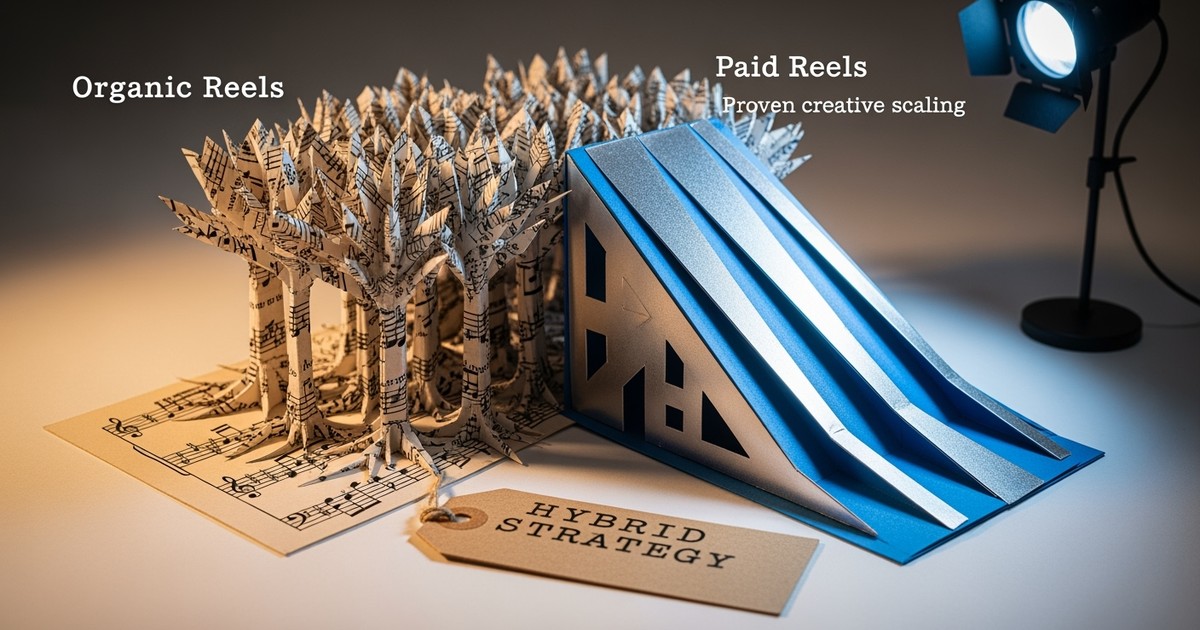
Organic Reels build audience relationships over time. Paid Reels compress that timeline in exchange for budget. The question is not which is "better" but when each approach fits what you are trying to accomplish.
Direct answer: use organic to validate creative and audience fit, then deploy paid Reels to scale the winners with a clear objective plan and budget guardrails.
This comparison covers how the algorithm treats each type differently, the real reach differences, and the content strategy adjustments that matter for music campaigns.
How the Algorithm Treats Each
Organic and paid Reels operate in different parts of Instagram's ranking system.
Organic Reels compete for attention in the Reels feed and Explore page based on engagement signals: watch time, likes, sends, and saves. Instagram's December 2024 updates prioritize original content and reward early engagement velocity. A Reel that gets strong saves and sends in the first hour will reach non-followers through algorithmic recommendations.
Paid Reels bypass the organic ranking competition. When you run a Reels ad through Ads Manager, Meta's delivery system finds users most likely to complete your objective, whether that is ThruPlay, outbound clicks, or conversions. The ad appears in the Reels feed with a "Sponsored" label, but users interact with it like any other Reel.
Note Adam Mosseri confirmed in January 2026 that running ads does not suppress your organic reach. The algorithm does not penalize accounts for advertising.
The difference is intent. Organic Reels earn their reach through content quality. Paid Reels buy reach and let you define who sees it.
Reach and Engagement Comparison
The numbers tell a clear story about what each approach delivers.
| Metric | Organic Reels | Paid Reels Ads |
|---|---|---|
| Average reach | 1-6% of followers, plus algorithmic discovery | Defined by budget and targeting |
| Engagement rate | ~1.23% (higher than photos or carousels) | ~3.2% for Reels ads (vs 1.1% for static ads) |
| Sound-on viewing | 93% of Reels watched with sound | 93% (same format, same behavior) |
| Discovery path | Explore page, Reels feed, hashtag search | Targeted delivery to defined audiences |
| Cost | Time and creative effort | $5-50+ daily depending on objective |
Organic reach for Reels dropped roughly 50% between 2022 and 2023, though Reels still outperform other Instagram formats by a wide margin. A Reel gets about 2x the reach of a single image post and 36% more than a carousel.
Paid Reels ads reach up to 726 million users globally, representing over 55% of Instagram's total ad audience. The format drives 2.1x higher conversion rates than horizontal video ads.
When Organic Is Enough
Organic works when you have time and the content itself is the product.
Building an artist identity. Day-in-the-life clips, studio sessions, and personality content do not need paid amplification. These Reels exist to make followers feel connected. Reach is secondary to relationship depth.
Testing hooks before spending. Instagram's Trial Reels feature (launched December 2024) lets you show a Reel only to non-followers first. If it performs well organically, you know the creative is ready for paid amplification. If it flops, you saved your budget.
Long-term catalog promotion. Evergreen content about your music, process, or story can compound over months. Paid ads optimize for immediate results. Organic can keep working indefinitely.
Tight budgets with flexible timelines. If the release does not have a hard deadline, organic consistency (3-5 Reels per week) can build meaningful reach without spend.
The artists thriving organically in 2026 treat Reels as a content engine, not a one-off tactic. They post consistently, analyze what resonates, and refine over time.
When to Amplify with Paid
Paid makes sense when you need predictable reach on a timeline.
Release week campaigns. Organic reach is unpredictable. A Reel might get 500 views or 50,000 based on algorithmic luck. Paid guarantees that your release content reaches the audience you define, when you need it to.
Proven creative scaling. The smart move is to boost content that already shows organic traction. If a Reel is generating strong watch time and saves organically, paid amplification extends that success to a larger audience with high confidence.
Geographic or demographic precision. Organic Reels go wherever the algorithm sends them. Paid lets you target Tier 1 markets specifically, exclude countries where streams do not convert to revenue, or focus on age brackets that match your listener profile.
Conversion objectives. Organic Reels cannot be optimized for link clicks or landing page conversions. If the goal is driving traffic to Spotify or a smart link, paid is the only option with measurable attribution.
Warning Boosting a Reel with licensed music requires replacing the audio with Meta's Sound Collection. The original stays intact for organic viewers, but the boosted version uses different audio. For music promotion, this often defeats the purpose.
Content Strategy Differences
The content that works organically is not always the content that works in ads.
Organic Content Strategy
Organic rewards personality and authenticity. The algorithm prioritizes content that generates sends and saves, which means content worth sharing or revisiting.
Hook structure: You have 1.5 to 3 seconds to stop the scroll. Pattern interruption matters: unexpected visuals, movement, or a text hook that creates curiosity.
Audio strategy: Mix trending sounds for reach with original music for catalog promotion. Trending audio gives algorithmic advantage for non-music content (behind-the-scenes, skits, reactions). Original audio should anchor any Reel where the song itself is the point.
Posting frequency: 3-5 Reels per week, posted when your audience is most active (check Insights). Consistency compounds. Perfection does not.
Paid Content Strategy
Paid rewards clarity and conversion intent. The ad needs to work for cold audiences who have never seen you before.
Hook structure: Still critical, but the hook must also communicate the value proposition. What is the song? Why should they listen? The ad has less runway to build intrigue.
Audio strategy: Your own music, always. The entire point of the ad is to promote the track. Use the strongest 15-30 seconds as the featured clip.
Creative testing: Run 3-5 creative variants with different hooks, clips, or text overlays. Let Meta's delivery system identify the winner, then shift budget toward it.
| Element | Organic approach | Paid approach |
|---|---|---|
| Goal | Build familiarity and relationship | Drive specific action (stream, save, follow) |
| Audio | Mix of trending + original | Your original music only |
| Hook | Curiosity, personality, pattern interrupt | Clear value proposition in 2 seconds |
| CTA | Soft (implied or in caption) | Direct (text overlay, end card, link) |
| Frequency | 3-5 posts per week | Always-on or flight-based campaigns |
The Hybrid Approach
The best music marketing campaigns use both.
Organic Reels feed the top of the funnel. They build familiarity, test creative angles, and identify what resonates with your existing audience. When a Reel takes off organically, you have signal that the hook works.
Paid Reels scale what organic proves. Take the winning creative and extend its reach to lookalike audiences, new geographic markets, or specific listener demographics.
The mistake is treating them as separate strategies. They are two levers in the same system. Organic generates creative intelligence. Paid converts that intelligence into reach at scale.