
What Is the Core Philosophy Difference Between Spotify and Apple Music?
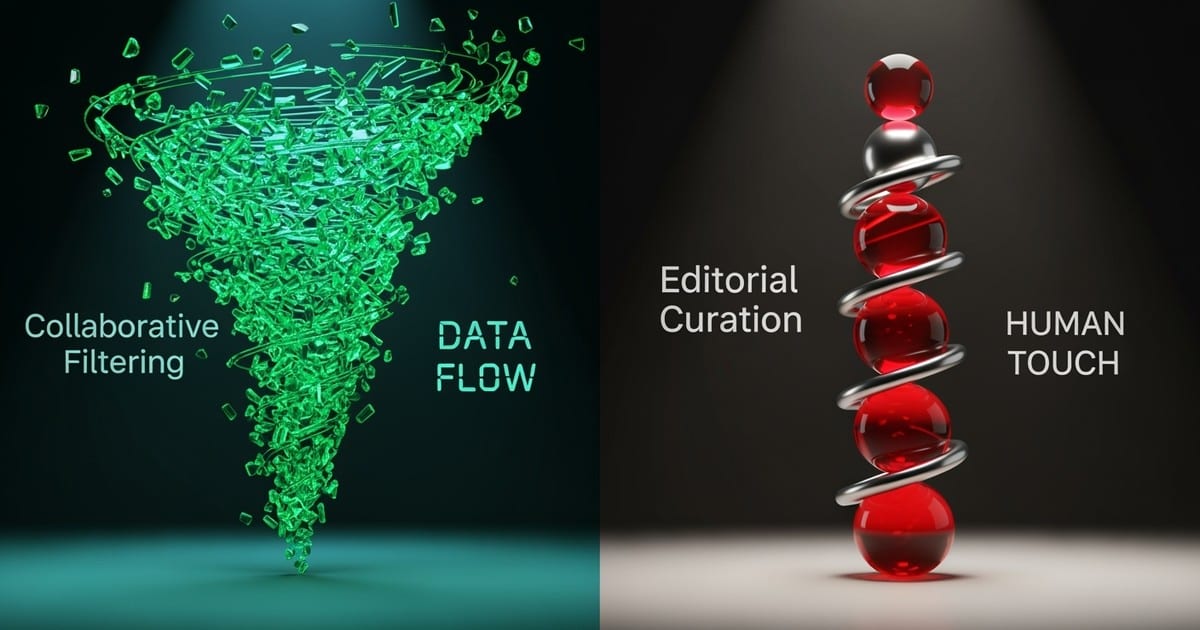
Spotify is algorithm-first. Personalized playlists like Discover Weekly, Release Radar, and Radio are generated automatically based on listening behavior, collaborative filtering, and audio analysis. Human curation exists but takes a secondary role.
Apple Music is hybrid. The platform combines algorithmic recommendations with significant human curation. Editorial playlists are curated by music experts, and the algorithm supplements rather than replaces human judgment.
| Aspect | Spotify | Apple Music |
|---|---|---|
| Primary driver | Algorithms and behavioral data | Human curation + algorithms |
| Discovery playlists | Discover Weekly (algorithmic) | Discovery Station (algorithmic) |
| New release distribution | Release Radar (algorithmic) | New Music Mix (algorithmic) |
| Editorial playlists | Present but secondary | Central to platform identity |
How Spotify Learns Preferences
Spotify tracks every interaction: plays, saves, skips, playlist adds, and completion rates. This behavioral data feeds collaborative filtering models that find patterns across millions of users.
The system learns quickly from your actions. A few skips on a genre can shift recommendations away from it. Repeated saves on a mood or tempo pattern will surface more similar tracks.
Spotify also analyzes audio characteristics and text metadata to find sonic and contextual neighbors.
How Apple Music Learns Preferences
Apple Music requires more explicit input. Users must "Favorite" artists, albums, and songs to train the algorithm effectively. Without favorites, recommendations skew toward general popularity rather than personal taste.
The platform also integrates across Apple's product suite. Listening on HomePod, Apple TV, or through Siri all contribute to your taste profile.
Apple's Discovery Station was launched to compete directly with Spotify's Discover Weekly. Combined with New Music Mix and My Station, Apple has reached feature parity with Spotify's core discovery surfaces.
Which Is Better for Artists?
"Better" depends on your goals and audience.
Spotify advantages:
- Larger user base (over 700 million monthly active users globally)
- Algorithmic surfaces can scale reach quickly if engagement signals are strong
- Detailed analytics in Spotify for Artists
- More data points for optimization (save rate, skip rate, completion)
Apple Music advantages:
- Higher per-stream royalty rates
- Stronger integration with Shazam (owned by Apple)
- Editorial playlists carry significant influence
- Less susceptible to playlist manipulation schemes
What Are the Optimization Differences Between the Two Platforms?
For Spotify:
Focus on behavioral signals. Save rate, low skips, and playlist adds matter most. Release Radar requires pitching 7 days early. Algorithmic pickup depends on engagement velocity in the first 48-72 hours.
For Apple Music:
Focus on editorial relationships and getting listeners to Favorite your music. Apple's algorithm responds more to explicit signals (favorites, star ratings) than to passive listening patterns.
Note Apple Music does not provide a public artist dashboard with the same depth as Spotify for Artists. This makes optimization harder to measure on Apple's platform.
How Should You Run Multi-Platform Campaigns?
For artists and labels running campaigns across both platforms:
Spotify: Optimize for saves and low skips. Target similar-artist fans. Track algorithmic playlist pickups weekly.
Apple Music: Push for editorial consideration. Encourage listeners to Favorite tracks. Use Shazam data for targeting.
Cross-platform: Use pre-save and pre-add campaigns for both services. Allocate budget based on where your audience actually listens.
What Is the Current Trend Between the Two Platforms?
Spotify continues to invest heavily in AI and personalization, including features like AI DJ. Apple Music has closed the gap on discovery features but maintains its human curation emphasis.
For most artists, Spotify offers more actionable optimization levers because the algorithm responds transparently to measurable engagement. Apple Music rewards artists who can secure editorial support or build audiences that actively favorite content.
Neither platform has a "better" algorithm in absolute terms. The right focus depends on where your audience listens and which levers you can realistically pull.