
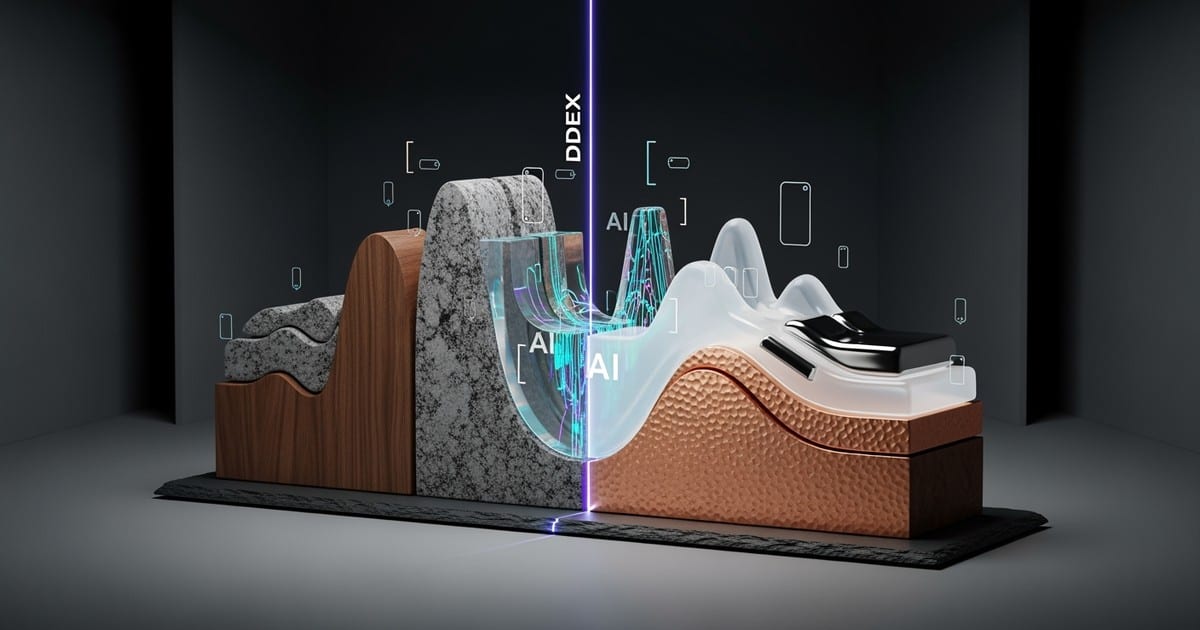
What Is DDEX?
DDEX is a not-for-profit membership organization that creates standardized data formats for the music industry. Their specifications ensure consistent metadata exchange between record labels, music distributors, streaming platforms, rights organizations, and publishers. Before DDEX standards, each platform had different metadata requirements. DDEX creates universal formats so information travels consistently across the entire music supply chain.
Spotify adopted the DDEX standard rather than creating its own labeling system. According to Spotify, "the industry is better off and listeners are better off with industry standards" rather than platform-specific solutions.
How DDEX AI Disclosure Works
Rather than building proprietary AI detection, Spotify chose to adopt industry-wide standards. The DDEX system adds metadata fields where labels and distributors specify AI involvement across five categories:
| AI Usage Category | What It Covers | Example |
|---|---|---|
| AI-generated vocals | Synthetic or cloned voices | Full Suno generation, voice synthesis |
| AI instrumentation | AI-composed melodies, harmonies, beats | AI-composed backing track with human vocals |
| AI composition | Melodies, harmonies, or arrangements from AI | AI-written chord progressions |
| AI post-production | AI-assisted mastering, mixing, enhancement | LANDR mastering, AI mixing tools |
| AI lyrical content | AI-written or AI-modified lyrics | ChatGPT-assisted songwriting |
This approach allows nuanced disclosure rather than a binary "AI or not AI" categorization. A track might have human vocals over AI-generated instrumentation, or human composition with AI-assisted mixing. According to Spotify, "We know the use of AI is going to be a spectrum, with artists and producers incorporating AI in various parts of their creative workflow, and this industry standard will allow for more accurate, nuanced disclosures."
How to Disclose AI in Your Music
Through Your Distributor
Distributors like DistroKid, LANDR, and Symphonic are implementing DDEX AI fields in their upload processes. Implementations vary — some have dedicated AI disclosure checkboxes, others include AI questions during release review, and some use description or notes fields until formal implementation.
What to Disclose
Be accurate about AI involvement in each area:
| Your Process | What to Disclose |
|---|---|
| Full Suno generation | AI vocals, AI instrumentation, AI composition |
| AI music, human vocals | AI instrumentation, AI composition |
| Human song, AI mastering | AI post-production |
| AI-written lyrics, human performance | AI lyrical content |
Note Major labels have endorsed the DDEX AI standard. Universal Music Group "welcome[s] Spotify's new AI protections as important steps forward consistent with our longstanding Artist Centric principles."
What Is the Current Status and Timeline?
The DDEX AI disclosure system was announced in September 2025 but requires implementation time. Key points:
What's Happening Now:
- Standard is defined and announced
- Spotify working with distributors on implementation
- Early adopter distributors may already have fields
What's Coming:
- Broader distributor rollout throughout 2026
- Credits will appear inside the Spotify app
- Industry-wide adoption across other DSPs expected
What's Not Yet Clear:
- Whether disclosure will become mandatory
- Specific consequences for non-disclosure
- Timeline for full implementation
How to Prepare
Even before your distributor adds DDEX fields, you can prepare:
Document Your Process Keep notes on which AI tools you used for each track. Include:
- AI generator name (Suno, Udio, etc.)
- What elements were AI-generated
- Your human contributions (prompts, editing, vocals, etc.)
Be Ready to Disclose When asked about AI involvement, provide accurate information. Attempting to hide AI use risks problems later as disclosure becomes standard.
Understand the Spectrum Consider where your music falls on the AI involvement spectrum:
- Fully AI-generated (all elements from AI)
- AI-assisted (AI for some elements, human for others)
- AI-enhanced (human creation with AI production tools)
Will Disclosure Hurt Your Music?
This is the key concern for many AI creators. Current evidence suggests no:
No Penalty for Disclosure Spotify has not indicated any algorithmic penalty for disclosed AI content. The system is about transparency, not restriction.
Avoiding False Binary The DDEX standard explicitly accommodates mixed human/AI creation. Using AI for mastering is treated differently than fully AI-generated tracks.
Industry Direction Multiple platforms are moving toward disclosure rather than bans. Honest attribution positions you as a legitimate creator.
Missing Disclosure Risks Missing or false disclosures could lead to delays, removal, or lower visibility in recommendations. Transparency is safer than concealment.
What Is the Practical Guidance for AI Disclosure?
For Fully AI-Generated Tracks: Disclose AI involvement across applicable categories. This does not mean your music will be removed or penalized, just labeled appropriately.
For AI-Assisted Work: Indicate which elements used AI. If you wrote lyrics but used AI for production, disclose production AI only.
For AI Production Tools: Using AI mastering services like LANDR or AI mixing assistance may or may not require disclosure depending on how standards evolve. Watch for distributor guidance.
The DDEX AI disclosure system reflects the industry's acceptance that AI is part of music creation. Rather than fighting it, platforms are building infrastructure for transparency. Creators who embrace honest disclosure will be well-positioned as these standards become universal.