

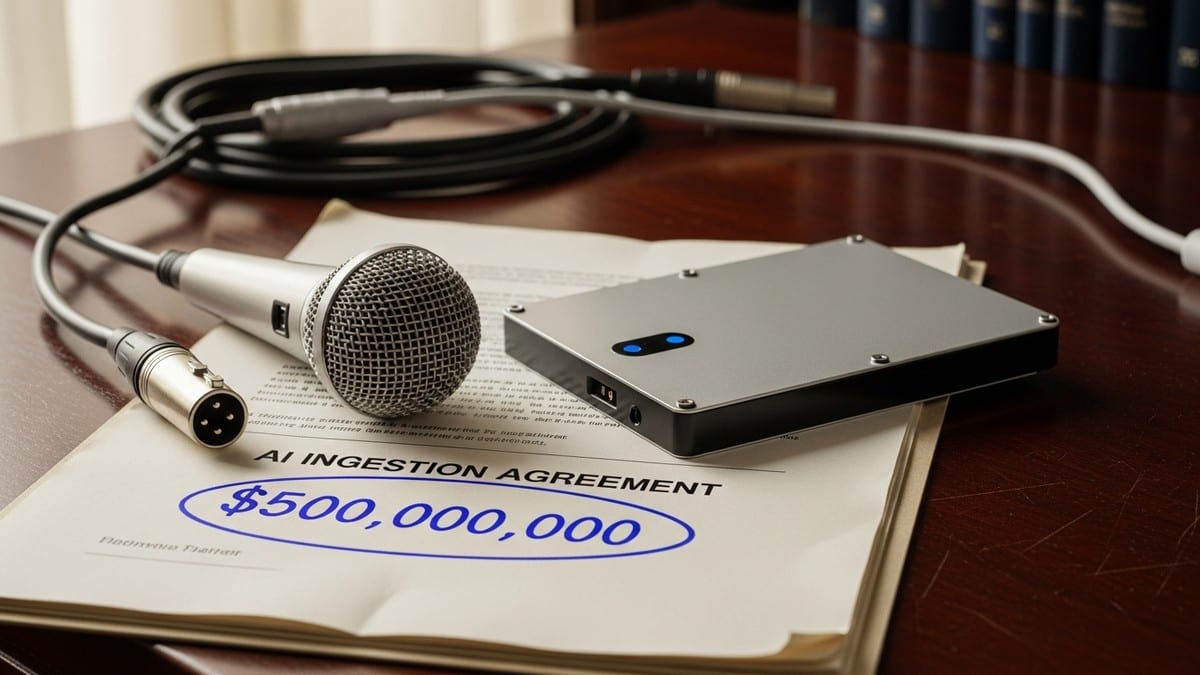
Warner Music Group just flipped the generative AI script from litigation to licensing. WMG and Apple sealed a $500 million multi-year partnership allowing the tech giant to train its proprietary audio models on 1.5 million catalog tracks.
This marks the first major tech acquisition of a major label catalog specifically for AI ingestion. It represents a definitive strategy pivot following WMG CEO Robert Kyncl's late-2025 settlements with startups Suno and Udio. Labels are no longer just fighting the inevitable. They are actively pricing it to offset slowing traditional streaming growth.
Valuing catalog as training data
For years, rights holders fought unauthorized scraping under the banner of copyright infringement. Now, WMG has established a firm market rate for legitimate ingestion.
The $500 million price tag validates the valuation floor set during the Suno settlement. Catalog is no longer just for passive listening. It is active training data with immense generative potential. WMG expects these AI partnerships to deliver material top and bottom line growth starting in fiscal 2027. Catalog valuation metrics will inevitably update to reflect vocal recognizability alongside historical streaming performance.
Mechanics of a voice identity pool
This deal introduces a first-of-its-kind royalty framework designed to protect and monetize artist likeness. Artists and songwriters must explicitly opt in before Apple can use their specific vocal characteristics.
We are witnessing the commodification of personhood signals. Timbre, prosody, and idiosyncratic phrasing are now licensable assets rather than abstract artistic traits. Kyncl frames the deal as a victory for the creative community, arguing that AI only becomes pro-artist when it adheres to principles of strict licensing and consent.
| Royalty Model | Core Asset | Revenue Driver |
|---|---|---|
| Traditional Streaming | Master recording | Total track plays |
| AI Derivative | Voice identity | Algorithmic generation |
| Publishing | Musical composition | Melodic reproduction |
Key insight: Treating an artist's vocal identity as a discrete, monetizable asset completely untethers revenue from market share and shifts it toward attribution.
The battle for platform stickiness
Apple is not spending half a billion dollars purely for experimental research. This is a highly calculated defensive maneuver against Spotify.
Spotify is already developing proprietary artist-first generation tools inside its own walled garden. Apple needs legally cleared, high-quality audio to power upcoming generative features within Logic Pro and Apple Music. They are aiming for zero legal friction when launching competitive tools like AI Derivatives or advanced prompt-based production suites. By securing this partnership, Apple ensures its next generation of audio software is built on a legally unassailable foundation.
Navigating compliance and dilution risks
Tracking attribution across millions of algorithmic generations requires massive infrastructure. WMG faces estimated compliance costs exceeding $50 million annually just to maintain AI transparency and auditing systems.
There are also structural concerns from industry watchdogs regarding royalty pool dilution. Skeptics question whether synthetic audio should draw from the same royalty pools as human-created music.
- The benefit: Artists access a lucrative new revenue stream based purely on their sonic recognizability.
- The risk: Synthetic tracks could flood the ecosystem and depress the per-stream payout for traditional musical works.
- Works when: Platforms maintain strict, auditable separation between human and synthetic generation pools.
- Fails when: Unlicensed deepfakes dilute the value of the official opt-in voice models.
Action items for representation
Managers must immediately update their deal structuring mental models. The name, image, likeness, and voice bundle, often tracked as NILV, is now as critical as mechanical royalties.
Representing talent in 2026 requires treating voice identity as a distinct asset class. Dealmakers need to audit their existing label contracts to ensure explicit opt-in clauses protect their clients from default AI ingestion. A failure to secure voice identity rights today will cost artists their most valuable algorithmic asset tomorrow.