
How TikTok Licenses Music
TikTok secures music rights through three primary channels: major label agreements, distributor partnerships, and direct publisher deals. This hybrid approach differs from traditional streaming platforms.
Major Label Agreements
TikTok holds global licensing agreements with all three major labels: Universal Music Group, Sony Music Entertainment, and Warner Music Group. These blanket deals grant TikTok access to millions of recordings for use in personal creator content.
The UMG relationship illustrates how these deals work. After a high-profile dispute in early 2024 over royalty rates, AI protections, and user safety, TikTok and Universal reached a new agreement in May 2024. UMG's catalog of approximately 4 million songs and 3 million recordings returned to the platform with "improved remuneration" for artists and songwriters.
The three-month catalog removal demonstrated a critical risk: major label disputes can mute your videos without warning if your sound relies on licensed catalog rather than owned masters.
Distributor Agreements
Independent artists access TikTok through distributor partnerships. Companies like DistroKid, TuneCore, CD Baby, and Symphonic Distribution maintain direct agreements with TikTok, allowing them to deliver music to the platform's Sound Library.
Each distributor negotiates its own terms with TikTok. TikTok pays a lump sum to distributors based on their catalog's total usage, which distributors then divide among their artists based on proportional share. This means your effective royalty rate depends partly on which distributor you use.
For music to appear in TikTok's searchable Sound Library with the "Add to Music App" button, it must be delivered through one of these licensed distributors. Uploading audio directly to TikTok as "Original Sound" bypasses this system entirely, eliminating both royalty eligibility and DSP linking capability.
Publishing Deals
Beyond master recordings, TikTok also licenses compositions from publishers. BMG recently renewed and expanded its direct publishing agreement with TikTok, adding provisions for improved songwriter crediting and enhanced reporting standards.
These publishing deals matter for catalog usage tracking. If you control your own publishing, your distributor handles TikTok delivery. If you have a publishing deal, your publisher's agreement with TikTok governs how your compositions are used and credited on the platform.
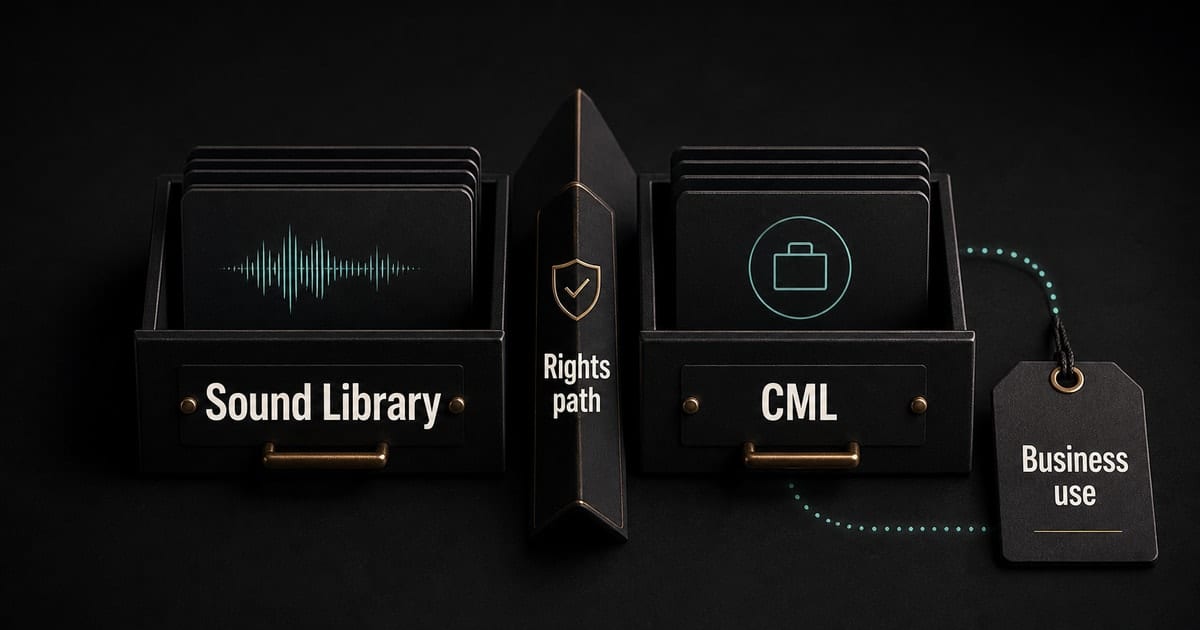
Sound Library vs. Commercial Music Library
TikTok maintains two distinct music libraries with different licensing terms. Confusing the two creates compliance problems.
General Sound Library (Personal Use)
Personal creator accounts enjoy access to TikTok's full music catalog of over one million tracks through blanket licensing deals with major labels. This library powers the sounds that go viral and appears when users tap the "Sounds" button to add music to videos.
Key characteristics of Sound Library usage:
| Aspect | Sound Library Rules |
|---|---|
| Account type | Personal/Creator accounts |
| Usage rights | Non-commercial only |
| Catalog size | Full catalog (1M+ tracks) |
| Trending sounds | Full access |
| Royalty generation | Yes, if distributed properly |
The "non-commercial" restriction is critical. Videos with products, brand mentions, or promotional intent technically require Commercial Music Library tracks, even on creator accounts.
Commercial Music Library (CML)
The Commercial Music Library contains over 1 million audio tracks pre-cleared for business use. These tracks are sourced from emerging artists and music production houses, not major label catalogs.
Business accounts can only use CML tracks. The general Sound Library is completely inaccessible to business accounts.
| Aspect | Commercial Music Library Rules |
|---|---|
| Account type | Business accounts only |
| Usage rights | Full commercial rights |
| Catalog size | Limited (different from general library) |
| Trending sounds | Most unavailable |
| Cross-platform | TikTok only |
A common frustration for artists: if your music is distributed to TikTok through a standard aggregator, it appears in the general Sound Library, not the Commercial Music Library. This means your own distributed track is technically off-limits for your own business account.
Why This Split Exists
The licenses TikTok holds for music outside the Commercial Music Library do not cover commercial use. Major labels grant blanket licenses for personal creator content but exclude brand usage. This protects the separate, higher-value sync licensing market.
For labels managing artists, this creates strategic considerations. You cannot simply deliver a track to TikTok and assume it is cleared for all uses. CML inclusion requires a separate opt-in through your distributor.
Getting Music on TikTok
The distribution path determines your licensing status, royalty eligibility, and marketing capabilities.
Standard Distribution Path
Most artists deliver music to TikTok through their existing distributor. DistroKid, TuneCore, CD Baby, AWAL, and similar services include TikTok as part of their standard delivery networks.
Timeline expectations:
- DistroKid: 1-7 days to TikTok
- TuneCore: 2-5 days to TikTok
- CD Baby: 2-3 weeks to TikTok
Schedule releases at least 2-4 weeks before planned TikTok promotion. You want your track searchable in the Sound Library before any organic or paid push.
TikTok SoundOn
SoundOn is TikTok's in-house distribution platform. It offers some advantages for TikTok-focused strategies:
| Factor | Standard Distributor | SoundOn |
|---|---|---|
| TikTok royalty retention | Varies (typically 80-100%) | 100% year 1, 90% after |
| DSP royalty retention | 80-100% | 90% |
| TikTok integration | Standard | Direct (faster, profile Sounds tab) |
| CML eligibility | Varies by distributor | Included |
SoundOn agreements are non-exclusive. Some artists use SoundOn specifically for TikTok while maintaining a separate distributor for DSPs. This can optimize TikTok royalty retention while preserving broader distribution relationships.
Commercial Music Library Inclusion
To get your music into the Commercial Music Library (making it available for brand and business account use), request CML opt-in through your distributor. Not all distributors offer this, and approval is not automatic.
Benefits of CML inclusion:
- Brands can use your music in their content (exposure opportunity)
- You can use your own music from a business account
- Sync licensing for TikTok-specific commercial use
The tradeoff: CML tracks are available to all business accounts, including competitors. Consider whether broad commercial availability aligns with your artist strategy.
Royalty Collection Requirements
TikTok only pays royalties for music delivered through licensed distribution channels. The technical setup matters.
What Must Be in Place
For royalties to flow correctly:
- Distributor with TikTok agreement: Your distributor must have a current licensing deal with TikTok
- TikTok delivery enabled: Some distributors charge extra for social platform delivery
- Correct metadata: Artist name, track title, and ISRC must match across platforms
- Not uploaded as Original Sound: Direct app uploads generate zero royalties
The "Add to Music App" button only appears when your track was delivered through a distributor, the same distributor delivered to DSPs, and metadata matches across platforms. If you use one distributor for TikTok and another for Spotify, the linking integration may break.
Current Royalty Rates
TikTok transitioned from a video-creation model to a view-based royalty system. Based on Dynamoi's first-party streaming data, current rates range from $0.007-0.013 per 1,000 streams (2025 average).
This means:
- 1 million streams across videos using your sound = approximately $7-13
- Roughly 30-50x lower than equivalent Spotify streams
TikTok royalties rarely represent significant revenue. The platform's value is discovery and DSP conversion, not direct royalty income.
Payment Timeline
Royalties flow quarterly through your distributor:
- Videos created using your sound in Q1
- TikTok reports to distributor in late Q2
- Distributor processes and pays in Q2 or Q3
- Artist receives payment through normal payout cycle
Expect 3-6 months between video creation and royalty receipt.
Licensing Risks and Enforcement
Understanding licensing risks helps avoid content takedowns and account restrictions.
Business Account Violations
Since early 2024, U.S. labels have stepped up enforcement on unauthorized brand usage. Videos using unlicensed music on business accounts may be muted or removed without warning.
The platform now enforces three distinct use categories:
- Creator use: Organic personal videos (full Sound Library access)
- Brand/commercial use: Requires CML or licensed original sounds
- Live streaming: Separate licensing considerations
Cross-Platform Rights
Commercial Uses outside of TikTok are not permitted. Even CML tracks are licensed for TikTok only. Repurposing a TikTok video to Instagram Reels or YouTube Shorts does not transfer music rights.
For labels managing multi-platform campaigns, this means separate licensing verification for each platform. A sound cleared for TikTok may trigger copyright claims elsewhere.
Label Disputes
The 2024 UMG dispute demonstrated systemic risk. When TikTok removed Universal's catalog, videos that had previously used those sounds were muted. Artists on UMG labels lost access to their own music on the platform for nearly three months.
Major label catalog represents 20-30% of popular sounds on TikTok. Future disputes could similarly affect large portions of active content.
Practical Licensing Decisions
For labels and managers, TikTok licensing requires strategic choices.
Distribution Strategy
Single distributor approach: Use one distributor for all platforms. This ensures metadata consistency, working "Add to Music App" integration, and simplified royalty tracking.
Split distribution approach: Use SoundOn for TikTok (maximizing TikTok royalty retention) and a separate distributor for DSPs. Requires careful metadata management and acceptance that DSP linking may not work.
Label/major deal: Artists on major labels or significant independents often have TikTok delivery handled through label distribution agreements, with potentially different (and often undisclosed) royalty terms.
Account Type Selection
Creator account benefits: Full Sound Library access, ability to use trending sounds, simplified workflow for organic content.
Business account benefits: Access to TikTok Ads Manager, business analytics, the option to run Spark Ads directly.
Many artists maintain both: a creator account for organic content using trending sounds, and a business account for paid campaigns and brand partnerships.
CML Opt-In Decision
Consider opting into the Commercial Music Library if you want brands to discover and use your music organically, you plan to post from a business account using your own catalog, or sync licensing exposure aligns with your career strategy.
Decline CML opt-in if you want to control commercial usage of your music, you are concerned about competitors using your sounds, or you prefer to negotiate sync deals individually.
Key Takeaways
TikTok music licensing operates through overlapping agreements that determine what you can use, where your music appears, and whether you get paid. For music professionals:
- Deliver through licensed distributors to appear in the Sound Library, generate royalties, and enable DSP linking
- Understand the Sound Library/CML split to avoid business account violations and content takedowns
- Use one distributor for consistency unless you have specific reasons to split
- View TikTok royalties as bonus income rather than primary revenue
- Track licensing developments because label disputes can affect your content without warning
The platform's discovery value far exceeds its direct royalty value. Proper licensing setup ensures you can capture that discovery value through DSP conversion rather than losing it to technical failures or compliance violations.