
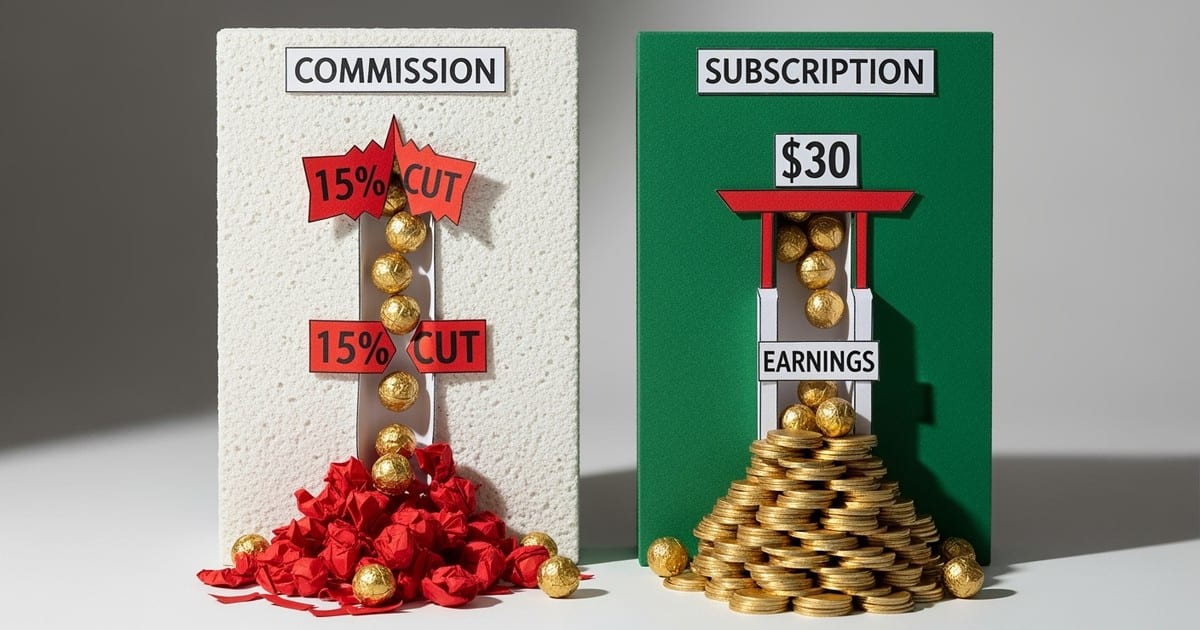
How "Free" Distribution Actually Works
The Math: When Free Costs More
A 15% commission sounds small until you calculate the breakeven point.
| Annual Royalties | RouteNote Free (15% cut) | DistroKid ($24.99/yr) | TuneCore ($24.99/yr) |
|---|---|---|---|
| $100 | You keep $85 | You keep $75.01 | You keep $75.01 |
| $200 | You keep $170 | You keep $175.01 | You keep $175.01 |
| $300 | You keep $255 | You keep $275.01 | You keep $275.01 |
| $500 | You keep $425 | You keep $475.01 | You keep $475.01 |
| $1,000 | You keep $850 | You keep $975.01 | You keep $975.01 |
| $5,000 | You keep $4,250 | You keep $4,975.01 | You keep $4,975.01 |
The crossover point is around $166/year in royalties. Below that, free distribution with a 15% cut actually leaves you with more money than a $25 subscription. Above that, the subscription model wins - and the gap widens as earnings grow.
At $5,000/year in royalties, the 15% commission costs you $750. The subscription costs $25-30. That's a $720+ difference.
What the commission costs in real streams
Our distribution data across 200+ platforms shows Spotify currently pays $3.02 per 1,000 streams. At that rate, RouteNote's 15% commission costs you $0.45 per 1,000 Spotify streams. That's $45 lost per 100,000 streams, compared to DistroKid's flat $24.99/year regardless of volume.
Put differently: if your catalog generates 55,000 Spotify streams in a year ($166 in royalties), the subscription already pays for itself. Every stream beyond that is pure savings. At 100,000 streams ($302), you've saved $20 over RouteNote Free. At 1,000,000 streams (~$3,020), you've saved over $425.
Higher-paying platforms make the gap wider. Amazon Music pays $9.02/1K streams and TIDAL pays $6.20/1K -- 15% of those rates adds up fast.
Source: Dynamoi royalty data, 2025.
Rule: If you expect to earn more than $200/year in streaming royalties, paid distribution almost always makes more financial sense than commission-based free tiers.
Feature Gaps on Free Tiers
Beyond royalties, free tiers typically restrict features that matter for serious releases.
Release speed. Free users often sit in longer queues. RouteNote's paid tier ($10/single) promises faster processing. Some artists report 4-6 week delays on free distribution during busy periods.
Support priority. When something goes wrong - a release stuck in review, a metadata error, a payout discrepancy - free users wait longer for help. Paid users get priority tickets.
Monetization tools. YouTube Content ID, TikTok sound page claims, and social monetization features may be paid-only or limited on free tiers.
Store coverage. Some free tiers exclude smaller or regional DSPs. Verify that platforms important to your audience (Beatport for electronic music, NetEase for China, JioSaavn for India) are actually included.
Analytics depth. Basic stream counts are universal, but detailed geographic breakdowns, playlist attribution, and listener demographics may require paid plans.
The Platforms Compared
RouteNote
Free tier: 15% commission, full distribution to major DSPs, unlimited releases. Paid tier: $10/single, $20/EP, $30/album one-time + $9.99/year renewal. Keep 100%.
RouteNote's free tier is genuinely functional. You get Spotify, Apple Music, Amazon, and most major platforms. The 15% cut is the trade-off, not hidden restrictions. For artists testing the waters with uncertain earnings, this is a reasonable starting point.
UnitedMasters
Free tier (Debut): 10% commission, but only TikTok, Instagram, and Facebook. No Spotify or Apple Music. Paid tier (Select): $59.99/year for full DSP distribution. Keep 90% of royalties.
UnitedMasters' free tier is misleading for artists who want streaming distribution. The 10% commission sounds better than RouteNote's 15%, but you're not getting the same thing. Full distribution requires the $59.99 annual subscription - and even then, they take 10%.
This makes UnitedMasters more expensive than alternatives for most artists. At $59.99/year plus 10% commission, you're paying more than TuneCore ($24.99, 100% royalties) while keeping less.
Amuse
Free tier: Discontinued. Paid tiers: Artist ($23.99/year), Artist Plus ($39.99/year), and Professional ($59.99/year).
Amuse is now a paid subscription distributor, not a free distribution option. The Artist plan includes unlimited distribution, pre-saves, smartlinks, daily insights, and royalty advances for one artist. Artist Plus and Professional add more artist slots and higher-touch features such as fan email collection, hi-res audio, auto-saves, custom label name, and priority support.
SoundOn (TikTok)
Free tier: Full commission-free distribution to TikTok and limited stores for one year. After year one: Standard terms apply with potential commission.
SoundOn's advantage is TikTok integration - useful if that platform drives your audience. The one-year commission-free period is a genuine perk, but the long-term terms after year one are less transparent than competitors.
When Free Distribution Makes Sense
Despite the math, free distribution isn't always wrong.
You're testing with zero budget. If you have no money and no earnings history, RouteNote's free tier gets you on Spotify with zero upfront risk. You only pay if you earn.
You're releasing a one-off project. A single release you don't plan to promote heavily may never earn enough for the commission to matter.
You want to validate before committing. Upload a single on a free tier, see how it performs, then decide whether paid distribution is worth it for future releases.
You're primarily targeting social platforms. If TikTok and Instagram are your focus and streaming is secondary, UnitedMasters' free tier covers what you actually need.
When to Upgrade to Paid
Switch to paid distribution when:
- Your catalog earns more than $200/year in royalties
- You're releasing frequently enough that per-release fees would add up
- You need faster processing for time-sensitive releases
- You want priority support access
- You need features like Content ID or detailed analytics
RouteNote makes upgrading easy - you can switch individual releases from free to paid without reuploading. Other platforms may require migration through the standard ISRC-preservation process.
The Bottom Line
Free distribution serves a purpose: zero-risk entry for artists who aren't sure they'll earn anything. But the commission structure means you're paying more than subscription services once you have any meaningful revenue.
For artists serious about building a catalog and an audience, paid distribution is almost always the better investment. The $25-30/year for unlimited releases through DistroKid or TuneCore pays for itself once you're earning a few hundred dollars annually - a threshold most active artists cross quickly.
The real question isn't whether free or paid is "better." It's which model matches your current situation and your trajectory over the next year.